
Meta title: Best Indicator for 1 Minute Scalping in 2026 (RSI, EMA, MACD & More Explained)
Meta description: Discover the best indicators for a 1 minute scalping strategy in forex and crypto, including RSI, exponential moving averages, MACD, Bollinger Bands, and VWAP. Learn concrete settings, entries, exits, and how to manage risk on ultra‑fast charts.
Asking which indicator is best for 1 minute scalping is a bit like asking which single tool builds a house. The honest answer: no single indicator wins every time. But certain combinations consistently outperform the rest when you trade 60-second candles. This guide breaks down the key indicators, gives you exact settings, walks through four ready-to-test scalping strategies, and shows you how to manage risk so that transaction costs and slippage don’t eat your edge alive.
Key Takeaways
There is no single “best” indicator for minute scalping. For most traders, a fast RSI paired with a 9/21 exponential moving average combo is the most practical core setup.
The most reliable 1 minute scalping strategy usually layers trend identification (EMAs), momentum (relative strength index), and either volatility (bollinger bands) or confirmation (moving average convergence divergence) together.
One-minute scalping is unforgiving: spreads, slippage, and poor risk management can erase the edge of even the best indicators.
Concrete starting configuration: for EUR/USD or NASDAQ futures during the London–New York overlap (approximately 12:00–16:00 UTC), use a 9 EMA / 21 EMA trend filter, RSI(7), and MACD(8,21,5).
Backtesting on at least 3–6 months of tick or 1-minute data-covering different market conditions-is mandatory before risking real money.
What is the 1-minute scalping strategy?
A 1 minute scalping strategy means trading 60-second candles to capture small price movements, with most positions lasting 20 seconds to about 3 minutes. The goal is to execute multiple trades per session, targeting roughly 2–5 pips on major currency pairs or a few ticks/points on indices and liquid crypto. Scalpers can make hundreds of trades in a single day, and some routinely exceed 100 trades daily.
Because there is no time to digest earnings reports or GDP releases, traders rely almost entirely on technical indicators and price action to make informed trading decisions. This trading style works best in highly liquid environments: major currency pairs are ideal for 1-minute scalping, cryptocurrencies offer high liquidity suitable for scalping, and 1-minute scalping is best suited for liquid markets like forex.
The catch? One-minute charts amplify market noise. Every random tick looks like a potential signal, so indicators must be tuned to react quickly without generating constant false signals on every micro-move. This strategy requires intense focus and quick decision-making, and 1-minute scalping requires precise entry and exit timing to keep results positive.

Is the 1-minute timeframe really good for scalping?
The 1-minute chart is ideal for pure scalping by experienced traders, but it is generally unsuitable for most beginners due to speed and complexity. Execution speed impacts profitability in scalping strategies, so your platform, internet connection, and reflexes all matter.
Pros:
Frequent trading opportunities throughout each session
Ability to flatten exposure quickly, reducing overnight risk
Works well on major forex pairs (EUR/USD, GBP/USD, USD/JPY), leading indices like the S&P 500 and DAX 40, and high-volume crypto
High-volume stocks provide frequent trading opportunities for scalpers
Indices like S&P 500 are active during main trading sessions
Commodity currencies are volatile, providing short-term scalping opportunities
Cons:
Extreme sensitivity to spreads, commissions, and slippage
Higher emotional stress from rapid-fire decision-making
More frequent false signals from nearly every indicator
High-frequency trading leads to higher trading costs overall
Many profitable scalpers actually favor 3- or 5-minute charts and only drop to 1 minute for fine-tuning entry points or managing exit trades. If you haven’t yet proven consistency on 5–15 minute charts, build that track record first before committing serious capital to 1-minute scalping.
Best indicators for the 1-minute scalping strategy
There is no absolute “best indicator.” Effectiveness depends on the market, session, and the trader behind the screen. That said, some tools consistently perform well on 1-minute charts.
This section compares the core families:
Category | Indicators | Primary Role |
|---|---|---|
Trend | SMA, EMA | Identify trend direction and pullback zones |
Momentum | RSI, Stochastic Oscillator | Spot momentum shifts and overbought and oversold conditions |
Volatility | Bollinger Bands | Measure market volatility, flag squeezes and reversals |
Confirmation | MACD, VWAP | Filter entry signals, confirm breakouts or trend strength |
Successful 1-minute scalpers rarely rely on a single indicator. Instead, they combine 2–4 complementary tools built around price action structure-support, resistance, micro-trendlines. Highly responsive indicators are crucial for 1-minute scalping strategies, and scalpers seek high-probability setups by combining multiple indicators. Indicators help identify entry and exit points for fast trades, but raw price reading always comes first.
The sections below give concrete default settings for each tool. Later, these indicators are assembled into four specific scalp trading strategy templates with step-by-step rules.
Simple Moving Average (SMA) & Exponential Moving Average (EMA)
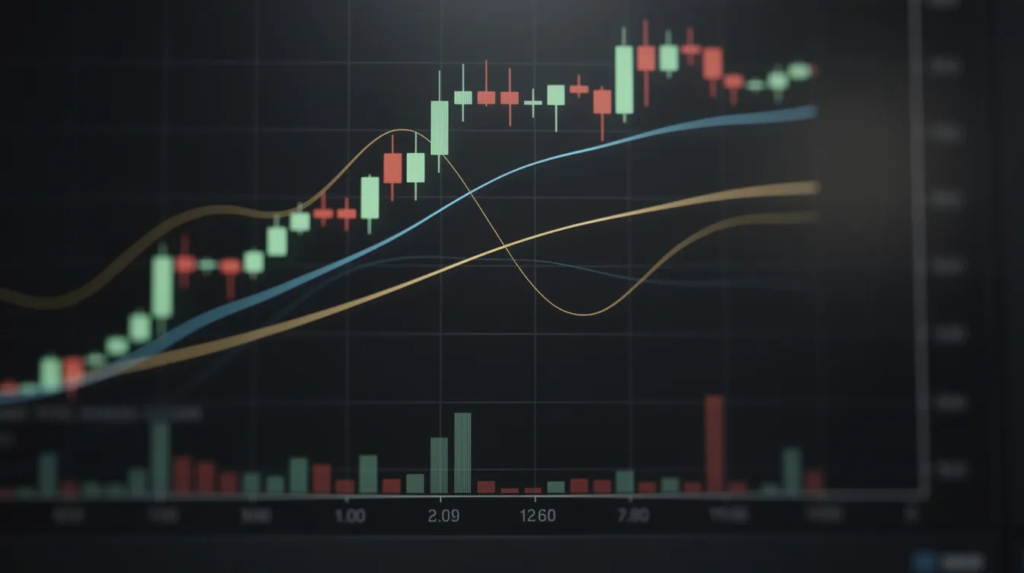
An SMA calculates the average price of a given number of bars equally. An exponential moving average gives more weight to recent price changes, which reduces lag-a critical advantage on 1-minute charts where every second counts. Exponential moving averages are favored for immediate trend identification.
Typical scalping EMA pairs:
9 EMA and 21 EMA on the 1-minute chart define micro trend direction and pullback zones. When price is above both moving averages and the 9 EMA sits above the 21 EMA, the price trend is bullish.
A 50 EMA or 100 EMA on the same chart can act as an intraday anchor trend and dynamic support/resistance, especially during the London–New York overlap.
Bullish example: Price is above both 9 and 21 EMA, EMAs stacked upward. Look for long trades on pullbacks to the 9 or 21 EMA with confirming buy and sell signals from RSI or MACD.
Bearish example: Price below both EMAs, stacked downward. Look for short trades when price rallies into the EMAs and rejects them with a bearish candle. This rejection acts as one of the clearest sell signals on a 1-minute chart.
Keep in mind that EMA crossovers produce many false signals in choppy, sideways markets. They are lagging by nature-shorter periods reduce lag but increase whipsaw risk. Always pair them with a momentum or volatility filter.
Relative Strength Index (RSI) for 1-minute scalping
The relative strength index is often the most practical single momentum indicator for minute scalping because it reacts quickly and is simple to interpret. RSI measures momentum and indicates potential price movements on a 0–100 scale.
Recommended scalping settings: Drop the period to RSI(7) or RSI(5) instead of the default 14. Adjust zones to 20/80 rather than 30/70 to filter out random overbought or oversold conditions that don’t lead to real reversals.
In an uptrend (price above 21 EMA), watch for RSI dipping below 30 or 20, then turning back up. This signals a potential low-risk long entry as selling pressure exhausts near support.
In a downtrend, RSI spikes above 70 or 80 and then rolls over can flag short entries near micro-resistance, helping you identify overbought levels where the current price is stretched too far.
RSI divergence-price making a new high while RSI fails to follow-serves as an early warning of weakening trend on the 1-minute chart. However, divergences are less reliable on such a fast timeframe due to noise.
Not every oversold reading is a buy signal. If price is in a waterfall selloff below all moving averages, oversold conditions can persist for dozens of candles. Context from EMAs and price action is essential.
Bollinger Bands and volatility on 1-minute charts
Bollinger bands measure volatility around an average price and are powerful on 1-minute charts for spotting squeezes, potential price reversals, and quick mean-reversion trades. Bollinger Bands help identify market volatility and potential reversals.
Common scalping setting: 20-period SMA middle band with 2 standard deviation outer bands.
Long setup (mean-reversion): In ranging or slow markets, price tags or pierces the lower band while RSI(7) is below 30. A reversal candle forms back inside the band. Enter long targeting the middle band, with a stop a few points below the wick low.
Short setup: Price hits the upper band with RSI above 70–80, especially under a flat or mildly declining middle band. Target a quick move back to the middle band.
Band squeeze: When bands contract (low Bollinger Band Width), it signals upcoming expansion. A breakout candle closing outside the band with strong trading volume can provide trend-following entries rather than fade trades.
Be cautious about fading strong breakouts. On news-driven candles, price can ride the outer band for several minutes, punishing counter-trend entries badly. This approach works best when overall market direction is unclear and price is oscillating within a defined range.
MACD (Moving Average Convergence Divergence) for confirmation
MACD is an average convergence divergence tool built from EMAs that reveals momentum shifts. MACD reveals changes in trend strength and direction, and alongside VWAP, MACD provides trend and momentum analysis. For 1-minute scalping, the default settings of 12-26-9 are too slow.
Scalping parameters: Try MACD(8,21,5) or MACD(6,19,3) to make the indicator more responsive to short term market movements.
Buy confirmation: The macd line crosses above the signal line while the histogram flips from negative to positive, ideally when price is reclaiming the 9 and 21 EMA after a pullback. A recent academic paper on VP-MACD demonstrates that integrating volume into MACD calculations can further improve entry timing.
Sell confirmation: The macd line crosses below the signal line with histogram turning negative, aligned with price breaking back below short EMAs.
A widening MACD histogram also confirms that a breakout from a Bollinger Band squeeze is gaining strength rather than fading. However, MACD works best as a filter or confirmation tool, not as the sole trigger on a noisy 1-minute chart. Using it alone invites too many late entries and false signals.
Other useful indicators for 1-minute scalping (Stochastic, VWAP, OBV)
Beyond EMAs, RSI, bollinger bands, and MACD, several secondary indicators can refine timing under specific conditions.
Stochastic Oscillator: With fast settings like 5-3-3 or 9-3-1, the stochastic oscillator identifies overbought or oversold conditions inside a range. It works especially well when combined with EMAs or Bollinger Bands in non-trending environments to catch quick profits on mean-reversion setups.
Volume Weighted Average Price (VWAP): This dynamic intraday line shows the average price weighted by trading volume. Volume Weighted Average Price helps identify intraday fair value. Price above VWAP favors longs; price below favors shorts. VWAP pullback entries are especially relevant during the first 60–120 minutes of the US cash session (approximately 13:30–17:00 UTC), where it acts as institutional “fair value.”
Volume-based tools: On-Balance Volume (OBV) or Money Flow Index (MFI) can confirm whether a breakout on the 1-minute chart is supported by real buying or selling pressure. Rising OBV during an upside breakout adds confidence; flat OBV warns of a potential trap.
Resist stacking too many indicators at once. The goal is a clear, fast-read chart-not a cluttered screen that slows you down when every second matters.
Four concrete 1-minute scalping strategies using these indicators
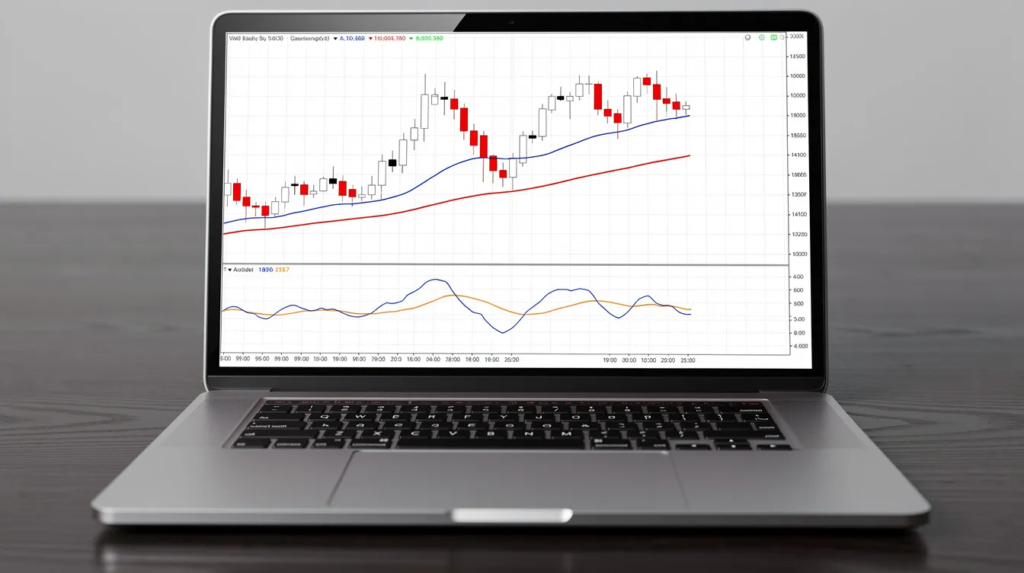
Now it’s time to translate theory into practice. Below are four specific 1 minute scalping strategy templates with step-by-step rules. Each specifies instruments, sessions, indicator settings, entry logic, stop placement, and exit points.
Risk management (typically 0.25–0.5% account risk per trade) is built into every template. These are starting points-test and adjust them for your broker, spreads, and platform before going live.
Strategy 1: EMA + RSI trend-following scalping
Instruments: Trending forex pairs like EUR/USD during the London–New York overlap.
Indicators: 9 EMA, 21 EMA, RSI(7).
Bullish rules: Trade only when price is above both EMAs and 9 EMA is above 21 EMA. Wait for RSI to drop below 40 then curl back up through 50. Enter long on a bullish candle closing back above the 9 EMA. Stop 3–6 pips beyond the recent swing low or slightly beyond the 21 EMA. Target 1.5–2R or the next intraday resistance level.
Bearish rules: Mirror the above-price below both EMAs, RSI rebounds toward 60–70 then turns down, enter short on a bearish rejection at the 9 EMA.
This strategy template has shown approximately 60–70% win rates in backtests on EUR/USD during high-volume sessions, assuming tight spreads and precise execution. Avoid trading during major economic news releases (NFP, FOMC, CPI) when price moves become erratic.
Strategy 2: RSI + Bollinger Bands mean-reversion
Best for: Range-bound conditions outside of major session opens-late Asian session on EUR/JPY or gold when market volatility compresses.
Indicators: Bollinger Bands (20, 2), RSI(7). A flat 50 EMA can help confirm non-trending price direction.
Long setup: Price closes at or below the lower band, RSI drops below 25, then a small bullish candle forms back inside the band. Stop below the wick low, target the middle band.
Short setup: Price pushes into or above the upper band, RSI above 75–80, then a bearish candle closes back inside. Stop above the recent high, target the middle band.
Avoid this approach during strong directional trends where price hugs one band for extended periods. Mean-reversion only works when prices oscillate.
Strategy 3: VWAP + MACD intraday momentum
Best for: Equity indices and large-cap stocks on 1-minute charts during the first 60–120 minutes after the US cash open.
Indicators: Intraday VWAP, MACD(8,21,5), optionally 9 EMA.
Long idea: Price pulls back toward VWAP during a bullish session, stabilizes above VWAP, and MACD line crosses above signal with histogram turning positive. Enter long with stop just below VWAP. 1-minute scalping aims for small profits from rapid trades, so target the next resistance zone or a fixed 1.5R reward.
Short idea: Price retests VWAP from below in a bearish session, fails to reclaim it, and MACD crossover turns negative. Stop slightly above VWAP.
Exits can also be triggered by a MACD signal line cross back in the opposite direction.
Strategy 4: EMA ribbon + Stochastic pullback scalping
Best for: Advanced traders comfortable reading EMA ribbons on crypto or forex during trending sessions.
Indicators: EMA ribbon (8, 13, 21 EMA), stochastic oscillator (5,3,3).
Trend filter: Only take trades where the EMA ribbon is neatly stacked and angled-up for long trades, down for short trades. This helps identify strong trends visually.
Long entry: Stochastic dips below 20 during the uptrend, then crosses back above its signal line while price touches or nears the 13 or 21 EMA. Enter with a tight stop just beyond the opposite side of the ribbon.
Short entry: Stochastic rises above 80, crosses down while price tests the ribbon from below. Target recent swing levels, keeping risk per trade minimal at 0.25–0.5% of equity.
How to manage risk in 1-minute scalping
On a 1-minute chart, trade frequency is high-scalpers can make 100 or more trades daily. This means disciplined risk management matters more than finding the “absolute best” indicator. Risk management is vital due to rapid market changes.
Position sizing: Risk 0.25–0.5% of account equity per trade, rarely above 1%. When you’re taking dozens of short trades and long trades per session, even small per-trade losses compound fast.
Transaction costs: Spreads, commissions, and slippage eat into very small average profits. High transaction costs can erode profits in scalping. Choose a low-cost broker offering tight spreads-tight spreads are essential for profitable scalping and tight spreads are crucial for successful scalping on any instrument you trade.
Stop-losses: Always use hard stop-loss orders. Setting stop losses is crucial to limit potential losses. Place them just beyond recent micro swing points or use an ATR-based approach (1–1.5 times a 14-period average true range on the 1-minute chart). Traders should set stop losses to limit potential losses on every single position.
Session selection: Focus on high-liquidity windows-London open, New York open, London–New York overlap for forex trading, and main cash sessions for indices-to reduce erratic price action and wider spreads.
Pre-trade checklist: Before each session, verify the economic calendar for upcoming releases, check your broker’s current spread size, confirm platform latency is acceptable, and honestly assess your own mental state. If you’re fatigued or emotional, step away. Disciplined execution is non-negotiable.
Which indicator is “best” for 1-minute scalping? (Putting it all together)
No indicator is universally best. But a core combination of exponential moving averages for trend direction, RSI for momentum, and either MACD or bollinger bands for confirmation and volatility control is the most balanced solution for most traders. Traders combine these tools to read the market from multiple angles without cluttering their chart.
For beginners to minute scalping, start with a simple 9 EMA / 21 EMA + RSI(7) template. Add MACD later once you’re comfortable. Jumping straight into five overlapping tools creates confusion, not consistent profits.
Understanding raw price action-support, resistance, trendlines, breakouts, and failed breakouts-is more important than memorizing indicator signals. When price crosses a key level with volume, that tells you more than any oscillator alone.
Pick one core setup from this guide. Log at least 100 demo or micro-lot trades under consistent rules. Review your statistics: win rate, average win versus average loss, and maximum drawdown. Only then should you size up.
Indicators are decision aids, not guarantees. Successful minute scalping depends on discipline, speed, disciplined risk management, and the ability to stop trading when market conditions degrade.

FAQ
Here are answers to common 1-minute scalping questions not fully covered above.
Is 1-minute scalping suitable for complete beginners?
Generally, no. One-minute scalping demands execution speed, emotional control, and a solid understanding of spreads and slippage that beginners typically lack. New traders should first practice on higher timeframes-15-minute or 1-hour charts-to learn trend structure, basic technical analysis, and indicator behavior. Graduate to 5-minute charts, then step down to 1-minute only after you’ve built a consistent track record.
What is the best market to apply a 1-minute scalping strategy?
The best choices are highly liquid instruments with tight spreads. Major currency pairs like EUR/USD, GBP/USD, and USD/JPY in the forex market are top picks. Large index CFDs or futures such as the S&P 500 and DAX offer frequent trading opportunities during cash sessions. Top-tier crypto pairs like BTC/USDT during peak volume hours also work well. Avoid thinly traded stocks, exotic currency pairs, or illiquid crypto tokens where spreads are wide and price jumps erratically.
How many indicators should I use on a 1-minute chart?
Most efficient scalpers keep it to 2–4 core indicators plus price action reading. A practical example: 9/21 EMA for price trend, RSI(7) for momentum, and either MACD or bollinger bands for confirmation. Stacking five or more oscillators slows decision-making and usually adds noise instead of clarity on such a fast timeframe. Your trading strategy should be readable at a glance.
Can I automate a 1-minute scalping strategy with a trading bot?
Automation is possible and increasingly common for this trading style, but it demands robust coding, high-quality tick data for backtesting, very low latency, and careful live monitoring to prevent catastrophic errors. First prove your rules work manually, then consider semi-automation-using alerts and one-click entry signals-before handing full control to an algorithm.
How long should I backtest a 1-minute scalping system?
Aim for a minimum of 3–6 months of historical 1-minute data covering different volatility regimes: quiet sideways periods, trending sessions, and high-impact news days. This reveals how your best indicators behave across real-world conditions. Combine historical backtesting with at least several weeks of forward demo trading to verify that spreads, slippage, and real-time execution still leave a positive edge before committing capital.