
meta_title: “Best Timeframe for Scalping Crypto in 2026: 1-Minute, 5-Minute or 15-Minute Charts” meta_description: “Discover which timeframe-1-min, 3-min, 5-min, or 15-min-is optimal for scalping crypto in 2026. Explore trade frequency, risk, noise vs clarity balance, multi-timeframe strategies, and practical tips for different trader profiles.”
Choosing the best timeframe for scalping crypto is one of the first decisions that separates consistently profitable traders from those who blow accounts. In 2026, most scalpers still operate between 1-minute and 15-minute charts, but the right choice depends on your speed, strategy, and the pairs you trade. This guide breaks down exactly how each timeframe performs, who it suits, and how to combine them.
Key Takeaways
Most cryptocurrency scalping is done on 1-minute, 3-minute, 5-minute, and 15-minute charts. Most scalpers use 1-minute to 15-minute charts depending on strategy and experience.
The ideal timeframe for cryptocurrency scalping is the 1-minute to 5-minute charts for most active setups, while 15-minute charts suit slower, lower-stress approaches.
The “best timeframe” depends on your reaction speed, your scalping strategy (range trading, breakout trading, order-book scalping), and the liquidity of the crypto market you’re trading.
Scalpers can execute dozens to hundreds of trades daily, making timeframe selection critical for managing noise and costs.
Multi-timeframe analysis (e.g., 15m for trend, 5m for setup, 1m for entries) is generally stronger than relying on a single chart.
What Is Crypto Scalping and Why Timeframe Matters?
Crypto scalping is an ultra-short term trading strategy where traders aim to capture very small price movements in minutes or even seconds. Unlike swing trading, which targets larger moves over days or weeks, scalping relies on rapid trades and tight execution to accumulate a net gain from many small wins. Arbitrage scalping, for example, exploits price differences across exchanges, while other approaches target order-book dynamics or chart patterns.
Active traders might execute dozens to hundreds of trades per day, especially on major pairs in the cryptocurrency market like BTC/USDT, ETH/USDT, and SOL/USDT. Market volatility offers profit opportunities for scalping, and scalping can lead to quick profits from small price movements when done correctly. Data from 2026 suggests that skilled scalpers on major pairs can expect 15–25 high-quality setups in a single session during peak liquidity windows.
The chosen timeframe-1m, 3m, 5m, or 15m-controls three key factors: signal quality, trade frequency, and psychological pressure. Very low timeframes show more market “noise,” meaning random fluctuations driven by micro order-book activity. This makes risk management, the bid ask spread, commissions, and slippage critical to profitability. Scalpers often target profits of 0.05% to 0.20% per trade, and when round-trip costs can reach 0.04–0.10%, the margin for error is razor-thin.
The rest of this article compares the most common timeframes and shows how they fit different crypto scalping strategies.
The Most Popular Timeframes for Crypto Scalping
The four dominant timeframes in crypto scalping are 1-minute, 3-minute, 5-minute, and 15-minute charts. Anything under 15 minutes is generally considered scalping territory. Here’s how they compare:
1-minute chart: Typical hold time is seconds to roughly 5 minutes. High trade frequency (10–20+ setups per session). Best for experienced traders with fast execution and advanced tools.
3-minute chart: Slightly calmer than 1-minute. Fewer trades per session. Useful for scalpers who want a middle ground between ultra-fast and more durable setups.
5-minute chart: Hold time around 5–20 minutes. Moderate frequency. Balances noise and structure, making it the starting point for many newer scalpers.
15-minute chart: Hold time around 30–90 minutes. Fewer but cleaner signals. Suits traders who want reduced stress or can’t dedicate full attention.
Shorter timeframes increase trading opportunities but add noise. High liquidity ensures tight bid-ask spreads in scalping, and high liquidity reduces slippage in scalping trades, which is why most scalpers stick to major pairs on liquid markets regardless of timeframe. Scalpers often prefer 5 to 30-minute intervals for trades depending on their trading style.
Many scalpers scan 1m–5m for immediate setups while using 15m charts for broader market context-defining trend direction, key support zones, and rotating market phases. Ultra-low timeframes like tick charts or 30-second charts exist but are primarily used for institutional or bot-based crypto trading, not most retail traders.
Is 1-Minute the Best Timeframe for Crypto Scalping?
The 1-minute chart remains the classic timeframe for aggressive cryptocurrency scalping. The 1-minute chart provides the most opportunities but is noisy. On a volatile day for BTC/USDT, you might spot 15–20 potential entries in a single session.
Pros:
Maximum number of setups per session, since every micro-move becomes visible on the chart
Very precise entries around support and resistance levels, letting you enter right where orders cluster
Suitability for order-book-based and bid ask spread strategies on deep markets where you profit from the difference between the highest price buyers and the lowest price sellers
Tight bid-ask spreads are crucial for profitable scalping at this speed, and scalping works best during peak market liquidity
Cons:
Extreme noise-frequent fake breakouts where price breaks a level then immediately reverses. Market volatility can lead to quick reversals in scalping
Shorter time frames can result in slippage in scalping, especially during news events
Higher impact of spreads and fees. High trading fees can significantly reduce scalping profits when your profit target per trade is only 0.02–0.05%
Very high mental and emotional stress; scalping requires discipline at this pace, and burnout is common
One scalping strategy template from 2026 using a 1-minute VWAP + EMA approach on BTC with ~$5,000 capital reported roughly 10–15 trades per day with a 65% win rate. Scalpers often use a 1:1 risk/reward ratio for trades at this speed, relying on win rate rather than large individual gains.
Concrete use cases where 1m shines: high-frequency breakout trading during major news releases (macro data, regulatory announcements), or scalping micro-trends on BTC/USDT during the London–New York overlap. Automated algorithmic systems help scalpers manage risks at this level, and many active traders use partial automation such as alerts or bots to maintain execution speed.
Why Many Traders Prefer the 5-Minute Chart
The 5-minute chart is popular among many cryptocurrency scalpers and is often called the “sweet spot” for retail and semi-professional traders. It filters much of the noise seen on 1-minute charts while still delivering multiple trades per session. 5-minute charts are popular for balancing noise and structure.
On 5m charts, chart patterns like flags, triangles, and channels become more reliably visible. Technical indicators such as the relative strength index, EMA crossovers, VWAP, and Bollinger Bands tend to produce fewer false signals compared to 1m. This means your best crypto scalping strategies are more likely to hold up over a larger sample of trades.
Typical holding times range from a few minutes to about 30 minutes, giving you time to plan your take profit and exit points rather than reacting in split seconds. Price action scalping relies on current price movements without indicators and also works well on 5m, where candlestick formations carry more weight than on noisy 1m charts.
For most new scalpers in 2026, starting with 5-minute charts-with 15m for context-is the recommended path before attempting ultra-fast 1m scalping. The costs in time, emotional stress, and fees are lower, and consistency tends to be better.
How 15-Minute Charts Fit into Crypto Scalping
The 15-minute chart sits at the boundary between classic cryptocurrency scalping and intraday day trading. The 15-minute chart is used for more calculated trades, offering fewer but generally higher-quality signals with clearer trends and stronger support and resistance zones.
Different chart intervals suit different market phases in scalping, and 15m excels in sideways markets where range boundaries are well-defined, as well as during trending sessions where you want to ride a breakout. Conservative scalpers can identify the main trend and key levels on 15m, then drop to 5m or 1m for precise entry and exit points.
The 15m timeframe is particularly useful for breakout trading on major chart patterns (triangles, wedges) where traders want to scalp the immediate post-breakout move. Beginners in scalping are advised to start with 15-minute charts because the slower pace allows time for decision-making and reduces overtrading. Holding periods typically range from 30 to 90 minutes, which some would argue crosses into short term trading territory, but the principle of capturing quick trades on small moves still applies.
15m timeframes typically reduce stress and overtrading compared to 1m, making them suitable for traders who can’t engage in constant monitoring every second.
Using Multiple Timeframes for Crypto Scalping
The most robust crypto scalping approaches in 2026 combine several timeframes rather than relying on a single chart. This is consistently emphasized across modern scalping guides.
A specific and popular multi-timeframe setup:
15m for trend and context – identify whether the market structure is bullish, bearish, or ranging. Identify support and resistance levels.
5m for setup – spot the actual trade setup: a range, breakout zone, or pullback to a key level.
1m for fine-tuned entry and stop placement – time your entry with precision, set tight stop losses, and define exit rules.
This method helps filter false signals. If 1m suggests a long but 15m shows a strong downtrend, many active traders will skip the trade entirely. Confluence across timeframes acts as a verification successful filter, dramatically reducing the odds of trading against the broader crypto market direction.
Multi-timeframe analysis works across different crypto scalping strategies, including breakout trading, chart pattern entries, and momentum-based systems. The key is consistency: pick a set of timeframes and stick with them long enough to gather meaningful trading statistics before adjusting.
Common pitfalls include checking too many timeframes (four or more), switching timeframes mid-trade, and letting a short timeframe override the original trend bias.
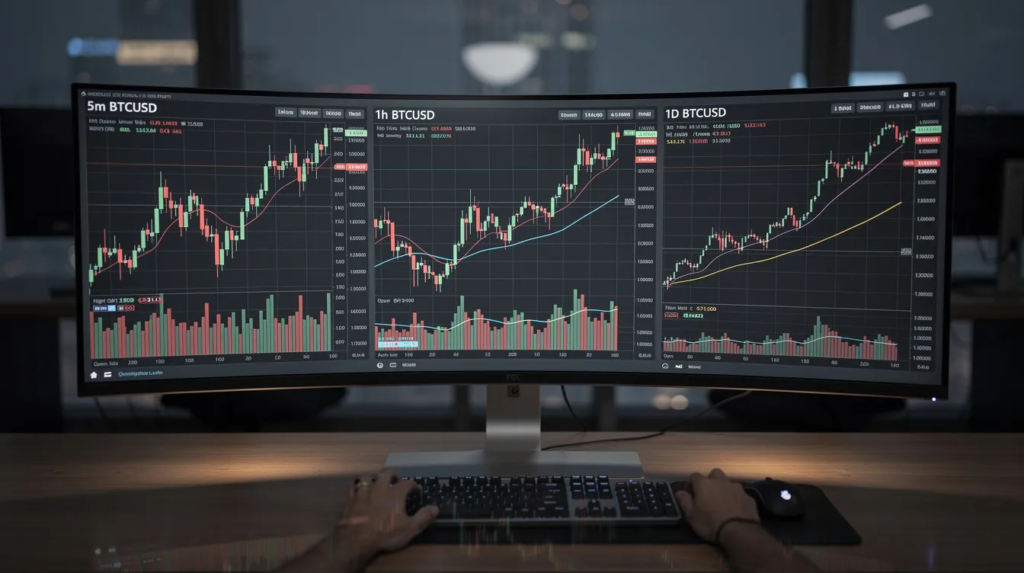
Matching Timeframe to Crypto Scalping Strategy
The best timeframe depends on the chosen trading strategy and instruments, not just personal preference.
Range trading: Scalpers use 3m–5m to define range boundaries and 1m to enter near support or resistance. Range trading involves buying near support and selling near resistance, and it works particularly well in sideways markets with constant volatility.
Breakout trading: Identify levels and chart patterns on 5m–15m charts for reliability. Execute trades on 1m or 3m when the breakout candle closes or when price retests the level. Traders aim to capture post-breakout momentum while filtering noise.
Order-book / bid-ask spread scalping: Focuses on 1m charts or faster feeds. Bid-ask spread scalping profits from the difference between buy and sell prices-essentially the gap between the bid price from the highest price buyers and the ask from the lowest price sellers. This requires high liquidity and tight spreads on major pairs.
Indicator-based strategies: Systems using RSI, MACD, EMA, or Bollinger Bands tend to give fewer but more reliable signals on 5m and 15m compared to 1m, where lag and false crossovers are more pronounced.
Price action scalping relies on current price movements without indicators and can be applied across all timeframes, though cleaner candles on 5m make it easier to identify support and resistance levels.
Practical Factors When Choosing a Scalping Timeframe
Non-technical factors often decide which timeframe is realistically sustainable for your cryptocurrency trading.
Screen time availability: Traders with only 1–2 hours per day are better suited to 5m–15m than 1m charts. Scalping requires constant monitoring of charts and market conditions, so be honest about how much time you can commit.
Reaction speed and stress tolerance: 1m charts demand instant decisions. Using leverage in scalping can amplify both gains and losses, and the pressure of leveraged quick trades on 1-minute charts can push undisciplined traders into emotional overtrading.
Fees and spreads: On very low timeframes, even a 0.1% fee and slightly wider spreads can erase your edge. High trading fees can significantly reduce scalping profits, especially when your target is only 0.05–0.20% per trade. High trading volumes can lead to lower fees for scalpers through tiered exchange structures, so volume matters. High-frequency trading relies on low transaction costs to maintain profitability.
Pair liquidity: Wider bid ask spread on low-cap digital assets with low liquidity makes 1m scalping risky. Stick to liquid markets for the fastest timeframes.
Capital risk: Scalpers should risk only 1-2% of their capital per trade. Using tight stop-losses is crucial for long-term survival in scalping, and strict risk management separates winners from those who wash out.
Test the same scalping strategy on 1m vs 5m vs 15m on a demo account. Track win rate, risk/reward, and mental fatigue over at least 50 trades per timeframe before committing real capital.
Best Timeframe by Trader Type
Different trader profiles naturally align with certain timeframes.
High-frequency active traders: Prefer 1m charts and often use automated trading tools. They focus on the largest, most liquid crypto pairs where they can execute trades with fast execution and minimal slippage. They make many trades per session, and their edge comes from volume and speed. Edges are harder to maintain in 2026 due to increased algorithmic competition from other traders.
Discretionary technical traders: Usually favor 3m–5m charts, using chart patterns, price action, and technical indicators to scalp within the broader crypto market trend. They use a short term trading strategy that emphasizes quality over quantity, exiting trades based on predefined exit rules. Scalpers aim for consistent small wins and carefully planned entry and exit.
Part-time or lower-stress traders: May use 15m charts to execute a limited number of well-planned scalp trade setups per session. This trading style suits those who can’t watch screens every minute but still want the frequent trades that scalping offers over pure day trading.
Profitability comes from matching timeframe, strategy, and personality. Copying another trader’s setup without understanding why it works for them rarely produces the same results.
Conclusion: So, What Is the Best Timeframe for Scalping Crypto?
There is no single best timeframe, but 1m–15m covers the practical range for most cryptocurrency scalping approaches in 2026. The answer depends on your experience, your chosen scalping strategy, and the market conditions of the pairs you trade.
Beginners usually perform better starting with 5m charts-and possibly 15m for context-before experimenting with ultra-fast 1m. Multi-timeframe analysis improves decision quality, especially when combining trend (15m), setup (5m), and execution (1m).
Scalping relies on repetition, discipline, and edge. Whether you’re focused on volatile markets during the London–New York overlap or grinding through steady-state Asian sessions, your timeframe must match your capacity for rapid trades and constant monitoring.
Your next step: Pick one timeframe combination, define exact entry and exit rules including where to take profit and where to place stops, then forward-test on a demo account before scaling up. Track every trade. Review weekly. Adjust only after you have enough data to make informed changes.
FAQ
Is 1-minute or 5-minute better for crypto scalping?
The 1-minute chart offers more opportunities but significantly more noise and stress. The 5-minute chart provides fewer but typically clearer signals, and most scalpers in 2026 find 5-minute charts more sustainable long term. A common approach is to combine 5m for setup identification with 1m for fine-tuning entries. Absolute beginners should start with 5m and only test 1m after they are consistently profitable and disciplined on the higher timeframe.
Can I scalp crypto on 15-minute charts?
Yes, though it blurs into short-term day trading because trades often last 30–90 minutes. The 15m timeframe is useful for traders who want fewer, high-quality setups and don’t want to stare at 1m candles all day. Many traders use 15m to identify support and resistance levels and trend direction, then drop to 5m for actual trade execution to keep the approach “scalping-like” with tighter entries.
What is the best timeframe for breakout trading in crypto?
Breakout zones are usually identified on 5m–15m charts because chart patterns and resistance levels are more reliable there. Scalpers then enter on 1m or 3m as soon as the 5m/15m breakout candle closes, or on the first pullback to the broken level. This combination captures post-breakout momentum while filtering some of the noise found on 1m alone.
Do I need different timeframes for different crypto pairs?
Highly liquid pairs like BTC/USDT and ETH/USDT can be scalped effectively on 1m–5m. Thinner altcoins with low liquidity may require 5m–15m to avoid excessive noise and slippage. Wider bid ask spread on low-cap coins means 1m scalping is risky because small price movements can be consumed entirely by costs. Adapt your timeframe and position size to each asset’s liquidity and volatility profile.
How long should a typical crypto scalping trade last?
On 1m charts, most scalps last from a few seconds up to about 5–10 minutes. On 5m charts, trades typically last 10–30 minutes. On 15m-based setups, scalps can extend toward 30–90 minutes, especially when riding a breakout. Holding time should be defined in your trading plan alongside your chosen timeframe. This prevents emotional decision-making and helps you maintain the discipline that separates scalping from gambling.