
Short term crypto trading involves rapid buy-and-sell transactions designed to capitalize on price volatility in digital assets. Unlike long term investors who hold through years of market cycles, short term traders aim to extract profit from price movements that unfold over seconds, hours, or a few days.
This guide breaks down the key strategies, technical analysis tools, and risk management practices you need to navigate the crypto market in 2026, whether you’re considering your first trade or refining an existing approach.
Key Takeaways
Short term crypto trading means buying and selling coins within seconds to a few weeks to profit from market volatility and small price differences rather than long-term fundamentals.
The four main short term strategies are scalping, day trading, swing trading, and crypto arbitrage, each with different holding times, risk profiles, and time commitments.
Effective risk management-including stop-loss orders, position sizing, and avoiding excessive leverage-matters more than any single trading strategy or technical indicator. Traders can still be profitable with a win rate around 40% by managing risk effectively.
Short term traders rely heavily on technical analysis, order book data, and news flow to react quickly to changing market conditions.
Novice traders should start small, practice on liquid majors like BTC and ETH, and avoid complex algorithmic trading until they understand the basics.
What Is Short Term Crypto Trading?
Short term crypto trading is the practice of buying and selling digital assets over brief timeframes-from a few seconds up to roughly two to three weeks-with the goal of capturing price fluctuations rather than betting on a project’s long-term success. Unlike long term investing, where you might hold BTC for years and ride out drawdowns, short term trading embraces market volatility as the primary source of profit.
Short-term trading involves holding positions for minutes to days, depending on the specific style. Typical holding periods range from seconds (scalpers executing rapid trades on BTC/USDT) to several days or weeks (swing traders riding trends on assets like ETH or SOL). Crypto prices can fluctuate rapidly, increasing potential losses but also creating frequent opportunities that don’t exist in traditional markets.
Here’s what makes short term crypto trading distinct:
Volatility as fuel: Short term traders exploit rapid price movements instead of avoiding them.
Liquidity requirements: Strategies depend on high liquidity pairs like BTC, ETH, and major stablecoin pairs to enter and exit quickly without huge slippage.
24/7 access: The crypto market never closes and is highly volatile, which increases both opportunity and risk. News can hit at 3 AM, and prices react instantly.
Technical over fundamental: Decisions are driven by price charts, indicators, and order flow rather than whitepapers or long-term roadmaps.
Key Features of Short Term Crypto Trading
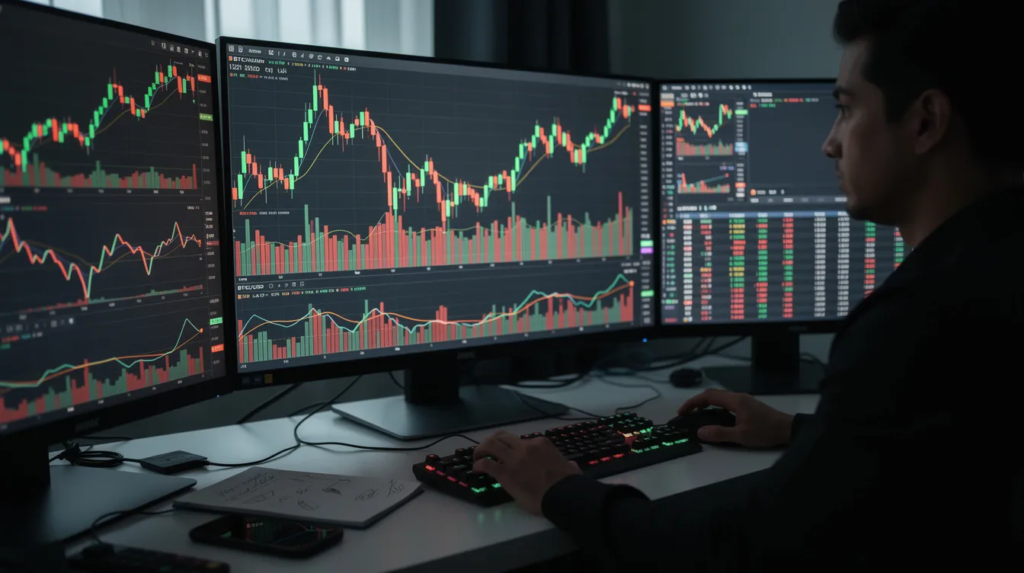
In 2024–2026 markets, short term traders display a set of common behaviors shaped by increasing institutional participation, the growth of derivatives markets, and tighter spreads on major pairs. The crypto market is highly reactive with potential slippage during trades, which means execution speed and platform reliability have become non-negotiable.
Key characteristics include:
Trade frequency: Ranges from a few trades per week for swing traders to dozens or even hundreds per day for scalpers operating on coins like BTC, ETH, and high-volume altcoins.
Leverage use: Many traders use 3x–10x leverage on derivatives exchanges for BTC perpetual futures and similar instruments. High leverage amplifies both profits and losses in trading, so even small market movements can trigger significant gains or liquidations.
Technical indicator reliance: Short term traders depend on tools like RSI, MACD, moving averages, and Bollinger Bands for timing entries and exits rather than reading long fundamental reports.
Execution quality: Tight spreads, low trading fees, and fast order fills are essential-especially during periods of strong market volatility when spreads can widen suddenly.
Discipline requirements: Constant monitoring, use of alerts, and disciplined risk management rules are necessary to avoid emotional trading decisions. Fear and greed can drive price movements in crypto markets, and traders who react impulsively tend to underperform.
Large crypto holders can manipulate prices to their advantage, which adds another layer of unpredictability that short term traders must account for in their strategies.
Core Short-Term Crypto Trading Styles
Short term crypto trading is an umbrella term covering several distinct approaches. Each trading style suits different personalities, schedules, and risk tolerance levels. The four main approaches are scalping, day trading, swing trading, and arbitrage.
Different market conditions favor different short term strategies. Trending markets reward momentum-based day trades and swing trades, while choppy, range-bound markets can suit scalping or range trading. High volatility periods create opportunities across all styles but also amplify risk.
If you’re just getting started, pick one style and learn it thoroughly before mixing multiple approaches without a clear plan.
Scalping: Ultra-Short-Term Crypto Trading
Scalping involves holding positions for seconds to a few minutes on very liquid pairs like BTC/USDT or ETH/USDT. Scalpers make numerous trades within a day for small profits, targeting tiny price moves-typically 0.1% to 0.5% per trade-and repeating the process 20 to 100+ times per session.
This approach thrives in periods of high intraday market volatility, such as around CPI data releases, major ETF announcements, or protocol upgrades. Scalping requires quick decision making and real-time data access to capture small price movements before they disappear.
Typical scalping tools include:
Depth-of-market (order book) views showing bid-ask liquidity
Lower timeframe charts (15-second to 1-minute candles)
Fast-moving EMAs (9-period, 21-period) and volume spike indicators
Very tight stop-loss orders, often 0.1%–0.3% per trade
The psychological and time demands are intense. Scalpers need constant focus and strict discipline. Stop-loss orders limit potential losses in trading, and for scalpers they’re non-negotiable-one bad trade without a stop can erase dozens of small wins.
Some scalpers use automated trading bots to handle execution speed, but these require careful backtesting and robust risk controls to avoid catastrophic losses from bugs or flash crashes.
Day Trading: Intra-Day Price Movements
Day traders open and close positions within a single day, eliminating overnight risk in a market that never sleeps. Compared to scalping, day trading targets larger moves-typically 1% to 5% intraday swings-in coins like BTC, ETH, SOL, or whichever altcoins are showing strong trading volume.
Common day trading techniques include:
Breakout trades: Entering when price breaks above resistance on 5–15 minute charts with volume confirmation
Fading overextended moves: Shorting after a sharp rally or buying after a panic dip when momentum indicators signal exhaustion
Intraday trend following: A form of momentum trading that involves entering trades based on strong upward or downward price movements, often using VWAP as a guide
Day traders rely on technical indicators such as MACD, moving averages, and RSI to identify market momentum and potential reversals. For example, trading ETH volatility around a major network upgrade or ETF approval rumor could generate 3–5% intraday swings-exactly the kind of move day traders look for.
A structured trading strategy minimizes guesswork and increases profitability. Write down your exact entry triggers, profit targets, stop-loss placement, and maximum daily loss limit before the session begins.
Swing Trading: Riding Short to Medium-Term Trends
Swing traders hold positions for several days or weeks, capturing larger directional moves than typical day trades. This trading style targets price swings of roughly 10%–50% on volatile altcoins, or smaller but more reliable moves on majors like BTC and ETH.
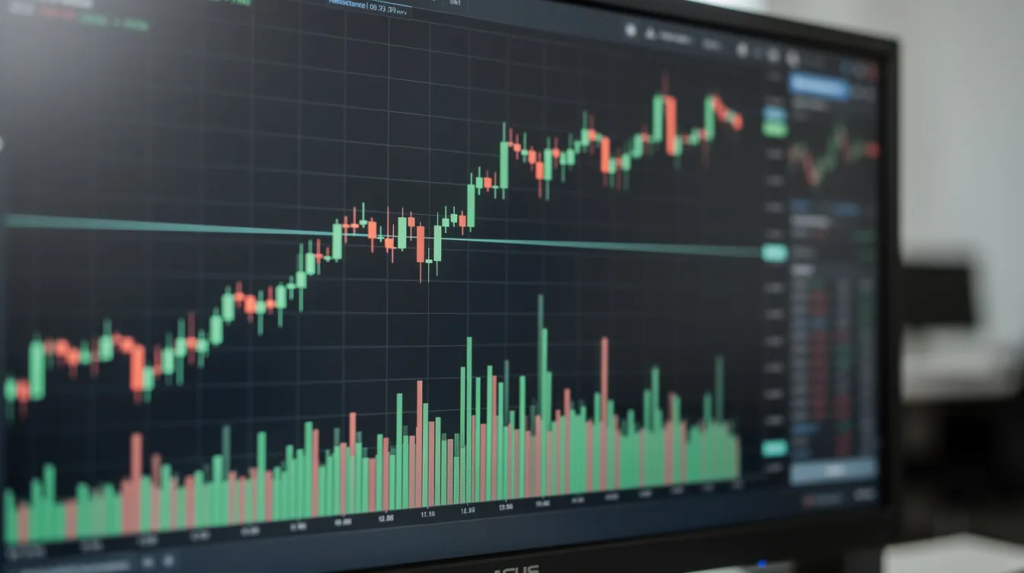
Swing trading uses 4-hour and daily charts to identify broader market trends. For instance, a multi-week uptrend in BTC following a halving event or a sustained rally in AI-related tokens might produce 2–3 viable swing trade setups per month on a given asset.
Swing trading is less time consuming than scalping or day trading, making it a practical choice for people who can’t watch screens all day. However, swing traders accept overnight and weekend risk, meaning they’re exposed to market news and events that hit outside regular hours.
To plan entries and exit points, swing traders combine technical analysis with major narrative drivers-L2 adoption waves, regulatory developments, or ecosystem catalysts. Use wider stop-losses than day traders but compensate with smaller position sizes to account for bigger price swings.
Crypto Arbitrage: Exploiting Price Differences
Arbitrage is a short term strategy that involves exploiting price differences between exchanges or trading pairs. At its simplest, spatial arbitrage means buying BTC at a lower price on one exchange and selling at a slightly higher price on another, pocketing the spread after accounting for fees and transfer times.
Beyond simple exchange-to-exchange moves, there are several arbitrage variants:
Triangular arbitrage: Exploiting pricing imbalances between three pairs on the same exchange (e.g., BTC/USDT → ETH/BTC → ETH/USDT)
DEX-to-CEX arbitrage: Taking advantage of price differences between decentralized and centralized venues, increasingly viable as Layer-2 gas costs drop
Statistical arbitrage: Trading mean reversion between correlated assets
Arbitrage traders exploit price differences between exchanges, but realistic spreads on BTC/USDT between major exchanges are now just 0.1%–0.4%. Many forms of arbitrage are dominated by algorithmic trading systems that react within milliseconds. Network congestion, withdrawal limits, and sudden shifts in market conditions can eliminate expected profits quickly.
For retail traders, the best opportunities tend to appear in mid-cap altcoins, less automated exchanges, or cross-chain contexts rather than top-tier BTC pairs.
How Short Term Traders Use Technical Indicators
Technical analysis uses chart patterns and indicators to identify high-probability setups. For short term traders, these tools provide an objective framework for interpreting price action and market volatility, reducing reliance on gut instinct.
Technical analysis tools include candlestick charts and moving averages, along with several other key instruments:
Moving Averages (SMA/EMA): Define trend direction and act as dynamic support/resistance. Shorter EMAs (9, 21-period) suit scalpers; longer ones (50, 200-period) help swing traders.
Relative Strength Index (RSI): Measures overbought or oversold conditions. Readings above 70 suggest overbought; below 30 suggest oversold.
Moving Average Convergence Divergence (MACD): The average convergence divergence signal indicates momentum shifts. Crossovers between the MACD and signal lines can flag trend reversals.
Bollinger Bands: Measure volatility. Price squeezing within narrow bands often precedes larger price movements.
Volume: Spikes in trading volume confirm breakouts; low-volume moves tend to be unreliable and prone to reversal.
Different strategies prefer different combinations. Scalpers might use EMA ribbons plus volume surges on 1-minute charts. Swing traders might wait for a MACD cross on the daily chart combined with RSI above 50 and a pullback to the 50-day moving average.
Avoid overcrowding your charts. Pick two or three complementary indicators and backtest them across historical price data covering bull, bear, and sideways markets before trading live capital.
Continuous education in technical and sentimental analysis is crucial for successful trading, as market dynamics evolve and what worked last quarter may need adjustment.
Risk Management in Short Term Crypto Trading
In a volatile market like crypto, effective risk management determines survival more than any clever entry signal. Many successful traders don’t have sky-high win rates-they simply cut losses fast and let winners run. Successful traders typically adhere to specific risk management rules that protect their capital across hundreds of trades.
Here are the foundational practices:
Position sizing: Traders should risk only 1–2% of capital per trade. Position sizing should align with risk tolerance and portfolio size. If you have a $5,000 account, risking 1% means your maximum loss per trade is $50.
Stop-loss orders: Stop-loss orders limit potential losses in trading by automatically closing a position at a predetermined price. For example, if you buy BTC at a support level, place your stop just below that support-1–2% below for swing trades, 0.2–0.5% for scalps.
Take-profit targets: Define your exit points before entering. A 2:1 or 3:1 reward-to-risk ratio means you only need to win around 40% of the time to stay profitable.
Leverage discipline: Avoid 25x–50x leverage as a novice. Even experienced day traders rarely exceed 5x–10x. A single sharp intraday swing can liquidate an over-leveraged position in seconds.
Diversification: Diversification reduces risk by spreading investments across assets. Don’t concentrate everything in one volatile micro-cap token-spread across a few coins and strategies.
After three consecutive losing trades, step away. This simple rule prevents revenge trading spirals where emotional trading often leads to poor decision-making and compounding losses.
Emotional discipline is the hardest part. A written trading plan you follow mechanically-regardless of how you feel-separates successful short term trading from gambling.
Choosing Cryptocurrencies and Platforms for Short Term Trading
Not all cryptocurrencies are equally suited for short term trading. Differences in high liquidity, spreads, and trading volume determine whether you can execute your strategy cleanly or get chewed up by slippage and fees.
Selecting assets:
Prioritize highly liquid coins: BTC, ETH, major layer-1s (SOL, AVAX), and leading DeFi tokens where order books are deep
Evaluate bid-ask spread, 24-hour trading volume, and historical volatility when picking assets for day trading or swing trading
Avoid illiquid micro-cap tokens as a novice-thin order books and large price gaps can magnify losses dramatically
Analyze price patterns and market sentiment on potential targets before committing capital
Selecting platforms:
Choosing secure exchanges with favorable fee structures is important for traders. User-friendly exchanges should have low fees and robust security, along with:
Reliable uptime during high volatility events (exchange crashes during market moves are costly)
Advanced charting and technical analysis tools built into the platform
API support if you plan to eventually explore algorithmic trading
Mobile trading apps that allow trading on the go for monitoring positions and managing risk when away from your desk
Real-time market data is essential for informed trading decisions, so choose platforms that provide live order book depth, fast price feeds, and customizable alerts.
Tips for Novice Short Term Crypto Traders
If you’re entering crypto trading for the first time in 2024–2026, treat your first few months as an education rather than an income source. Here’s how to build a foundation:
Start small: Use only capital you can afford to lose. A few hundred to a couple thousand dollars is enough to learn mechanics. Consider demo or paper trading first to understand order types and platform features.
Focus narrowly: Stick to one or two major pairs (BTC/USDT, ETH/USDT) instead of chasing every new token trend or meme coin pump. Predict future price movements on assets you understand well.
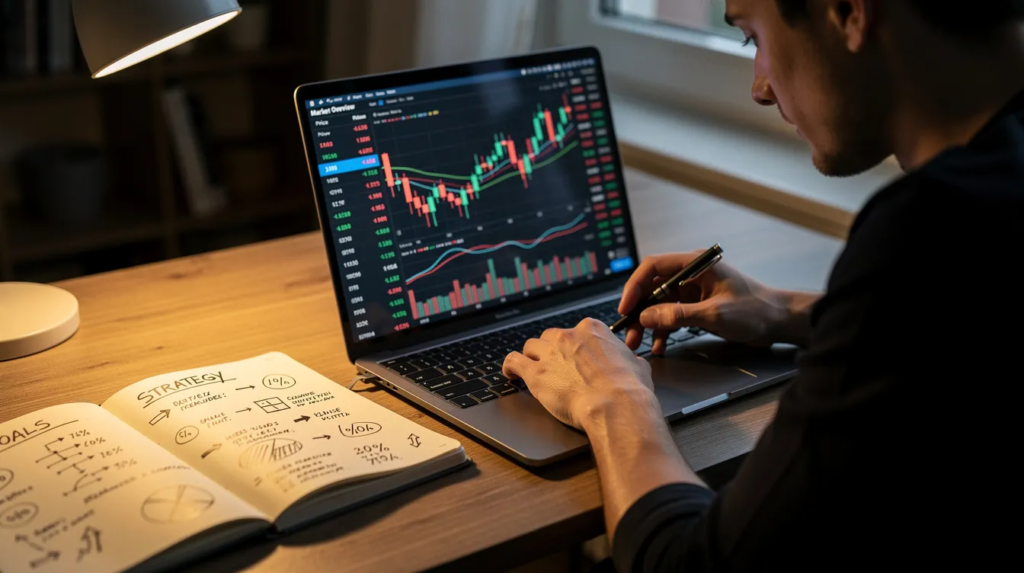
Write a plan: Create a simple trading strategy specifying your preferred timeframes, indicators, entry rules, and risk management parameters. This eliminates guesswork during live market analysis.
Keep a journal: Track every trade with entry and exit reasons, outcome, and lessons. Review weekly. Many successful traders credit journaling as the single habit that improved their results most.
Monitor market news selectively: Stay informed about macro events and crypto-specific catalysts, but don’t overreact to every headline. Market trends matter more than individual tweets.
Watch for traps: Be aware of social media hype, pump-and-dump schemes, and short term price fluctuations driven by coordinated manipulation. Always verify before acting.
The goal isn’t to be right on every trade. The goal is to follow your process, manage risk, and survive long enough to improve.

FAQs
Below are answers to common questions that expand on topics covered in this guide.
Is short term crypto trading suitable for complete beginners?
Beginners can learn short term trading, but they should start very small and expect losses during the initial months. Think of early losses as paid education. Master basic concepts first-order types, how fees work, reading price charts-and practice on highly liquid coins before actively scalping or day trading. Some people find that slower-paced swing trading suits their personality better than staring at 1-minute candles, while others discover that long term investing aligns more naturally with their available time and risk tolerance. There’s no shame in trying a style and switching if it doesn’t fit.
How much capital do I need to start short term crypto trading?
There is no fixed minimum, but you should use only money you can afford to lose without affecting essential expenses. Trading fees and spreads make very tiny accounts harder to grow-if your entire account is $50, a single fee-heavy trade can wipe out a meaningful percentage. Most traders begin with a few hundred to a few thousand USD equivalent. What matters more than total account size is maintaining proper risk per trade (1–2% of your account), which builds correct habits and prevents catastrophic drawdowns regardless of starting capital.
Can I do short term crypto trading part-time?
Part-time trading is absolutely possible, especially with swing trading on 4-hour or daily charts. These advanced trading strategies don’t require constant monitoring because trades unfold over a few days to weeks. Scalping and intense day trading, however, are hard to combine with a full-time job-they demand rapid decisions and sustained screen time. Choose key strategies that match your available hours and energy. Set clear rules for when not to trade, and resist the urge to force trades during limited windows just because the market is open.
How do taxes work for short term crypto trades?
In many jurisdictions, profits from selling assets through short term crypto trades are taxed as short-term capital gains or ordinary income, but exact rules vary by country. In the U.S., short term gains typically face higher tax rates than long-term holdings. Frequent trading creates a large number of taxable events, so traders should keep detailed records of every trade-dates, prices, fees-and plan ahead for reporting obligations. Consulting a local tax professional familiar with digital assets is strongly recommended, especially as regulatory scrutiny of crypto continues to tighten.
When should I consider using algorithmic trading or bots?
Algorithmic trading is typically a later step, suited for traders who already have a profitable manual strategy and deeply understand risk management. Jumping straight into automated trading bots without this foundation is risky-bots amplify mistakes just as easily as they amplify efficiency. Start with simple rule-based alerts or semi-automated tools that notify you when your conditions are met, then gradually automate execution once you trust your system. Avoid purchasing “plug-and-play” bots from unknown sources without thorough due diligence, especially in highly volatile market conditions where untested code can produce rapid, unrecoverable losses.