
Key Takeaways
To start trading forex, you need five things: core forex knowledge, a regulated forex broker and trading platform, a funded trading account (often from $100–$500), a simple trading strategy, and a clear risk management plan.
The forex market trades 24 hours a day, 5 days a week, with daily trading volume above $9.6 trillion. Leverage and market volatility are the main reasons beginners lose money – more than 70% of retail forex traders end up in the red.
New forex traders should practice trading on a demo account first, then move to small real positions while tracking every trade in a simple trading journal.
Combining technical and fundamental analysis (price charts plus news and economic data) gives more reliable trading signals than using either approach alone.
Forex trading is high risk, not a get-rich-quick scheme. Traders should never risk more than they can afford to lose.
Introduction: What Does It Really Take to Start Trading Forex?
Trading forex means buying and selling currency pairs like EUR/USD on the foreign exchange market – the world’s largest financial market. In 2026, many people are drawn to currency trading because of its low entry cost, 24/5 access, and the constant flow of global news-driven price movements. But what do you actually need to start trading forex?
The short answer: education, a regulated broker and trading platform, starting capital, a trading strategy, risk rules, and time to practice trading. The forex market is decentralized and trades electronically across major financial centers like Tokyo, London, and New York. Market volatility can rapidly amplify both profits and losses, which means preparation matters more than enthusiasm.
Set your expectations now. A beginner should plan on several weeks or months of learning and demo practice before committing serious capital to start forex trading. This article walks you through everything – from basic forex trading strategies and market analysis to account setup and common beginner pitfalls.
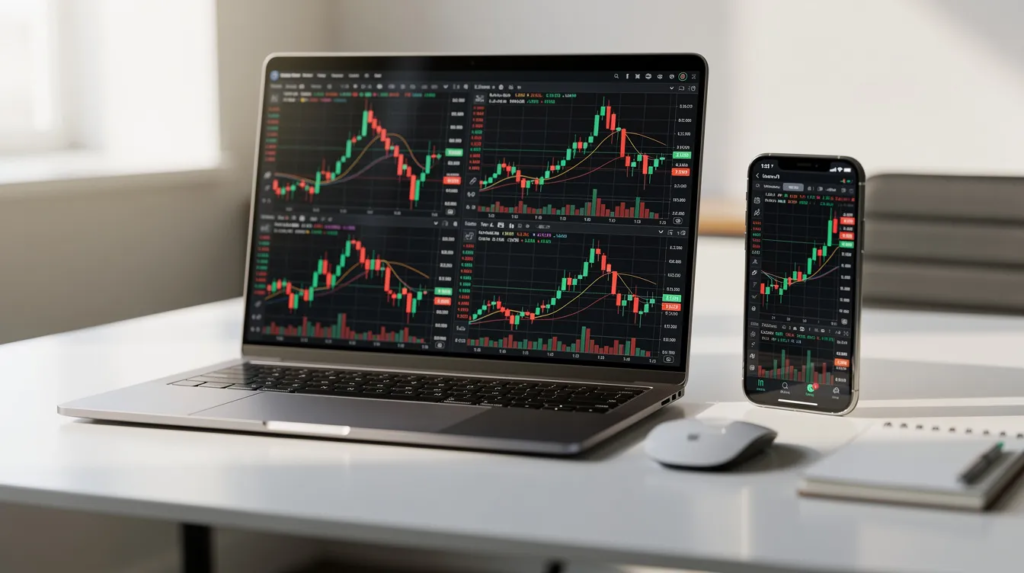
1. Build Your Core Forex Knowledge
Before you start trading forex with real money, you need a clear grasp of how the forex market works and the basic terms you will see on trading platforms. Starting forex trading requires understanding market mechanics, so invest in your forex knowledge before investing your money.
Core concepts to learn:
A currency pair consists of a base currency (first) and a quote currency (second). For example, EUR/USD at 1.0900 means 1 euro costs 1.09 US dollars.
Major currency pairs involve the US dollar paired with currencies like EUR, GBP, or JPY. Minors (crosses) exclude USD, and exotics pair a major currency with an emerging-market one like USD/TRY.
A pip is the standard smallest price movement in a currency pair’s price – typically 0.0001 for most majors.
Leverage and margin:
Leverage allows you to control a large position with smaller capital. For example, 30:1 leverage on a $500 account controls up to $15,000 notional, with the margin requirement being roughly 3.33% of that. Leverage levels can reach up to 50:1 or higher depending on jurisdiction. A $1,000 investment with 50:1 leverage controls $50,000. Leverage can allow you to control $50,000 with $1,000, but it can also amplify losses significantly in forex trading.
Market types within forex:
The spot market is the largest forex market type, where currencies are traded at current prices. Spot market trades settle within two business days.
Forward contracts are customized agreements for future currency trades between two parties.
Futures contracts are standardized and traded on exchanges.
Options contracts give the right to buy or sell currencies at a predetermined price.
Key order types you must understand:
Market orders execute immediately at the best available price.
Limit orders execute only at your specified price or better.
Stop-loss orders automatically close your trade to cap losses.
Take-profit orders lock in gains at a predetermined level.
Learning resources: Structured courses, reputable broker education hubs, books written after 2018, and central bank websites are all solid ways to learn the basics of forex and deepen your trading knowledge. A complete beginner should spend at least 20–40 focused hours learning basics and watching live charts before opening any real positions.
2. Choose a Regulated Forex Broker and Trading Platform
Your choice of forex broker and trading platform is one of the most important practical steps when you start forex trading. It directly affects safety of funds, trading costs, and execution quality. Choose a regulated broker to ensure safe trading – this is non-negotiable.
Why regulation matters:
Because forex is a decentralized OTC market with no central exchange, regulation provides legal protections: fund segregation, capital requirements, dispute resolution, and transparency. Choose a broker regulated by reputable financial authorities such as the FCA (UK), ASIC (Australia), CFTC/NFA (US), or CySEC in the EU. Offshore regulators (Seychelles, Vanuatu, Belize) allow higher leverage but offer weaker investor protection.
Broker comparison points:
A good broker offers competitive spreads and low trading costs. Raw ECN spreads on EUR/USD can be as low as 0.0 pips.
Available leverage: capped at 30:1 on majors in EU/UK, up to 50:1 in the US, and 500:1+ with offshore brokers (higher risk).
Minimum deposit: many brokers accept $50–$250 for micro accounts.
Range of currency pairs: majors, minors, and exotics.
Check for a broker’s customer service quality before choosing – responsiveness and language coverage matter.
Trading platform features:
Select a broker that provides educational resources and tools, and ensure the broker has a reliable trading platform for execution. Look for stable desktop and mobile apps, clear order entry, charting tools with technical indicators, economic calendar integration, and easy account funding and withdrawal. Popular trading platforms include MetaTrader 4 and MetaTrader 5, along with various proprietary web and mobile platforms offered by individual brokers.
Broker safety checklist:
Regulated by a Tier-1 authority
Client funds held in segregated accounts
Negative balance protection for retail clients
Transparent disclosure of all fees (spreads, commissions, overnight costs, withdrawal fees)
3. Decide How Much Money You Need to Start Forex Trading
There is no single mandatory starting balance for a forex trading account. Forex trading requires a minimum deposit of $100 to $500 with most brokers, though risk management should dictate your starting size more than marketing claims.
Account scales:
Nano/micro accounts: you can start trading forex with as little as $100, trading 0.01 lots (micro lots) to keep exposure minimal.
Standard accounts: many brokers require a minimum deposit of $500 to $1,000 for standard accounts, where trading 0.10 or 1.00 lots becomes practical.
Lot sizes (0.01, 0.10, 1.00) directly determine your pip value and exposure per trade.
Many beginners can reasonably start trading forex live with between $200–$1,000 while keeping position sizes tiny and risking 1–2% per trade. Keep monthly return expectations realistic – consistent small gains are the goal, not overnight wealth.
Concrete example: For a $500 account, risking 1% per trade means about $5 risk per position. If you place a 50-pip stop-loss on EUR/USD, your pip value must be roughly $0.10 – which means trading a 0.01 micro lot.
Budget for trading costs:
Spreads (bid-ask cost on entry and exit)
Overnight swap/rollover fees for holding positions past the daily cutoff
Any withdrawal or inactivity fees your broker may charge
Trading capital should be truly risk capital – money you can afford to lose without affecting rent, food, loans, or other obligations. If losing your entire deposit would cause financial stress, you are trading with too much.
4. Learn Technical and Fundamental Analysis
Successful forex traders blend technical and fundamental analysis to form a coherent trading strategy instead of guessing based on currency prices alone. This combination gives a more complete picture of potential currency movements.
Technical Analysis
Technical analysis includes studying chart reading and support levels. Here are the high-level topics a beginner should cover:
Reading candlestick charts and recognizing patterns (doji, engulfing, pin bars)
Identifying support and resistance zones where price charts show repeated reversals
Using simple indicators: moving averages (SMA, EMA), RSI, and MACD
Understanding timeframes – from M15 for short-term views to H1, H4, and daily charts for broader context
Basic forex trading strategies like trend following, breakout trading, and range trading are largely based on repeated technical patterns visible on forex charts.
Fundamental Analysis
Fundamental analysis involves understanding macroeconomic factors that drive currency risk and price movements. Traders should track:
Interest rates and central bank decisions (Fed, ECB, BOJ, BOE)
Inflation data like CPI and PPI
Employment reports (e.g., US non-farm payrolls)
GDP growth, trade balances, and government debt developments
Geopolitical events and policy shifts
These economic indicators and economic factors are among the key factors influencing currency prices across the currency market.
Market volatility often spikes around scheduled economic calendar events, so new forex traders must learn to either avoid these time windows or deliberately prepare for them with wider stops and smaller position sizes.
Combine both approaches: use fundamental signals (like an expected central bank rate shift) to determine directional bias, then use technical analysis levels to fine-tune entry and exit prices in the direction that macro trends suggest.
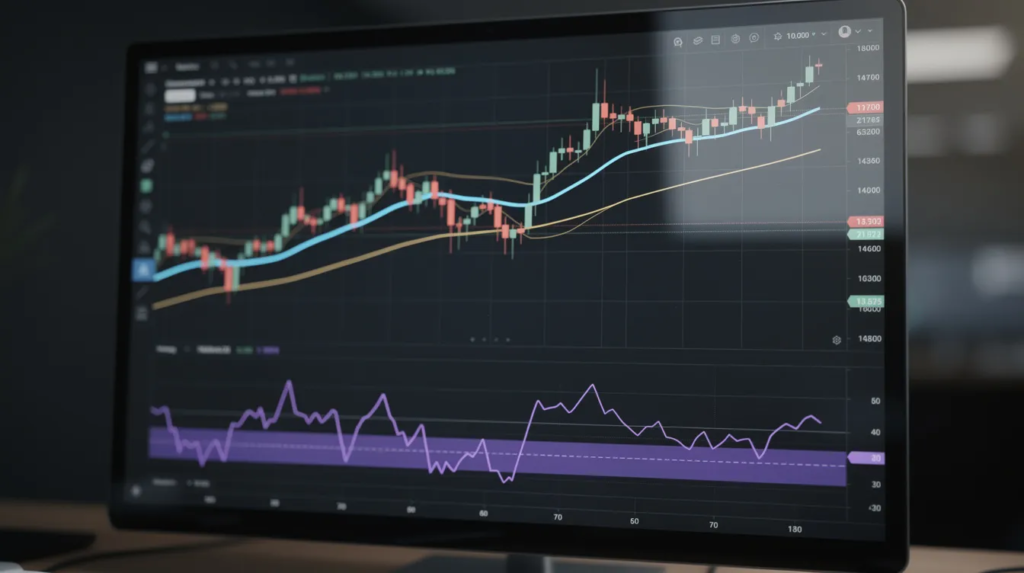
5. Choose a Trading Style and Build a Simple Trading Strategy
Before you start trading forex live, choose a trading style that fits your schedule and personality, then design a simple, rule-based trading strategy around it. Develop a trading plan outlining your goals and strategies before risking real money.
Main trading styles:
Style | Holding Period | Screen Time | Best For |
|---|---|---|---|
Scalping | Seconds to minutes | Very high | Scalping is a short-term strategy for quick profits; requires tight spreads and fast execution |
Day trading | Hours (flat by session end) | High | Traders who can dedicate full sessions and want no overnight risk |
Swing trading | Days to weeks | Moderate | Swing trading holds positions for days to capture medium-term movements; suits part-timers |
Position trading | Weeks to months | Low | Macro-oriented traders focused on big fundamental shifts |
Swing trading is particularly suitable for many beginners because it avoids the stress of minute-to-minute charts, allows combining technical and fundamental analysis, and works well for people who traders focus their analysis around end-of-day routines.
What a basic trading strategy should include:
Specific entry rules (e.g., price above 50-day EMA plus RSI crossing above 50 during the London session)
Clear exit rules: predetermined stop-loss and take-profit levels
Conditions to avoid trading: during major news releases, low-liquidity hours, or when spreads widen abnormally
Illustrative forex trading examples: A simple EUR/USD trend-following swing strategy on the 4-hour chart might look like this: identify a series of higher highs and higher lows, wait for a pullback to the 50-EMA, confirm a bounce via RSI leaving oversold territory, enter long. Place stop-loss below the recent swing low. Set take-profit at a 1:2 risk-reward ratio based on the prior swing high.
Other basic forex trading strategies include trend trading, which involves following the market’s direction; range trading, which focuses on buying at support and selling at resistance; and breakout trading, which aims to enter the market after price breaks a range.
Start with one simple, repeatable trading strategy and trade only 1–3 currency pairs until you achieve consistent execution. Experienced traders build complexity over time – beginners build consistency first.
6. Practice Trading with a Demo Account Before Going Live
Practice trading on a demo account allows you to learn the trading platform and test your trading strategy without risking real money. Open a demo account to practice trading risk-free – it is one of the smartest first steps in your forex trading journey.
Most brokers in 2026 offer free demo accounts with virtual balances (e.g., $10,000–$50,000) that simulate real-time forex markets, spreads, and order execution. These accounts let you buy or sell currencies, test different order types, and experiment with forex charts in live market conditions.
How to use a demo account effectively:
Treat demo trading seriously: risk only 1–2% of the notional balance per trade
Log every trade in a simple trading journal to observe patterns of success and failure
Aim for a defined practice period – 4–8 weeks, or 50–100 completed trades – before funding a small live account
The key limitation of demo trading: it does not fully replicate emotions like fear and greed. Market participants behave differently when real money is on the line, so transitioning to small real-money trades is still necessary to experience the psychological pressure of your first forex trade.
Skills to confirm before going live:
Placing and modifying all order types (market, limit, stop, trailing stop)
Setting stop-loss and take-profit orders accurately
Reading candlestick charts and identifying basic patterns
Handling price movements during news events without panicking
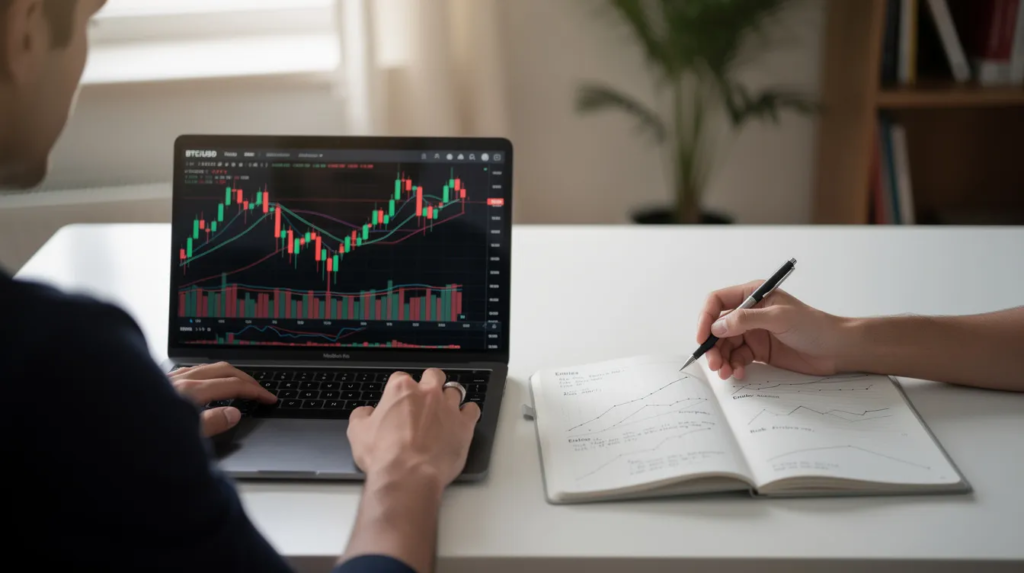
7. Set Up Risk Management Rules from Day One
Risk management is the main difference between long-term surviving forex traders and those who blow up accounts within weeks, especially when using leveraged trading. Risk management is vital to avoid over-leveraging in trading – it is not optional.
Core risk management strategies:
Cap risk per trade at around 1–2% of account equity
Always use a predetermined stop-loss – using stop-loss orders is essential for managing risk in forex
Avoid adding to losing positions (“no averaging down” for beginners)
Think in terms of risk-to-reward ratios: aim for at least 1:2, meaning you risk 1 unit to target 2 units of profit
Concrete example: For a $1,000 account, risking 1.5% per trade equals $15. If your stop-loss is 50 pips, your position size must be calculated so that a triggered stop costs approximately $15 – not more.
Leverage warnings:
A 2% market move against a 30:1 leverage position can wipe out half your investment. High leverage (100:1 or more) can destroy a small account with a modest price swing. Beginners should select lower effective leverage and smaller positions until their trading skills and trading discipline are proven. Market volatility can lead to substantial gains or significant losses – managing risk means surviving long enough to benefit from your edge.
Define a maximum daily or weekly loss limit – such as 3–5% of the account. If you hit it, stop trading and review your strategy rather than chasing losses. Successful traders protect capital first and grow it second.
8. Prepare Your Trading Environment and Routine
Trading forex consistently requires a stable environment and a repeatable routine, even if you only trade a few hours a week. You don’t need a Wall Street setup – but you do need reliability.
Basic technical setup:
Reliable internet connection (wired is preferable to Wi-Fi for stability)
At least one computer or tablet with a clear display
Mobile access for monitoring open positions and receiving alerts
Define your trading hours based on the major forex sessions. If you are trading EUR/USD or GBP/USD, the London–New York overlap (roughly 8 AM–12 PM Eastern) offers the highest liquidity and tightest spreads across these major financial centers. Don’t try to monitor markets 24/5.
Pre-trade checklist:
Check the economic calendar for high-impact events
Review any open trades and current exposure
Scan your watchlist of currency pairs for setups
Confirm your risk levels before placing any new order
Keep a trading journal capturing date, currency pair, direction (buy or sell), entry and exit prices, position size, reason for taking the trade, and after-trade notes on what worked or failed. This is how you turn random trades into a comprehensive trading plan with measurable trading goals.
Psychological discipline matters as much as any indicator. Follow your plan. Avoid revenge trading after losses. Take breaks. Accept that not every trade will be a winner – even the best strategies have losing streaks. Your risk tolerance should guide position sizing, not your emotions.
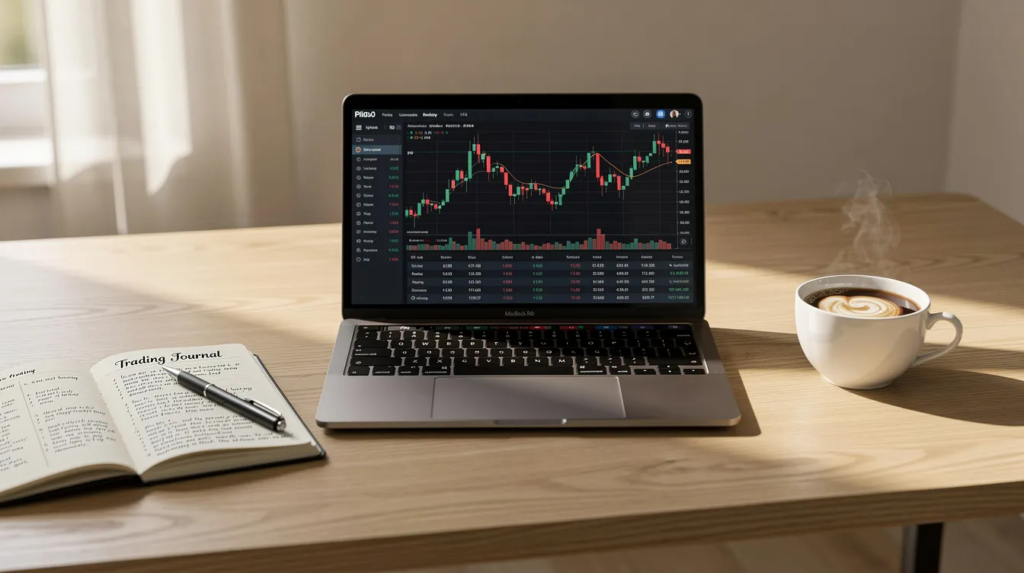
9. Common Beginner Mistakes to Avoid When You Start Trading Forex
Many new forex traders lose money not because foreign exchange trading is impossible, but because they repeat the same avoidable mistakes when they start trading.
Typical errors:
Jumping into live trading without enough demo practice
Trading without a written trading plan – entries, exits, and risk rules must be documented
Overtrading on very short timeframes, reacting to every minor chart movement
Constantly changing strategies after a few losses instead of giving a system enough trades to prove itself
Overuse of leverage is a frequent cause of account blow-ups, especially when combined with tight stops and volatile pairs like GBP/JPY or exotic currencies with wide spreads and sharp gaps. More than 70% of retail forex clients lose money – leverage misuse is a leading contributor.
External pitfalls:
Relying on unverified social media trading signals or copy trading without understanding the underlying trading strategy
Falling for “guaranteed profit” schemes – if it sounds too good to be true, it is
Psychological traps:
Fear of missing out (FOMO): entering trades without a valid setup just because the market is moving
Moving stops farther away instead of taking a small loss
Increasing trade size impulsively after a win (overconfidence) or a loss (revenge trading)
Focus on process over outcome. Good market analysis and disciplined execution matter more than the result of any single trade. Forex success comes from consistency, not from chasing home runs.
FAQs
How long does it take to learn enough to start trading forex safely?
Timing varies, but a typical motivated beginner might need 2–3 months of consistent study and demo practice (several hours per week) before opening a small live forex trading account. Learning continues for years – many traders take 6–12 months to see steady small profits. The goal is not perfection, but reaching a point where basic concepts, trading platforms offered by your broker, and risk management strategies feel familiar. Delay live trading until you can describe your trading strategy, risk rules, and typical trade setup clearly in writing.
Which currency pairs are best for new forex traders?
Start with major currency pairs such as EUR/USD, GBP/USD, and USD/JPY because they usually have tighter spreads, higher liquidity, and more readily available analysis. Avoid thinly traded exotic pairs (like USD/TRY or USD/ZAR) at first, as their wider spreads and sharper gaps increase trading costs and currency risk. Focus on one or two pairs initially to build specialized experience with their typical daily ranges and reactions to news from market participants.
Can I start trading forex while working a full-time job?
Yes, but you must choose an appropriate trading style. Swing trading or position trading work well because they do not require constant screen time. Set specific daily or weekly “analysis windows” – such as evenings in your local time zone – and use pending orders and alerts to enter and manage trades. Avoid monitoring markets from work in an unfocused way, which often leads to impulsive decisions and poor trade management.
Do I need expensive software or multiple monitors to trade forex?
Most beginners do not need complex setups. A single reliable computer or laptop, stable internet, and the broker’s default trading platform are usually sufficient. Charting tools, indicators, and news feeds are typically built into modern trading platforms, so extra paid tools can wait until you prove consistent profitability. Risk management, trading discipline, and strategy matter far more than hardware – especially during your first year of trading currencies in the foreign exchange market.
Is forex trading suitable for everyone?
No. The currency market is high risk, and foreign exchange trading may not suit people who cannot tolerate significant swings in account value or who are under financial pressure. Those with heavy debts, unstable income, or very low savings should prioritize financial stability before considering leveraged trading. Reflect honestly on your financial situation, time availability, and emotional resilience. The risks involved are real, and there is no guarantee of profit. Consider seeking independent financial advice if you are unsure whether this path fits your circumstances.