
New to trading? Learn how to start trading forex, stocks, and crypto with confidence — covering markets, strategies, and risk management for beginners.
Have you ever watched the markets move and wondered if you could be part of it?
Maybe you’ve seen a friend brag about buying Bitcoin before it spiked, or scrolled past a headline about the S&P 500 hitting new highs and felt that little spark of curiosity. You’re not alone — and here’s the good news: you don’t need to be a finance expert to get started.
So, what is trading, exactly? At its core, trading means buying and selling financial instruments — currencies, stocks, crypto, commodities — with the goal of profiting from price movements. It’s not the same as investing, which usually means holding assets for years and betting on long-term growth. Trading moves faster. It’s about spotting opportunities, managing risk, and making decisions in real time.
If you’re new to this, you probably have questions like:
- How does trading actually work?
- Which markets should I look at first?
- How do I avoid losing money as a complete beginner?
This guide answers all of that, step by step. We’ll start with the basics of how trading works, explore the main markets you can trade — forex, stocks, crypto, and more — walk through different trading strategies, and finish with the risk management skills that separate confident traders from reckless ones.
Whether you picture yourself trading currency pairs in the forex market, buying shares in companies through stock trading, or exploring the fast-moving world of cryptocurrency, this beginner’s guide gives you a solid foundation to build on.
No jargon overload. No assumptions that you already know what “leverage” or “position sizing” means. Just a clear, practical roadmap from curious onlooker to informed trader.
Ready to find out where to start? Let’s dive in.
What Is Trading? Understanding the Basics
Before you place a single trade, it helps to understand what you’re actually doing — and why it’s different from what your parents probably did with their pension fund.
Trading vs Investing: What’s the Difference
People use these words interchangeably, but they’re not the same game.
- Investing is about patience. You buy an asset and hold it for years, riding out the ups and downs because you believe in its long-term value.
- Trading is about timing. You’re aiming to profit from price movements over days, hours, or even minutes, actively opening and closing positions as the market shifts.
Neither approach is “better” — they just serve different goals, time horizons, and risk appetites. If you’re drawn to the idea of actively reading charts and reacting to market news, trading is likely the more natural fit.
How Trading Works
At its simplest, how trading works boils down to one idea: you’re trying to buy low and sell high — or, in some markets, sell high and buy back low (this is called “going short”).
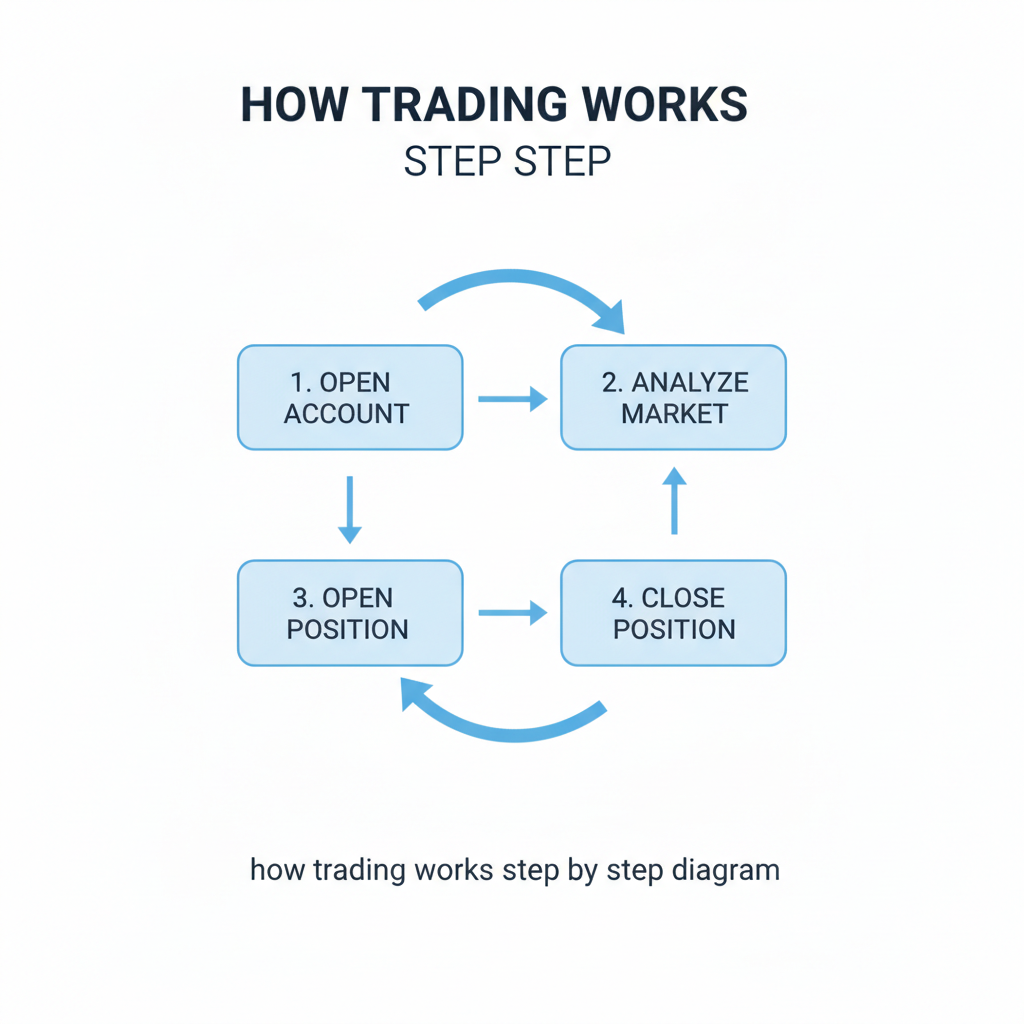
Here’s the basic flow:
- You open a trading account with a broker.
- You analyze a market and decide whether you think its price will rise or fall.
- You open a position — buying if you expect a rise, selling if you expect a fall.
- You close the position to lock in a profit (or, sometimes, a loss).
That’s the mechanism. The skill — and the part this guide will help you build — is in steps 2 and 4: knowing when to enter and when to exit.
Trading Definition for Beginners
If you need one clean definition to anchor everything else: trading is the practice of buying and selling financial assets with the aim of generating a profit from short- to medium-term price changes.
Keep that definition close. Every strategy, market, and risk tool in this guide is really just a different way of putting that one idea into practice.
Exploring the Main Markets You Can Trade
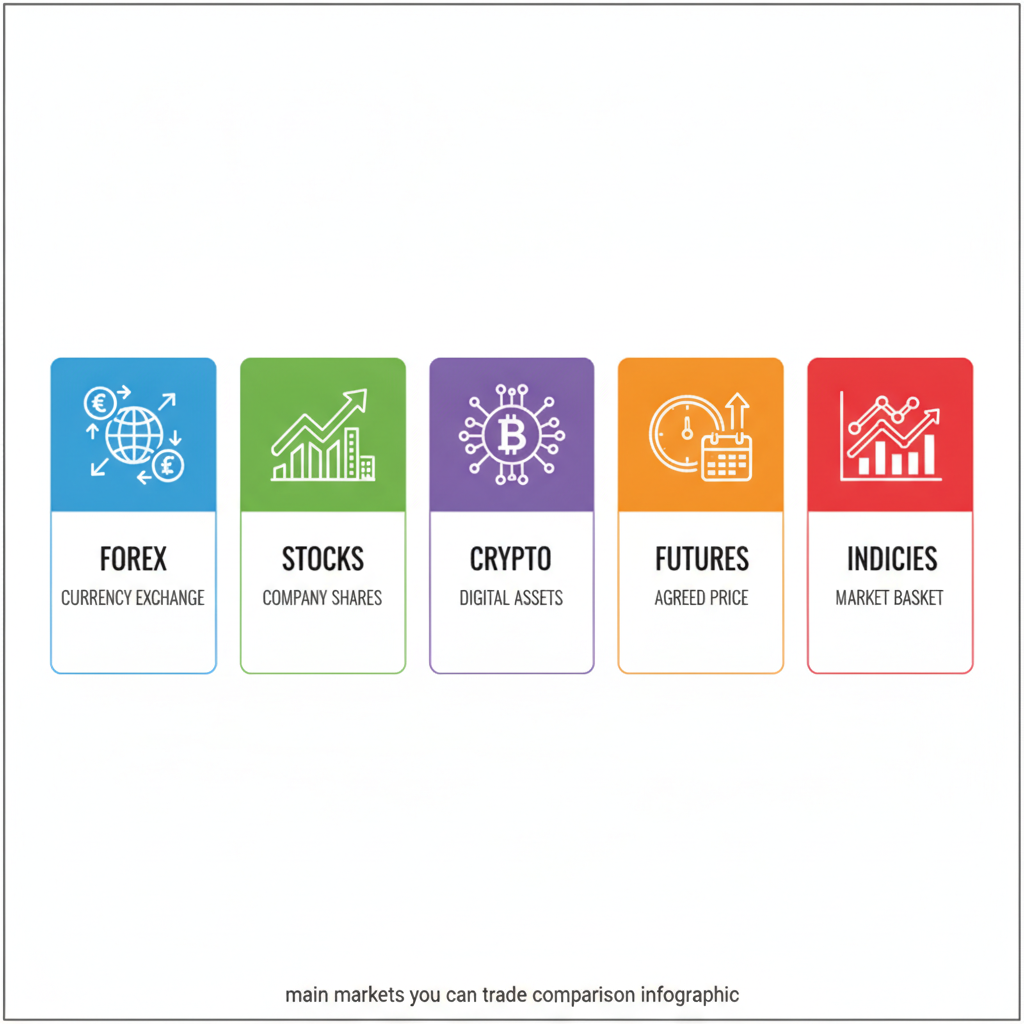
Once you understand what trading is, the next question is naturally: where do I actually do it? The main markets you can trade each have their own personality, and getting familiar with them will help you figure out where your interests (and risk tolerance) line up.
Forex Trading: Currencies and Pairs Explained
Forex (foreign exchange) is the world’s largest financial market, and it’s built entirely around currency pairs — you’re always trading one currency against another, like EUR/USD or GBP/JPY.
What makes forex appealing to beginners:
- It’s open nearly 24 hours a day, five days a week
- High liquidity means trades execute quickly
- You can speculate on global economic events, not just company performance
Stock Trading: Shares and Companies
Stock trading means buying and selling shares — small ownership stakes — in publicly listed companies. When you trade stocks, you’re essentially betting on a company’s performance, leadership, and industry outlook.
It’s often the most intuitive market for beginners, simply because most of us already understand what it means to own “a piece” of a company like Apple or Nike.
Cryptocurrency Trading for Beginners
Cryptocurrency trading involves buying and selling digital assets like Bitcoin, Ethereum, or countless smaller “altcoins.” It’s known for:
- Extreme price volatility (which cuts both ways — bigger potential gains and losses)
- 24/7 market access, since crypto never closes
- A relatively low barrier to entry for first-time traders
If you’re exploring cryptocurrency trading as a beginner, volatility is the single biggest thing to respect and prepare for.
Futures Trading: Gold, Oil, and Beyond
Futures trading lets you speculate on the future price of commodities like gold and oil, as well as financial instruments, through standardized contracts. You’re agreeing to buy or sell an asset at a set price on a future date.
This market tends to attract traders who want exposure to global supply-and-demand forces — energy prices, harvests, geopolitical events — rather than company-specific news.
Index Trading: S&P 500, Nasdaq, and More
Rather than picking individual stocks, index trading lets you trade a basket of them at once — think the S&P 500 or the Nasdaq. It’s a way to get broad exposure to “the market” as a whole, which can smooth out some of the wild swings of single-stock trading.
Types of Trading Strategies to Know
Knowing what to trade is only half the equation. The other half is deciding how you’ll approach it — and that’s where strategy comes in.
CFD Trading Explained for Beginners
A CFD (Contract for Difference) is a popular way to trade many of the markets above without owning the underlying asset itself. Instead, you’re speculating on price movement, which means:
- You can potentially profit whether prices rise or fall
- You don’t need to physically own the stock, currency, or commodity
- Leverage is often available, amplifying both gains and losses (more on that risk shortly)
CFDs are flexible, but that flexibility comes with real responsibility — which is exactly why risk management gets its own section later in this guide.
Short-Term vs Long-Term Approaches
Among the many types of trading strategies, most fall somewhere on this spectrum:
- Day trading – opening and closing positions within a single day
- Swing trading – holding positions for several days to weeks, aiming to capture a “swing” in price
- Position trading – holding for weeks or months, closer to a trading-investing hybrid
There’s no universally “correct” choice here. It depends on how much time you can dedicate, your tolerance for fast decision-making, and your personality as a trader.
Matching a Strategy to Your Goals
Before picking a strategy, ask yourself:
- Am I trying to generate steady income, or build long-term capital?
- How much time can I realistically commit each day or week?
- How do I react under pressure when a trade moves against me?
Buying and selling financial assets for profit isn’t about copying someone else’s playbook — it’s about finding the approach that fits your schedule, temperament, and goals.
How to Start Trading, Step by Step
You understand the basics, the markets, and the strategies. Now, the part you’ve been waiting for: how to actually start trading.
How to Choose a Regulated Broker
This step is non-negotiable. A regulated broker is overseen by a recognized financial authority, which protects you from fraud and ensures fair trading conditions.
When evaluating brokers, check for:
- Regulation from a recognized authority in your region
- Transparent fees, spreads, and commissions
- A trading platform that feels intuitive to you
- Responsive, accessible customer support
Opening Your First Trading Account
Once you’ve chosen a broker, starting to trade online typically involves:
- Completing an identity verification process (standard for regulated brokers)
- Depositing funds using a payment method that suits you
- Familiarizing yourself with the trading platform before risking real money
Practicing With Demo Trading Accounts, Risk-Free
Here’s a step too many beginners skip: demo trading accounts. These let you practice with virtual funds in real market conditions — no financial risk attached.
Use a demo account to:
- Get comfortable with the platform’s tools and charts
- Test a strategy before committing real capital
- Build confidence in your decision-making process
There’s no rush here. The traders who last are usually the ones who took the time to practice first.
Managing Risk Like a Pro
If there’s one section in this guide worth re-reading, it’s this one. Trading risk management isn’t an optional extra — it’s the difference between a long trading career and a short, expensive lesson.
Understanding Trading Leverage and Its Risks
Leverage lets you control a larger position than your account balance alone would allow, by borrowing capital from your broker. It sounds appealing — and it can amplify profits — but it works both ways.
A small market move against a highly leveraged position can wipe out your capital far faster than trading without leverage. If you only take one thing from this section, make it this: understand your leverage ratio before you ever click “trade.”
Stop Loss and Position Sizing Explained
Two tools do most of the heavy lifting in risk management:
- Stop loss orders automatically close a trade once it hits a price you’ve set, capping your potential loss
- Position sizing determines how much capital you commit to a single trade, relative to your overall account
Used together, stop loss and position sizing let you define your risk before you ever enter a trade — rather than reacting emotionally once you’re already in it.
Common Trading Risks for Beginners
Beyond leverage and sizing, watch out for:
- Overtrading — taking too many trades out of impatience or excitement
- Revenge trading — trying to immediately win back a loss, usually leading to a bigger one
- Ignoring a trading plan — making impulsive decisions instead of following your strategy
- Underestimating volatility — especially in fast-moving markets like crypto
Every experienced trader has run into these risks at some point. The goal isn’t to avoid mistakes entirely — it’s to build habits that keep mistakes small and recoverable.
Conclusion: Your Next Steps Into Trading
Let’s bring it all together. Here’s your roadmap, summarized:
- Understand the basics — know how trading works and how it differs from investing.
- Explore the markets — forex, stocks, crypto, futures, and indices each offer different opportunities.
- Choose a strategy — whether that’s CFD trading, day trading, or a longer-term approach.
- Start smart — pick a regulated broker and practice with a demo account first.
- Manage your risk — use stop losses and position sizing, and stay alert to common beginner pitfalls.
Trading rewards patience, curiosity, and discipline far more than it rewards luck. You don’t need to master every market or strategy on day one — you just need a clear starting point, and now you have one.
This article is for educational purposes only and does not constitute financial advice. Trading involves risk, including the potential loss of your invested capital.