
Meta Description: Discover how candlestick patterns like engulfing, piercing, and doji perform in modern markets. Dive into academic research, real-world data, timeframe effects, and how to combine with trend, volume, and risk controls for a more reliable edge.
Candlestick patterns are one of the most popular tools in technical analysis, yet few traders truly understand how much weight these formations carry in real markets. Are they reliable predictors of price movement, or just visual noise dressed up in centuries-old tradition? This guide digs into the academic evidence, practical filters, and honest limitations so you can decide exactly how much significance to assign them in your own trading.
Key Takeaways
Candlestick patterns provide a real but modest statistical edge. Studies across multiple markets show win rates of roughly 50–52% in isolation, improving to 60–70% with proper filtering.
Academic research since the early 2000s on markets like the Taiwan stock exchange and China’s SSE50 index finds some predictive power in patterns like the bullish engulfing pattern, morning star, and bearish engulfing, but the edge often shrinks after transaction costs and over time.
Higher-timeframe candlestick charts (daily and 4-hour) are significantly more reliable than 1- or 5-minute charts because they filter out noise and intraday market volatility.
Combining candlestick analysis with other tools-moving averages, RSI, volume, support and resistance-produces a more meaningful edge than trading off patterns alone.
Treat candlestick pattern analysis as a decision aid and risk-management tool, not as a standalone buy/sell signal generator.
What Are Candlestick Patterns and Why Do Traders Care?
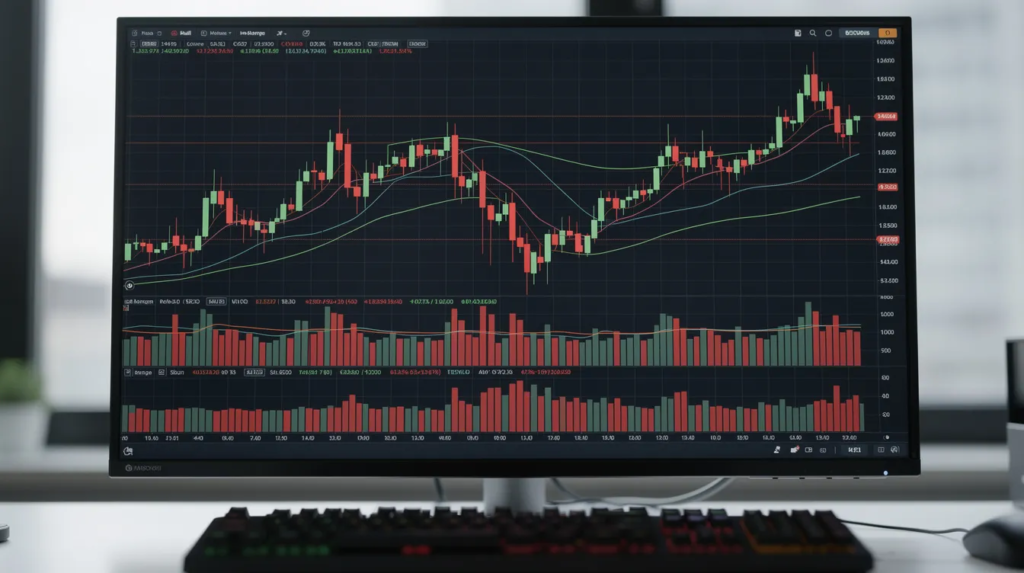
Candlestick patterns are a foundational technical analysis tool used by traders across financial markets. Each candlestick represents price information for a specific time period-whether one minute, one hour, or one day-capturing four data points: the opening price, the closing price, the high, and the low. Using candlestick patterns requires understanding their components: open, close, high, low. The body of a candlestick shows the strength of market movement during that session, while the wicks (or shadows) reveal the extremes that were tested and rejected.
Candlestick patterns originated in 18th-century Japan, where Munehisa Homma developed candlestick patterns for rice trading in Osaka’s commodity markets. The system remained largely unknown in the West until Steve Nison introduced candlestick patterns to the Western world through his 1991 book Japanese Candlestick Charting Techniques. Since then, candlestick charts have become a standard way to visualize daily price movements and market sentiment.
A candle pattern is a specific configuration of one or more candles that traders believe has predictive value. Candlestick patterns can indicate potential market reversals or continuations. The main categories include:
Single-candle patterns like the hammer candlestick pattern and the doji candlestick. Doji candlestick patterns represent market indecision, with opening and closing prices nearly identical and a very small body.
Multi-candle reversal patterns such as the morning star pattern, evening star pattern, bullish engulfing candlestick pattern, and bearish engulfing pattern.
Continuation candlestick patterns like rising three methods and falling three methods, which signal pauses within a larger trend.
These different candlestick patterns are applied across markets-stock market indices like the S&P 500, individual equities, forex pairs, and crypto-but their significance varies by asset class, liquidity, and volatility regime.

How Significant Are Candlestick Patterns in Practice?
Here is the direct answer: candlestick patterns provide a real but modest edge. They are more significant as a way to visualize order flow and market psychology than as mechanical “price will go here next” rules. Candlestick patterns can signal when a trend is losing momentum, but they rarely provide high-confidence directional calls on their own.
Research across multiple markets and decades tells a consistent story. A study covering the Taiwan stock market from 1992–2009 found that only four single-day patterns were profitable after transaction costs, and profitability improved when patterns were filtered by trend direction and moving averages. In China, a study on SSE50 index components (2000–2018) found that several bullish patterns produced statistically significant returns over 3- to 10-day holding periods, but bearish patterns were less consistent. Meanwhile, a study on Thailand’s SET50 (2006–2016) found that most patterns did not generate statistically significant mean returns, and filtering via RSI, stochastics, or MFI did not reliably help.
When transaction costs, slippage, and bid-ask spreads are included, the profitability of raw, pattern-only strategies often disappears or becomes marginal. This is especially true in highly efficient large-cap stocks where algorithmic trading has tightened spreads and accelerated price discovery.
Pattern significance tends to be higher when:
The pattern aligns with the higher-timeframe market trend
It appears at clear support or resistance on the candlestick chart
It is confirmed by volume or momentum technical indicators
Candlestick patterns are most effective when used alongside other technical indicators. In 2026 markets dominated by algorithmic and high-frequency trading, a recent study (Loubaris, 2026) confirms that pattern reliability deteriorates in volatile or crisis regimes, reinforcing the need to combine candlestick patterns with other tools rather than treating them as self-sufficient signals.
Reading Bullish vs Bearish Patterns: What Do They Actually Tell You?
The real significance of a candle pattern lies in how it captures the battle between buyers and sellers at a specific spot on the chart. A pattern indicates whether one side is gaining or losing control over a trading session-and that shift in dominance is what traders care about.
What Bullish Candlestick Patterns Indicate
Bullish candlestick patterns signal exhaustion of selling pressure and the emergence of demand. Bullish patterns can indicate potential buy signals. Common examples include:
Hammer candlestick: The hammer pattern indicates a potential bullish reversal after a downtrend. A long lower wick shows strong buying pressure rejected sellers at the lows.
Bullish engulfing: A bullish engulfing pattern indicates strong buying strength. It consists of a small bearish candle followed by a larger bullish candle whose body fully engulfs the prior one.
Morning star: The morning star pattern is a three candlestick pattern signaling a bullish reversal, moving from a bearish candle to indecision (small body) to a strong bullish candle.
Piercing line pattern: The piercing line pattern consists of a bearish candle followed by a bullish candle that closes above the midpoint of the first candle.
Three white soldiers: Three white soldiers is a strong bullish signal formed by three consecutive long green candles, signaling a strong bullish reversal.
What Bearish Candlestick Patterns Indicate
Bearish candlestick patterns indicate exhaustion of buying and a possible swing high. Bearish patterns can indicate potential sell signals. Key formations include:
Shooting star: A shooting star pattern forms at the top of an uptrend. Its long upper shadow shows that buyers pushed price higher during the session but failed to hold.
Hanging man: The hanging man pattern indicates a potential market reversal when it appears after a rally.
Bearish engulfing: Bearish engulfing patterns signal a peak in price movement, with the second bearish candle fully consuming the prior bullish candle.
Evening star: The evening star pattern indicates a reversal of an uptrend using a three-candle sequence.
Dark cloud cover: Dark cloud cover indicates a bearish reversal after an uptrend.
Three black crows: Three black crows consist of three consecutive long red candles, representing three consecutive bearish candlesticks that confirm strong selling pressure.
Candlestick patterns can indicate bullish or bearish market sentiment depending on their structure and location. They also help identify potential market reversals and can help identify market rejection when a price approaches a resistance level. For instance, a shooting star with a long upper shadow near a major resistance level directly shows that buyers tried to break through and were overwhelmed-giving that upper shadow real psychological weight.
When Are Candlestick Patterns Most (and Least) Reliable?
Context is what makes a candlestick pattern significant or just noise. Here are the main filters traders should apply:
More Reliable When:
Higher timeframes: Higher time frames yield more reliable candlestick patterns. Daily and 4-hour candlestick charts filter out noise, while 1- or 5-minute charts generate many false signals. The crypto markets study (2018–2022) showed hourly or daily data being far more stable than shorter intervals.
Trend alignment: A reversal pattern like the morning star or bearish engulfing is more significant after an extended trend. Continuation patterns like rising three methods work best within a clear, ongoing move in the overall market trend.
Key price structure: Patterns at major support or resistance, prior swing highs/lows, or key moving averages (50-day, 200-day) carry more weight. These levels concentrate stop orders and psychological attention.
Volume confirmation: Above-average volume on the reversal candle adds conviction. In the SSE50 study, combining trend plus overbought/oversold filtering improved detection of profitable bullish patterns.
Less Reliable When:
Pattern forms in the middle of a choppy range without clear trend context
Ultra-high market volatility (FOMC days, earnings releases, crisis periods) distorts candle shapes and increases false signals
Very short timeframes (1- or 5-minute) where noise dominates signal
Transaction costs and spreads are large relative to the expected move from the pattern signals
Spotlight on Two-Candle Reversal Patterns: Engulfing and Dark Cloud / Piercing
Engulfing-type patterns are among the most widely studied trading patterns in candlestick research because they directly show one side overwhelming the other within just two sessions.
A bullish engulfing pattern appears when a bearish candle is followed by a larger bullish candle whose body completely engulfs the prior candle’s body. This pattern signals a sharp shift from selling pressure to strong buying pressure. A bearish engulfing pattern is the inverse: a bullish candle followed by a bearish candle that envelopes the prior body, suggesting a bearish reversal is underway.
A study of S&P 500 data from 1950–2018 found that the bullish engulfing candlestick pattern showed statistically significant short-term returns when identified using open and low criteria, while the bearish engulfing performed best with open and high criteria. Using only the closing price weakened both signals, highlighting how pattern definition choices matter.
The piercing line pattern (bullish) and dark cloud cover (bearish) are “near-engulfing” formations. In the piercing line, the second candle opens below the first’s low and closes more than halfway up the first’s body-that midpoint is psychologically important because it represents the point where buyers reclaim majority control. Dark cloud cover is the bearish mirror image.
Forex traders adapt these chart patterns since true overnight gaps are rare in 24-hour markets. They rely on relative positioning of wicks and body midpoints rather than strict gap requirements.
A bullish engulfing at a major support level in the S&P 500-such as those that appeared near the late-2022 bear-market lows-carries far more weight than the same formation in the middle of a directionless range.
The Six Bearish Candlestick Patterns Traders Watch Closely
While there are dozens of bearish formations catalogued in candlestick literature, a small core set appears repeatedly in textbooks and empirical backtests-making them more significant for practical trading. Here are six bearish candlestick patterns that deserve the most attention:
Bearish engulfing: A large bearish candle fully consumes the prior bullish candle, showing sellers have taken control.
Evening star pattern: A three candlestick pattern where a large bullish candle is followed by a small-bodied candle (indecision), then a strong bearish candle that closes well into the first candle’s body.
Shooting star: A single candle with a small body near the low and a long upper shadow, forming at a potential top.
Hanging man: Similar shape to a hammer but appearing after an uptrend, warning that the market direction may be shifting.
Dark cloud cover: The second candle opens above the first’s high but closes well into its body, signaling the start of a bearish reversal pattern.
Three black crows pattern: Three consecutive bearish candlesticks-each opening within the prior candle’s body and closing near its low-demonstrate sustained strong selling pressure.
These six bullish candlestick patterns’ bearish counterparts are most closely watched when a market is extended to the upside-late-stage rallies in growth stocks, crypto run-ups, or overbought index readings. However, confirmation is essential. A lower close the next day, a break of short-term support, or an uptick in volume on the reversal candle all increase the probability that the pattern is calling a real shift rather than a temporary pause.
Continuation Candlestick Patterns: When “Rest” Matters More Than Reversal
Not all many candlestick patterns signal reversals. Some are continuation patterns that show pauses or consolidations before the prior market trend resumes. Recognizing these is critical because fading every stall in a strong trend-like the 2020–2021 bull market in tech stocks-would be extremely costly.
Key continuation formations include:
Doji and spinning tops candlestick pattern: These indecision candles (with a very small body) suggest neither buyers nor sellers won the session. In a trend, they often represent rest rather than reversal.
Rising three methods: A long bullish candle, followed by three small-bodied bearish or neutral candles (which stay within the first candle’s range), then another strong bullish candle. This pattern indicates the trend is simply pausing.
Falling three methods: The bearish equivalent-a large bearish candle, three small green candles within its range, then continuation downward with consecutive bearish candlesticks.
These continuation candlestick patterns are most useful when combined with moving averages or trendlines to decide whether to “buy the dip” or “sell the rally.” If price pulls back to the 20-day EMA and forms a bullish continuation pattern, the case for staying with the trend strengthens.
How to Combine Candlestick Patterns with Other Technical Tools
The real significance of candlestick pattern analysis emerges when you combine candlestick patterns with broader technical and quantitative context. Traders should confirm candlestick patterns with other technical indicators rather than relying on them in isolation.
Here is a practical playbook:
Moving averages for trend direction: Overlay a 20-day EMA (short-term trend), 50-day SMA, or 200-day SMA. Only take bullish candlestick patterns when the relevant moving average is rising, and bearish patterns when it is falling. The Taiwan market study found that filtering patterns by moving average direction significantly improved results.
Oscillators for condition filtering: Use RSI or stochastic indicators to filter signals. A bullish engulfing near oversold RSI levels (below 30) is far more significant than the same pattern at overbought readings. This layered approach helps interpret market sentiment more accurately.
Volume confirmation: A high-volume bullish candle at major support carries more weight than a low-volume version. Volume validates that real capital is behind the move, not just a few orders in a thin session.
Backtesting simple rules: Traders can backtest straightforward candlestick strategies-for example, only taking a morning star when the 50-day moving average is rising-to quantify whether combining patterns with trend filters improves their edge. Many common candlestick patterns that look profitable in raw form lose their edge without these filters.
Traders use candlestick patterns as a filter to avoid weak trades. The pattern itself is the starting point; the confirmation is what makes the trade.
Risk Management and Common Pitfalls of Candlestick Trading
Overconfidence in patterns is a major risk. Their moderate predictive power can be wiped out by poor position sizing and absence of stops.
Pattern overfitting: Traders often “see” patterns where none exist or treat every minor candle configuration on a 1-minute chart as significant. Past price movements on lower timeframes are noisy. Focus on clean, textbook-quality setups on daily or 4-hour timeframes.
Stop-loss discipline: Place stops beyond the pattern’s invalidation point-below the low of a hammer candlestick or bullish engulfing, above the high of a shooting star or bearish candle. Size positions so a single failed candle pattern does not cause outsized account damage.
Key rules of thumb:
Only trade patterns that appear at logical price structure (support, resistance, moving averages)
Risk no more than 1–2% of account equity on any single pattern-based trade
Accept that even the best reversal pattern has a failure rate of 30–50%
Avoid chasing every bullish candlestick pattern in sideways, choppy markets where trend reversal signals are unreliable
Psychological pitfalls also matter. Ignoring bigger fundamental news-earnings, rate decisions, macro data-that can overwhelm any technical signal is a common mistake. A perfect evening star means little if an FOMC announcement moves the market 3% the next morning.
Candlestick Patterns Across Markets and Volatility Regimes
While candlestick analysis originated in commodities, today it is applied across equities, forex, indices, and crypto-each with different trading hours and volatility profiles.
Forex: In 24-hour forex markets, price gaps are rare. This changes how patterns like the evening star or bearish engulfing are interpreted. Traders place more emphasis on wicks and relative body size than on true gaps between sessions.
Crypto: A study across approximately 400 cryptocurrencies (2018–2022) found that certain patterns-bullish harami, bearish harami, hanging man-produced statistically significant returns using hourly data. Interestingly, volume and volatility filtering did not materially change results, suggesting different dynamics than in equities.
High-volatility regimes: During events like the 2020 COVID crash or 2022 rate-hike cycle, market volatility creates more dramatic candles but also increases false breakouts, reducing the standalone significance of a single pattern. The Loubaris (2026) study documented that candlestick pattern reliability drops substantially during crisis periods.
Low-liquidity assets: In thinly traded small-cap stocks or low-liquidity crypto pairs, candlestick patterns may be distorted by sporadic large orders. Confirmation and wider stops become even more important.
Test your candlestick pattern analysis separately on each market type you trade. Six bullish candlestick patterns that work on daily S&P 500 charts may behave differently on 15-minute Bitcoin charts.

Conclusion: Where Candlestick Patterns Fit in a Modern Trading Plan
Candlestick patterns remain significant mainly as a visual language for supply and demand and as timing tools within a broader strategy. They help traders interpret market sentiment, spot potential trend reversal zones, and manage entries-but they are not a complete trading system. Candlestick patterns visualize daily price movements and market sentiment in a way that line charts simply cannot.
The strongest use case is combining candlestick chart signals with trend analysis, support and resistance, volume, and disciplined risk management. Whether you trade the stock market, forex, or crypto, the pattern is only as good as the context surrounding it.
In 2026, traders should view candlestick pattern analysis as one component among many-alongside macro context, fundamentals, and quantitative tools-rather than a standalone “secret” to consistent profits. Start by mastering 8–12 core patterns on daily charts, practice on historical data or demo accounts, and build rules around when those patterns matter most. The significance is real, but it requires discipline to extract.
FAQ
Are candlestick patterns still relevant in 2026 with algorithmic and high-frequency trading?
Yes, but with caveats. While algorithms dominate short-term price formation, many of them react to order flow that ultimately appears in candlestick charts. Patterns still capture real shifts in market direction. However, the edge from naive, pattern-only candlestick strategies has declined over the past two decades. Patterns remain most useful as a discretionary timing and risk-management tool on higher timeframes (daily, 4-hour), combined with structural factors like trend, macro news, and liquidity conditions.
Which candlestick pattern is considered the most significant for reversals?
No single pattern works best in all markets. Research and trader experience often highlight the bullish engulfing, bearish engulfing, hammer, shooting star, morning star, and evening star as among the most meaningful. An inverted hammer pattern and the piercing line pattern also rank highly in certain studies. Beginners should master these core formations rather than memorizing dozens of rare configurations, and focus on how they behave at key levels-support, resistance, and major moving averages.
Can I use candlestick patterns alone to trade intraday in the stock market?
It is technically possible but generally risky. Intraday noise and rapid price movement make many intraday candle patterns less reliable than they appear in hindsight. Intraday traders should pair patterns with order-book data, volume profile, or at least momentum indicators and clearly defined risk limits. Daily or 4-hour timeframes tend to show more significant, stable candlestick setups than 1-minute or 5-minute charts.
How many candlestick patterns do I really need to learn?
Learning 8–12 core patterns-a mix of six bullish candlestick patterns, six bearish candlestick patterns, and a few continuation formations-is usually enough for practical trading. High-impact patterns include the hammer, shooting star, doji, bullish and bearish engulfing, morning star, evening star, three white soldiers, and three black crows pattern. Invest deeper study into context and confirmation rather than expanding the pattern list indefinitely.
Do candlestick patterns work the same way on crypto and forex as on stocks?
The basic logic-buyers versus sellers-is the same, so patterns like bullish engulfing or doji can be meaningful on Bitcoin, EUR/USD, or major stock indices. However, 24/7 or near-24-hour trading in crypto and forex reduces classic price gaps, slightly changing how some star and gap-based patterns are evaluated. Backtest or paper-trade your candlestick pattern analysis in each asset class you use, since market volatility, liquidity, and trading hours all affect pattern significance.
Meta Title: How Significant Are Candlestick Patterns? Empirical Insights & Practical Strategy Guide
Meta Description: Discover how candlestick patterns like engulfing, piercing, and doji perform in modern markets. Dive into academic research, real-world data, timeframe effects, and how to combine with trend, volume, and risk controls for a more reliable edge.
Candlestick patterns are one of the most popular tools in technical analysis, yet few traders truly understand how much weight these formations carry in real markets. Are they reliable predictors of price movement, or just visual noise dressed up in centuries-old tradition? This guide digs into the academic evidence, practical filters, and honest limitations so you can decide exactly how much significance to assign them in your own trading.
Key Takeaways
Candlestick patterns provide a real but modest statistical edge. Studies across multiple markets show win rates of roughly 50–52% in isolation, improving to 60–70% with proper filtering.
Academic research since the early 2000s on markets like the Taiwan stock exchange and China’s SSE50 index finds some predictive power in patterns like the bullish engulfing pattern, morning star, and bearish engulfing, but the edge often shrinks after transaction costs and over time.
Higher-timeframe candlestick charts (daily and 4-hour) are significantly more reliable than 1- or 5-minute charts because they filter out noise and intraday market volatility.
Combining candlestick analysis with other tools-moving averages, RSI, volume, support and resistance-produces a more meaningful edge than trading off patterns alone.
Treat candlestick pattern analysis as a decision aid and risk-management tool, not as a standalone buy/sell signal generator.
What Are Candlestick Patterns and Why Do Traders Care?
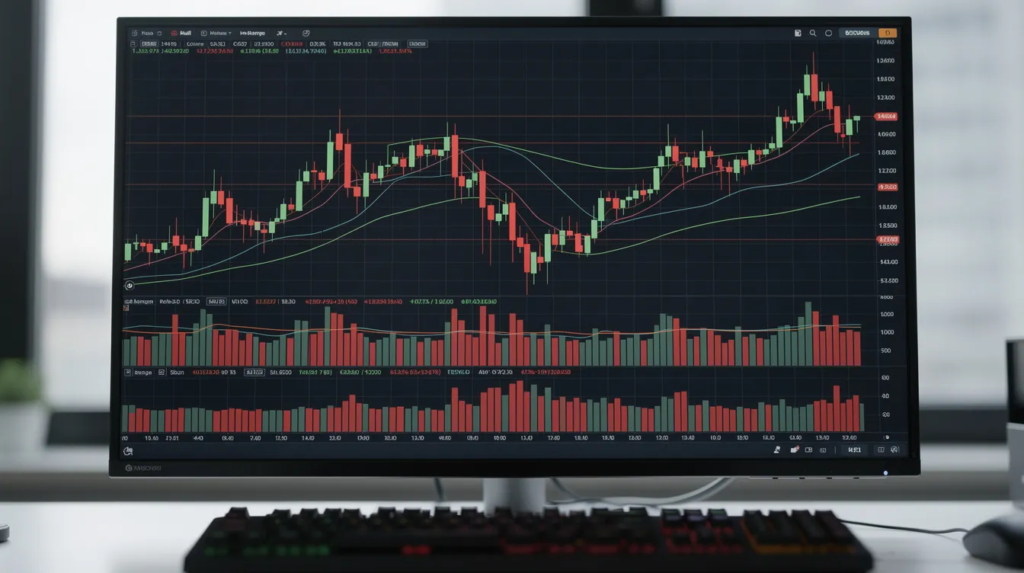
Candlestick patterns are a foundational technical analysis tool used by traders across financial markets. Each candlestick represents price information for a specific time period-whether one minute, one hour, or one day-capturing four data points: the opening price, the closing price, the high, and the low. Using candlestick patterns requires understanding their components: open, close, high, low. The body of a candlestick shows the strength of market movement during that session, while the wicks (or shadows) reveal the extremes that were tested and rejected.
Candlestick patterns originated in 18th-century Japan, where Munehisa Homma developed candlestick patterns for rice trading in Osaka’s commodity markets. The system remained largely unknown in the West until Steve Nison introduced candlestick patterns to the Western world through his 1991 book Japanese Candlestick Charting Techniques. Since then, candlestick charts have become a standard way to visualize daily price movements and market sentiment.
A candle pattern is a specific configuration of one or more candles that traders believe has predictive value. Candlestick patterns can indicate potential market reversals or continuations. The main categories include:
Single-candle patterns like the hammer candlestick pattern and the doji candlestick. Doji candlestick patterns represent market indecision, with opening and closing prices nearly identical and a very small body.
Multi-candle reversal patterns such as the morning star pattern, evening star pattern, bullish engulfing candlestick pattern, and bearish engulfing pattern.
Continuation candlestick patterns like rising three methods and falling three methods, which signal pauses within a larger trend.
These different candlestick patterns are applied across markets-stock market indices like the S&P 500, individual equities, forex pairs, and crypto-but their significance varies by asset class, liquidity, and volatility regime.

How Significant Are Candlestick Patterns in Practice?
Here is the direct answer: candlestick patterns provide a real but modest edge. They are more significant as a way to visualize order flow and market psychology than as mechanical “price will go here next” rules. Candlestick patterns can signal when a trend is losing momentum, but they rarely provide high-confidence directional calls on their own.
Research across multiple markets and decades tells a consistent story. A study covering the Taiwan stock market from 1992–2009 found that only four single-day patterns were profitable after transaction costs, and profitability improved when patterns were filtered by trend direction and moving averages. In China, a study on SSE50 index components (2000–2018) found that several bullish patterns produced statistically significant returns over 3- to 10-day holding periods, but bearish patterns were less consistent. Meanwhile, a study on Thailand’s SET50 (2006–2016) found that most patterns did not generate statistically significant mean returns, and filtering via RSI, stochastics, or MFI did not reliably help.
When transaction costs, slippage, and bid-ask spreads are included, the profitability of raw, pattern-only strategies often disappears or becomes marginal. This is especially true in highly efficient large-cap stocks where algorithmic trading has tightened spreads and accelerated price discovery.
Pattern significance tends to be higher when:
The pattern aligns with the higher-timeframe market trend
It appears at clear support or resistance on the candlestick chart
It is confirmed by volume or momentum technical indicators
Candlestick patterns are most effective when used alongside other technical indicators. In 2026 markets dominated by algorithmic and high-frequency trading, a recent study (Loubaris, 2026) confirms that pattern reliability deteriorates in volatile or crisis regimes, reinforcing the need to combine candlestick patterns with other tools rather than treating them as self-sufficient signals.
Reading Bullish vs Bearish Patterns: What Do They Actually Tell You?
The real significance of a candle pattern lies in how it captures the battle between buyers and sellers at a specific spot on the chart. A pattern indicates whether one side is gaining or losing control over a trading session-and that shift in dominance is what traders care about.
What Bullish Candlestick Patterns Indicate
Bullish candlestick patterns signal exhaustion of selling pressure and the emergence of demand. Bullish patterns can indicate potential buy signals. Common examples include:
Hammer candlestick: The hammer pattern indicates a potential bullish reversal after a downtrend. A long lower wick shows strong buying pressure rejected sellers at the lows.
Bullish engulfing: A bullish engulfing pattern indicates strong buying strength. It consists of a small bearish candle followed by a larger bullish candle whose body fully engulfs the prior one.
Morning star: The morning star pattern is a three candlestick pattern signaling a bullish reversal, moving from a bearish candle to indecision (small body) to a strong bullish candle.
Piercing line pattern: The piercing line pattern consists of a bearish candle followed by a bullish candle that closes above the midpoint of the first candle.
Three white soldiers: Three white soldiers is a strong bullish signal formed by three consecutive long green candles, signaling a strong bullish reversal.
What Bearish Candlestick Patterns Indicate
Bearish candlestick patterns indicate exhaustion of buying and a possible swing high. Bearish patterns can indicate potential sell signals. Key formations include:
Shooting star: A shooting star pattern forms at the top of an uptrend. Its long upper shadow shows that buyers pushed price higher during the session but failed to hold.
Hanging man: The hanging man pattern indicates a potential market reversal when it appears after a rally.
Bearish engulfing: Bearish engulfing patterns signal a peak in price movement, with the second bearish candle fully consuming the prior bullish candle.
Evening star: The evening star pattern indicates a reversal of an uptrend using a three-candle sequence.
Dark cloud cover: Dark cloud cover indicates a bearish reversal after an uptrend.
Three black crows: Three black crows consist of three consecutive long red candles, representing three consecutive bearish candlesticks that confirm strong selling pressure.
Candlestick patterns can indicate bullish or bearish market sentiment depending on their structure and location. They also help identify potential market reversals and can help identify market rejection when a price approaches a resistance level. For instance, a shooting star with a long upper shadow near a major resistance level directly shows that buyers tried to break through and were overwhelmed-giving that upper shadow real psychological weight.
When Are Candlestick Patterns Most (and Least) Reliable?
Context is what makes a candlestick pattern significant or just noise. Here are the main filters traders should apply:
More Reliable When:
Higher timeframes: Higher time frames yield more reliable candlestick patterns. Daily and 4-hour candlestick charts filter out noise, while 1- or 5-minute charts generate many false signals. The crypto markets study (2018–2022) showed hourly or daily data being far more stable than shorter intervals.
Trend alignment: A reversal pattern like the morning star or bearish engulfing is more significant after an extended trend. Continuation patterns like rising three methods work best within a clear, ongoing move in the overall market trend.
Key price structure: Patterns at major support or resistance, prior swing highs/lows, or key moving averages (50-day, 200-day) carry more weight. These levels concentrate stop orders and psychological attention.
Volume confirmation: Above-average volume on the reversal candle adds conviction. In the SSE50 study, combining trend plus overbought/oversold filtering improved detection of profitable bullish patterns.
Less Reliable When:
Pattern forms in the middle of a choppy range without clear trend context
Ultra-high market volatility (FOMC days, earnings releases, crisis periods) distorts candle shapes and increases false signals
Very short timeframes (1- or 5-minute) where noise dominates signal
Transaction costs and spreads are large relative to the expected move from the pattern signals
Spotlight on Two-Candle Reversal Patterns: Engulfing and Dark Cloud / Piercing
Engulfing-type patterns are among the most widely studied trading patterns in candlestick research because they directly show one side overwhelming the other within just two sessions.
A bullish engulfing pattern appears when a bearish candle is followed by a larger bullish candle whose body completely engulfs the prior candle’s body. This pattern signals a sharp shift from selling pressure to strong buying pressure. A bearish engulfing pattern is the inverse: a bullish candle followed by a bearish candle that envelopes the prior body, suggesting a bearish reversal is underway.
A study of S&P 500 data from 1950–2018 found that the bullish engulfing candlestick pattern showed statistically significant short-term returns when identified using open and low criteria, while the bearish engulfing performed best with open and high criteria. Using only the closing price weakened both signals, highlighting how pattern definition choices matter.
The piercing line pattern (bullish) and dark cloud cover (bearish) are “near-engulfing” formations. In the piercing line, the second candle opens below the first’s low and closes more than halfway up the first’s body-that midpoint is psychologically important because it represents the point where buyers reclaim majority control. Dark cloud cover is the bearish mirror image.
Forex traders adapt these chart patterns since true overnight gaps are rare in 24-hour markets. They rely on relative positioning of wicks and body midpoints rather than strict gap requirements.
A bullish engulfing at a major support level in the S&P 500-such as those that appeared near the late-2022 bear-market lows-carries far more weight than the same formation in the middle of a directionless range.
The Six Bearish Candlestick Patterns Traders Watch Closely
While there are dozens of bearish formations catalogued in candlestick literature, a small core set appears repeatedly in textbooks and empirical backtests-making them more significant for practical trading. Here are six bearish candlestick patterns that deserve the most attention:
Bearish engulfing: A large bearish candle fully consumes the prior bullish candle, showing sellers have taken control.
Evening star pattern: A three candlestick pattern where a large bullish candle is followed by a small-bodied candle (indecision), then a strong bearish candle that closes well into the first candle’s body.
Shooting star: A single candle with a small body near the low and a long upper shadow, forming at a potential top.
Hanging man: Similar shape to a hammer but appearing after an uptrend, warning that the market direction may be shifting.
Dark cloud cover: The second candle opens above the first’s high but closes well into its body, signaling the start of a bearish reversal pattern.
Three black crows pattern: Three consecutive bearish candlesticks-each opening within the prior candle’s body and closing near its low-demonstrate sustained strong selling pressure.
These six bullish candlestick patterns’ bearish counterparts are most closely watched when a market is extended to the upside-late-stage rallies in growth stocks, crypto run-ups, or overbought index readings. However, confirmation is essential. A lower close the next day, a break of short-term support, or an uptick in volume on the reversal candle all increase the probability that the pattern is calling a real shift rather than a temporary pause.
Continuation Candlestick Patterns: When “Rest” Matters More Than Reversal
Not all many candlestick patterns signal reversals. Some are continuation patterns that show pauses or consolidations before the prior market trend resumes. Recognizing these is critical because fading every stall in a strong trend-like the 2020–2021 bull market in tech stocks-would be extremely costly.
Key continuation formations include:
Doji and spinning tops candlestick pattern: These indecision candles (with a very small body) suggest neither buyers nor sellers won the session. In a trend, they often represent rest rather than reversal.
Rising three methods: A long bullish candle, followed by three small-bodied bearish or neutral candles (which stay within the first candle’s range), then another strong bullish candle. This pattern indicates the trend is simply pausing.
Falling three methods: The bearish equivalent-a large bearish candle, three small green candles within its range, then continuation downward with consecutive bearish candlesticks.
These continuation candlestick patterns are most useful when combined with moving averages or trendlines to decide whether to “buy the dip” or “sell the rally.” If price pulls back to the 20-day EMA and forms a bullish continuation pattern, the case for staying with the trend strengthens.
How to Combine Candlestick Patterns with Other Technical Tools
The real significance of candlestick pattern analysis emerges when you combine candlestick patterns with broader technical and quantitative context. Traders should confirm candlestick patterns with other technical indicators rather than relying on them in isolation.
Here is a practical playbook:
Moving averages for trend direction: Overlay a 20-day EMA (short-term trend), 50-day SMA, or 200-day SMA. Only take bullish candlestick patterns when the relevant moving average is rising, and bearish patterns when it is falling. The Taiwan market study found that filtering patterns by moving average direction significantly improved results.
Oscillators for condition filtering: Use RSI or stochastic indicators to filter signals. A bullish engulfing near oversold RSI levels (below 30) is far more significant than the same pattern at overbought readings. This layered approach helps interpret market sentiment more accurately.
Volume confirmation: A high-volume bullish candle at major support carries more weight than a low-volume version. Volume validates that real capital is behind the move, not just a few orders in a thin session.
Backtesting simple rules: Traders can backtest straightforward candlestick strategies-for example, only taking a morning star when the 50-day moving average is rising-to quantify whether combining patterns with trend filters improves their edge. Many common candlestick patterns that look profitable in raw form lose their edge without these filters.
Traders use candlestick patterns as a filter to avoid weak trades. The pattern itself is the starting point; the confirmation is what makes the trade.
Risk Management and Common Pitfalls of Candlestick Trading
Overconfidence in patterns is a major risk. Their moderate predictive power can be wiped out by poor position sizing and absence of stops.
Pattern overfitting: Traders often “see” patterns where none exist or treat every minor candle configuration on a 1-minute chart as significant. Past price movements on lower timeframes are noisy. Focus on clean, textbook-quality setups on daily or 4-hour timeframes.
Stop-loss discipline: Place stops beyond the pattern’s invalidation point-below the low of a hammer candlestick or bullish engulfing, above the high of a shooting star or bearish candle. Size positions so a single failed candle pattern does not cause outsized account damage.
Key rules of thumb:
Only trade patterns that appear at logical price structure (support, resistance, moving averages)
Risk no more than 1–2% of account equity on any single pattern-based trade
Accept that even the best reversal pattern has a failure rate of 30–50%
Avoid chasing every bullish candlestick pattern in sideways, choppy markets where trend reversal signals are unreliable
Psychological pitfalls also matter. Ignoring bigger fundamental news-earnings, rate decisions, macro data-that can overwhelm any technical signal is a common mistake. A perfect evening star means little if an FOMC announcement moves the market 3% the next morning.
Candlestick Patterns Across Markets and Volatility Regimes
While candlestick analysis originated in commodities, today it is applied across equities, forex, indices, and crypto-each with different trading hours and volatility profiles.
Forex: In 24-hour forex markets, price gaps are rare. This changes how patterns like the evening star or bearish engulfing are interpreted. Traders place more emphasis on wicks and relative body size than on true gaps between sessions.
Crypto: A study across approximately 400 cryptocurrencies (2018–2022) found that certain patterns-bullish harami, bearish harami, hanging man-produced statistically significant returns using hourly data. Interestingly, volume and volatility filtering did not materially change results, suggesting different dynamics than in equities.
High-volatility regimes: During events like the 2020 COVID crash or 2022 rate-hike cycle, market volatility creates more dramatic candles but also increases false breakouts, reducing the standalone significance of a single pattern. The Loubaris (2026) study documented that candlestick pattern reliability drops substantially during crisis periods.
Low-liquidity assets: In thinly traded small-cap stocks or low-liquidity crypto pairs, candlestick patterns may be distorted by sporadic large orders. Confirmation and wider stops become even more important.
Test your candlestick pattern analysis separately on each market type you trade. Six bullish candlestick patterns that work on daily S&P 500 charts may behave differently on 15-minute Bitcoin charts.

Conclusion: Where Candlestick Patterns Fit in a Modern Trading Plan
Candlestick patterns remain significant mainly as a visual language for supply and demand and as timing tools within a broader strategy. They help traders interpret market sentiment, spot potential trend reversal zones, and manage entries-but they are not a complete trading system. Candlestick patterns visualize daily price movements and market sentiment in a way that line charts simply cannot.
The strongest use case is combining candlestick chart signals with trend analysis, support and resistance, volume, and disciplined risk management. Whether you trade the stock market, forex, or crypto, the pattern is only as good as the context surrounding it.
In 2026, traders should view candlestick pattern analysis as one component among many-alongside macro context, fundamentals, and quantitative tools-rather than a standalone “secret” to consistent profits. Start by mastering 8–12 core patterns on daily charts, practice on historical data or demo accounts, and build rules around when those patterns matter most. The significance is real, but it requires discipline to extract.
FAQ
Are candlestick patterns still relevant in 2026 with algorithmic and high-frequency trading?
Yes, but with caveats. While algorithms dominate short-term price formation, many of them react to order flow that ultimately appears in candlestick charts. Patterns still capture real shifts in market direction. However, the edge from naive, pattern-only candlestick strategies has declined over the past two decades. Patterns remain most useful as a discretionary timing and risk-management tool on higher timeframes (daily, 4-hour), combined with structural factors like trend, macro news, and liquidity conditions.
Which candlestick pattern is considered the most significant for reversals?
No single pattern works best in all markets. Research and trader experience often highlight the bullish engulfing, bearish engulfing, hammer, shooting star, morning star, and evening star as among the most meaningful. An inverted hammer pattern and the piercing line pattern also rank highly in certain studies. Beginners should master these core formations rather than memorizing dozens of rare configurations, and focus on how they behave at key levels-support, resistance, and major moving averages.
Can I use candlestick patterns alone to trade intraday in the stock market?
It is technically possible but generally risky. Intraday noise and rapid price movement make many intraday candle patterns less reliable than they appear in hindsight. Intraday traders should pair patterns with order-book data, volume profile, or at least momentum indicators and clearly defined risk limits. Daily or 4-hour timeframes tend to show more significant, stable candlestick setups than 1-minute or 5-minute charts.
How many candlestick patterns do I really need to learn?
Learning 8–12 core patterns-a mix of six bullish candlestick patterns, six bearish candlestick patterns, and a few continuation formations-is usually enough for practical trading. High-impact patterns include the hammer, shooting star, doji, bullish and bearish engulfing, morning star, evening star, three white soldiers, and three black crows pattern. Invest deeper study into context and confirmation rather than expanding the pattern list indefinitely.
Do candlestick patterns work the same way on crypto and forex as on stocks?
The basic logic-buyers versus sellers-is the same, so patterns like bullish engulfing or doji can be meaningful on Bitcoin, EUR/USD, or major stock indices. However, 24/7 or near-24-hour trading in crypto and forex reduces classic price gaps, slightly changing how some star and gap-based patterns are evaluated. Backtest or paper-trade your candlestick pattern analysis in each asset class you use, since market volatility, liquidity, and trading hours all affect pattern significance.