
Day trading attracts thousands of new participants every year, drawn by the promise of quick profits and financial independence. The reality is far more nuanced. Most people who attempt day trading will not succeed, and those who do typically invest months of disciplined practice before seeing consistent results.
This guide walks you through every step of getting started – from understanding what day trading actually is, to choosing a market, building a strategy, and managing risk – so that you can make an informed decision about whether this path fits your life.
Key Takeaways
-
Day trading involves buying and selling securities within the same trading day to profit from small price movements. It is practiced most commonly in the stock market and through forex trading, and the risk of losing capital is substantial. Beginner traders should start with paper trading before risking real money.
-
New traders should pick one market (stocks or forex), choose one simple trading strategy with clear entry and exit points, and practice it across hundreds of simulated trades before going live. Jumping between strategies or markets is one of the fastest ways to drain an account.
-
Risk management matters more than finding the “perfect indicator.” Keep position sizes small (never risk more than 1% to 2% of your total account balance on a single trade), use strict stop-losses, and only trade with money you can afford to lose entirely.
-
In the U.S., the pattern day trader rule requires a minimum account balance of $25,000 in a margin account if you execute four or more day trades in a five business day period. A cash account has no minimum balance requirement for day trading but comes with other limitations.
-
Becoming a successful day trader usually takes 6 to 24 months of structured practice. If someone tells you otherwise, be skeptical.
What Is Day Trading?
Day trading is the practice of buying and selling the same financial instruments – such as stocks, ETFs, or forex pairs – within a single trading day to capture short term price movements. Positions are opened and closed on the same day, meaning nothing is held overnight.
Day trading is most common in stock and forex markets. Typical instruments include high-volume U.S. equities, major forex pairs like EUR/USD, and index CFDs. In all cases, the goal is the same: profit from intraday price action before the market session ends.
How does day trading differ from swing trading? Timeframe. A day trader holds positions for minutes to hours, closing everything by the end of the same trading day. A swing trader holds positions for days to weeks, accepting overnight and weekend risk in exchange for larger potential moves.
A day trader focuses on intraday trading – reading candlestick charts, using technical indicators like moving averages or RSI, and reacting to price movements in real time. Long-term fundamentals (earnings growth, valuations) are largely irrelevant to the intraday trading style.
Most brokers and regulators classify a “day trade” as opening and closing a position in the same security on the same calendar day.

How Does Day Trading Work in Practice?
A typical morning for an active day trader starts well before the market opens. You scan pre-market movers on the stock market or check which forex pairs are showing volatility during the London session overlap. You set price alerts, review an economic calendar for scheduled news events, and identify two or three setups that match your trading plan.
Day traders rely on real-time market data – Level 1 and Level 2 quotes, live charts, and volume indicators – to spot where liquidity and volatility are concentrated. Without fast, accurate data, you are trading blind.
The basic process looks like this:
-
Identify a setup that matches your predefined rules.
-
Place an order (limit or market) at your planned entry price.
-
Set a stop-loss and take-profit immediately after entry.
-
Manage the position – adjusting if price action warrants it.
-
Exit the trade the same day, win or lose.
Among popular day trading strategies, you will hear about momentum trading (riding strong directional moves), breakout trades (entering when price pushes through key levels), scalping (many rapid trades for tiny gains), and news trading (capitalizing on volatility from economic releases or earnings). Each has different demands on your time, speed, and temperament.
This guide focuses on discretionary beginner traders – people making their own trading decisions manually rather than running algorithmic systems.
Is Day Trading Right for You?
Before you open a trading account and start scanning charts, run a quick self-assessment:
-
Time: Can you dedicate 2 to 4 focused hours during a live market session, without interruptions from work or family?
-
Emotional resilience: Can you handle watching money disappear on a losing trade without panic-selling or revenge trading?
-
Financial cushion: Are you using only risk capital – money that would not affect rent, debt payments, or essential expenses if it were entirely lost?
Here is the uncomfortable truth: day trading is high risk, and the statistics are stark. Only about 10% to 15% of day traders are consistently profitable. Roughly 13% show profits over a six-month window, but long-term consistent profitability drops to approximately 1% over five years. Some studies suggest that approximately 97% of day traders lose money when all costs are factored in. Less than 10% of day traders are consistently profitable over time. Less than 15% of day traders profit long-term.
If you cannot monitor financial markets during trading hours, consider alternatives like swing trading (holding positions for days) or long-term index investing. Both require far less screen time.
Define your goals honestly. Are you building a skill over 12+ months, or do you need income replacement next month? If it is the latter, day trading is almost certainly the wrong vehicle. Day trading for beginners should be treated as a learning phase, not a money-making phase.
Only use your own money that you can genuinely afford to lose.
Step-by-Step: How Do I Start Day Trading?
This is the core roadmap. Follow it in order.

Step 1: Learn Market Basics
Before risking a single dollar, build a foundation. Understanding market mechanics is essential before risking real money in day trading. Learn how bid/ask spreads work, the difference between limit and market orders, what volatility means, and how trading sessions operate.
Decide whether to focus on stock trading or forex trading first. Picking one market lets you develop pattern recognition faster through repetition.
Step 2: Choose One Simple Trading Strategy
Pick one beginner-friendly strategy – a momentum breakout, a pullback setup, or a simple trend-following approach – and define its rules precisely:
-
Entry criteria (what must happen before you buy or sell)
-
Stop-loss placement (where you exit if wrong)
-
Take-profit target (where you exit if right)
Write these rules down. Vague ideas like “buy when it looks strong” are not a trading strategy. Specific rules like “enter long when price breaks above the 15-minute high on volume 2x the average, stop below the breakout candle, target 2:1 reward-to-risk” are.
Step 3: Select a Regulated Broker and Trading Platform
Choose a broker regulated by a recognized authority (like the Financial Industry Regulatory Authority in the U.S. or the FCA in the UK) that offers:
-
Demo or paper trading capability
-
Real-time market data and charting
-
Low commissions and transparent fee structure
-
Fast, reliable order execution
Your trading platform is your primary tool. Make sure you are comfortable with its interface before trading live.
Step 4: Practice with Paper Trading
Traders should practice in a simulator before using real money. Spend at least 2 to 3 months – or a minimum of 100 to 200 simulated trades – executing your strategy in a paper trading environment with live or near-live data. Track every trade. This is where you build muscle memory and discover whether your strategy actually has an edge after costs.
Step 5: Go Live with Small Risk
Once paper trading results show consistency, open a small live account. Risk 0.5% to 1% of your equity per trade. Increase buying power and position size only after months of demonstrated consistency.
You must secure adequate capital to start day trading. But “adequate” depends on your market and strategy – it does not always mean $25,000.
Each step should include a written checklist. Build a simple daily routine: pre-market prep, trade execution, and a post-market review.
Choosing Your Market: Stocks vs. Forex vs. Other Assets
Picking one primary market speeds up your learning through focused repetition. Here is a quick comparison:
|
Factor |
U.S. Stocks |
Forex |
Futures / Crypto |
|---|---|---|---|
|
Hours |
9:30 a.m.–4:00 p.m. ET |
24/5 (Sun evening–Fri evening) |
Varies; crypto is 24/7 |
|
Minimum position |
1 share |
Micro lot (1,000 units) |
1 contract |
|
Leverage |
Up to 4:1 intraday (margin) |
Often 50:1 or higher |
High, varies |
|
Key regulation |
PDT rule (U.S.) |
Broker-dependent |
Less regulated (crypto) |
For the stock market, activity concentrates in the first and last hours of each market session. High-volume, news-driven stocks tend to offer the best intraday trading opportunities.
For forex trading, major liquidity occurs during the London and New York session overlap. Lot sizes (standard, mini, micro) let you scale position size precisely, which can benefit day traders with smaller accounts.
Index futures and crypto are also viable intraday markets, but beginners should stick with one core market first. Choose based on your schedule, account size, and preferred market volatility. Note that the pattern day trader rule primarily affects U.S. stock traders using margin accounts.
Understanding Accounts, Capital, and Buying Power
Capital size and account type directly affect both your risk management options and your regulatory obligations.
Cash Account
A cash account has no minimum balance requirement for day trading. You trade with settled funds only – no borrowing, no short selling securities. In U.S. stocks, trades typically settle on T+1, meaning the cash from a sale is not available to re-use until the next business day. This limits how many round-trip trades you can make on the same day.
Margin Account
A margin account lets you borrow from your broker, access short selling, and use significantly more buying power – often up to four times your excess equity for intraday stock trading. Day traders using margin can access up to four times their excess equity, meaning a $25,000 account could control up to $100,000 in intraday positions.
This amplifies both gains and losses proportionally. A 1% move against you on $100,000 of stock is a $1,000 loss – 4% of your actual equity.
The Pattern Day Trader Rule
Day traders must adhere to the Pattern Day Trader Rule set by FINRA. Here is how it works:
-
If you make four or more day trades within a five business day period in a margin account, your broker classifies you as a pattern day trader.
-
Pattern day traders must maintain a minimum account balance of $25,000.
-
Day traders can only trade in margin accounts if classified as pattern day traders (with the associated minimum).
-
Falling below $25,000 can result in restrictions until you deposit additional funds.
Day trading requires a minimum account balance of $25,000 for pattern traders.
Note: As of June 2026, FINRA has adopted new intraday margin standards that will eventually replace the traditional PDT framework. During the transition period (through October 2027), your broker may still enforce old PDT rules. Check with your broker for current requirements.
Practical Guidance for Beginners
-
Learning phase: $1,000–$5,000 in a cash account is sufficient for small-scale stock trading or micro-lot forex trading.
-
Unrestricted U.S. stock day trading: You will need $25,000 or more in a margin account to avoid PDT restrictions.
-
No matter the account size, a minimum account balance should cover enough trades to be statistically meaningful while following your risk rules.
Core Day Trading Concepts and Tools
Think of this as your toolbox. You do not need everything on day one, but you should understand what is available.
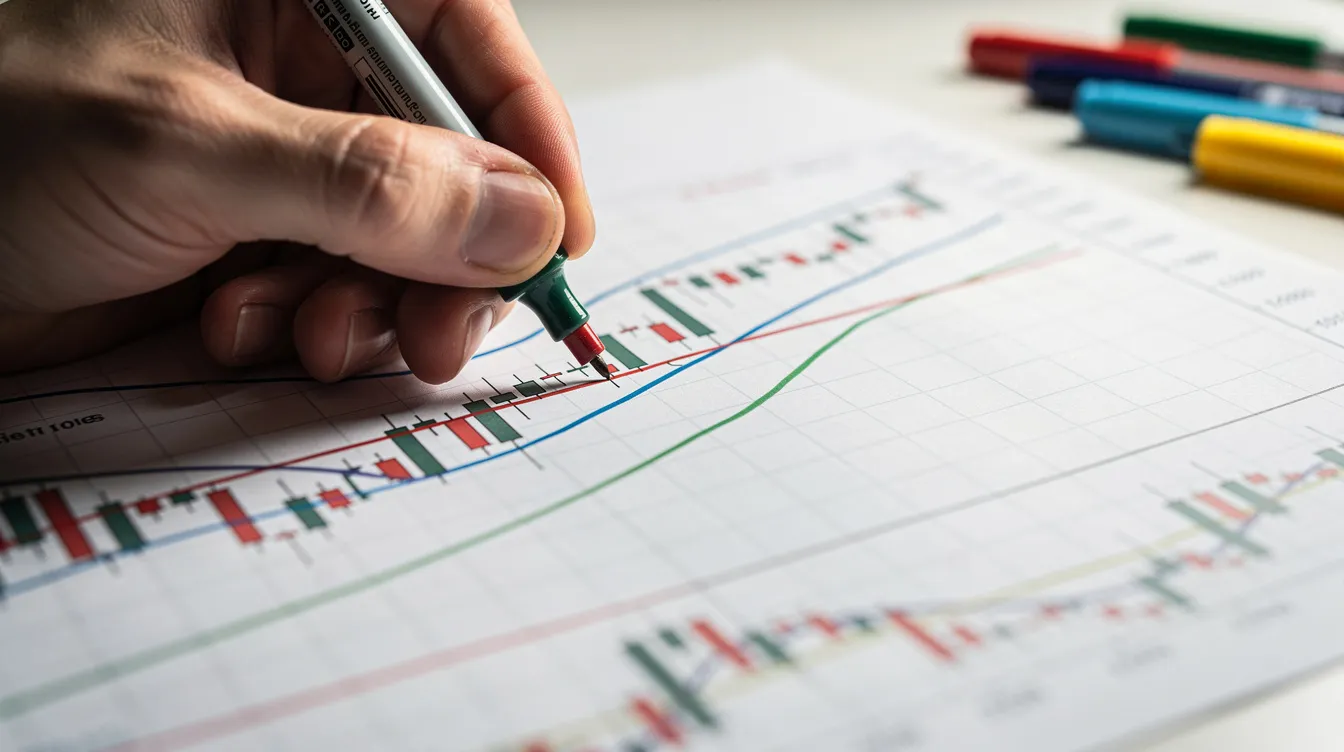
Charts: Candlestick charts are the default for most day traders. Each candle shows the open, high, low, and close for a given time frame (1-minute, 5-minute, 15-minute). Traders often combine a faster chart (1-minute) with a slower one (15-minute) to see both detail and context.
Technical Indicators: Day trading requires a solid understanding of technical analysis. Common indicators include:
-
Moving averages (simple or exponential)
-
RSI (Relative Strength Index)
-
MACD
-
VWAP (Volume-Weighted Average Price)
Day traders often use technical analysis to make trading decisions, but beginners should pick only one or two indicators to avoid clutter.
Platform Features: Look for fast order entry, watchlists, alerts, and integrated news or economic calendars. Some platforms offer hotkeys for rapid execution – useful for scalping but not essential initially.
Market Data Feeds: Real-time data often requires paid subscriptions, especially for full-depth stock data. Budget $50 to $200 per month for quality Level 2 data if trading U.S. equities.
Beginner-Friendly Day Trading Strategies
Master one simple trading strategy before adding complexity. Here are two accessible setups that many successful day traders use as starting points.
Momentum Breakout Strategy
Momentum trading is one of the most popular day trading strategies. The idea: identify a stock or forex pair making new intraday highs on strong volume, then enter when price breaks through a defined resistance level.
Example setup:
-
Stock XYZ consolidates at $48.00 after a strong gap up.
-
Volume surges and price breaks above $48.00.
-
Enter at $48.10. Set stop-loss at $47.90 (risking $0.20 per share).
-
Target $48.50 (rewarding $0.40 per share – a 2:1 reward-to-risk ratio).
-
On 100 shares, you risk $20 to target $40.
Pullback-in-Trend Setup
Trade in the direction of the prevailing market trend. Wait for price to pull back to a moving average or prior support level, then enter on a confirmation candle showing the trend is resuming.
This approach often provides tighter stops and better reward-to-risk ratios than chasing breakouts, but requires patience to wait for the pullback.
Trend following strategies involve trading in the direction of market trends – you are not trying to predict reversals, you are joining moves already underway.
Other Strategies Worth Knowing
-
Scalping involves making numerous small trades for tiny profits – often holding positions for seconds to minutes.
-
News trading capitalizes on significant news events causing price volatility, like earnings announcements or economic data releases.
-
Range trading works when price oscillates between defined support and resistance levels in a sideways market.
-
Spread trading involves taking offsetting positions in related instruments to capture price differentials.
-
Arbitrage exploits price discrepancies between different markets, though this typically requires sophisticated tools and speed.
The goal is not to learn every strategy. It is to pick one, define its rules, and execute it consistently across hundreds of trades.
Risk Management 101 for New Day Traders
Protecting your trading capital is more important than chasing large wins, especially during your first year. Success in day trading requires discipline, a technical foundation, and risk management – and risk management arguably matters most.
The 1% Rule
Never risk more than 1% to 2% of your total account balance on a single trade. Successful day traders often risk only 1% to 2% of their capital per trade.
Example: With a $2,000 account, your maximum risk per trade is $20 (at 1%). If your stop-loss distance is $0.20 per share, your maximum position size is 100 shares.
Stop-Loss Orders
Always set automated stop-loss orders to exit a position if the market moves against you. Place stops based on the chart – support and resistance levels, recent swing lows – not arbitrary dollar amounts.
Daily Loss Limits
Set a daily maximum loss (e.g., 2 to 3% of your account). Once hit, stop trading for the day. This single rule prevents the emotional spiral of revenge trading that has destroyed countless accounts.
Common Risk Mistakes
-
Over-leveraging: Using maximum buying power on every trade.
-
Revenge trading: Immediately entering new trades after a loss to “make it back.”
-
Holding losers: Refusing to take a stop-loss in hope that price will reverse.
-
Poor risk management is one of the primary reasons day traders lose money.
Successful day traders focus on minimizing losses as much as maximizing profits. The math is simple: if you lose 50% of your account, you need a 100% return just to break even.
Paper Trading and Building Your First Trading Plan
Paper trading is simulated trading with virtual funds using live or delayed market data. It lets you test strategies, build execution habits, and learn your trading platform’s interface without risking a dollar.
How Long to Paper Trade
Commit to a minimum of 2 to 3 months or 100 to 200 completed trades, whichever comes later. This gives you a statistically meaningful sample to evaluate.
Your First Trading Plan
A simple written trading plan should include:
-
Market: U.S. stocks, EUR/USD, or another specific instrument
-
Trading hours: e.g., 9:30–11:30 a.m. ET only
-
Strategy rules: Exact entry, stop-loss, and take-profit criteria
-
Risk per trade: 1% of account equity
-
Daily loss limit: 2–3% of account equity
-
Maximum trades per day: e.g., 3–5
Journaling
Keep a meticulous journal logging every trade to track performance and emotional state. Record the date, instrument, entry price, exit price, whether you followed your rules, and how you felt before, during, and after the trade.
Review your journal weekly. Drop setups that consistently underperform. Double down on patterns where you execute well and the edge holds.
Developing the Skills of a Successful Day Trader
Successful day trading rests on three skill categories:
-
Technical skills: Reading charts, recognizing patterns, interpreting volume and technical indicators.
-
Risk skills: Position sizing, stop placement, capital preservation.
-
Psychological skills: Emotional control, patience, and discipline under pressure.
Consistent execution of a trading strategy across hundreds of trades matters far more than any single “big win.” Experienced traders know that past performance on one trade tells you almost nothing – it is the aggregate result over hundreds of trades that reveals whether you have an edge.
Building Discipline
-
Pre-market checklist: Scan for setups, review the economic calendar, define your plan.
-
During trading: No impulsive entries. If a setup does not match your rules, do not take it.
-
Post-session review: What went right? What went wrong? Did you follow the plan?
Emotions such as fear and greed are leading causes of failure in day trading. FOMO (fear of missing out) pushes traders into positions they should skip. Cutting winners too early locks in small gains while letting losers run. These are not character flaws – they are skills to train over time through structured practice.
Emotional trading and emotional decision-making can lead to significant losses if left unchecked.
Common Mistakes Beginner Traders Should Avoid
Here are the pitfalls that consistently drain new traders’ accounts:
-
Trading without a written plan. If your rules are not written down, you do not have a plan – you have a wish.
-
Risking too much per trade. Betting 5 to 10% of your account on one idea is gambling, not trading.
-
Jumping between strategies daily. Every strategy has losing streaks. Abandoning one after three losses means you never collect enough data to know if it works.
-
Ignoring fees and spreads. Day traders often face high transaction costs. A scalper doing 8+ trades per day can see 40 to 80% of gross profits consumed by commissions and spreads. High transaction costs are a silent killer.
-
Over-reliance on technical indicators without understanding price action or broader market dynamics.
-
Copying trades from social media without knowing the underlying investment strategy or risk parameters. What works for a professional trader with $500,000 in capital may be catastrophic for you with $2,000.
-
Overtrading out of boredom or after losses. Set a maximum number of trades per session and respect it.
Treat every loss as feedback for improving your process, not a reason to overhaul your entire system overnight.
Day Trading vs. Other Trading and Investing Styles
Not everyone who starts exploring day trading ends up staying. Here is how the major styles compare:
|
Factor |
Day Trading |
Swing Trading |
Long-Term Investing |
|---|---|---|---|
|
Holding period |
Minutes to hours (same day) |
Days to weeks |
Months to years |
|
Trades per week |
5–50+ |
2–10 |
0–2 |
|
Screen time |
2–6 hours daily |
30–60 min daily |
Minimal |
|
Risk profile |
High (leverage, speed) |
Moderate |
Lower (diversified) |
|
Capital needs |
Varies ($500–$25,000+) |
Moderate |
Any amount |
|
Best for |
Full-time focus, quick decisions |
Part-time traders |
Passive wealth building |
Many retail traders start with day trading aspirations but discover that a longer-term trading style – like swing trading – fits their personality and schedule better. That is not failure; that is self-awareness.
Long-term investing focuses on fundamentals, broad diversification, and time horizons of years, often using index funds. Professional traders and financial advisors frequently recommend this as the core of any investment strategy, with day trading as a small allocation of risk capital at most.
Revisit this comparison after a few months of experience and adjust your approach if needed.
How Long Does It Take to Learn Day Trading?
Set realistic expectations. Becoming consistently profitable at day trading typically takes 6 to 24 months of serious, structured practice.
Rough timeline:
-
Months 1–3: Learn basics, set up your trading platform, begin paper trading. Focus on understanding market mechanics and your chosen strategy.
-
Months 4–9: Refine one strategy through hundreds of simulated trades. Start tracking detailed process metrics.
-
Months 9–12+: Transition to small live trading. Improve consistency and emotional control under real market risk.
Progress is not linear. There will be drawdowns and plateaus even as skills improve. Measure progress by process metrics – rule adherence, quality of setups taken, consistency of execution – not short-term day trading profits alone.
According to BrokerChooser’s analysis of over 1,000 trader profiles, median profit per trade is often negative until a trader has completed roughly 5,000 trades. More than 75% of day traders quit within two years.
Some aspiring traders ultimately decide the psychological and time demands of day trading do not fit their life. That is a valid and even wise outcome. The risks involved are real, and not everyone’s risk tolerance is suited to this activity.
Conclusion: A Safer Way to Start Day Trading
The path is straightforward, even if execution is hard: learn the basics, pick one market and one strategy, use paper trading extensively, and only then move to small live risk.
Is day trading profitable? It can be – but only for those who treat it as a skill-based craft rather than a lottery ticket. Successful traders win through disciplined execution, sound risk management, and continuous review – not through prediction “accuracy” or finding a magic indicator.
Commit to a realistic learning horizon. Understand market risk. Manage risk with precision and protect your capital above all else during the learning phase.
Your next concrete step: Choose your market today. Draft a one-page trading plan this week. Open a demo account and place your first simulated trade before the weekend. That is how you identify potential trading opportunities and start building real skill – one trade at a time.

Frequently Asked Questions
Can I start day trading with $100 or $500?
It is technically possible to start with $100 to $500, especially in forex trading with micro lots or fractional-share stock trading. However, if you follow proper risk rules (risking 1% per trade), your position sizes will be tiny – risking $1 to $5 per trade.
Treat accounts this small as training tools, not income sources. The goal is skill development. U.S. stock traders with less than $25,000 will need to use a cash account or limit their trade frequency to avoid pattern day trader restrictions in a margin account.
Is day trading illegal with small accounts? No. Day trading is legal at any account size. The restrictions are about margin use and trade frequency, not legality.
Do I need formal education or a finance degree to be a day trader?
No formal degree is required. Many successful day traders are self-taught through books, online courses, and thousands of hours of practice. Structured education – whether self-directed or through reputable training programs – can shorten the learning curve significantly.
Be cautious of “get-rich-quick” day trading programs. Favor resources that stress risk management, realistic expectations, and process-based learning over flashy profit screenshots. Financial advisors can also help you understand whether day trading fits your overall financial picture.
What time of day is best for day trading?
For U.S. stocks, the most active periods during a trading day are the first hour after the open (9:30 to 10:30 a.m. ET) and the final hour before the close (3:00 to 4:00 p.m. ET). These windows typically offer the most volume, volatility, and opportunity to identify potential trading opportunities.
For forex trading, major liquidity and short term market fluctuations often peak during the London and New York session overlap (roughly 8:00 a.m. to 12:00 p.m. ET).
Beginners should focus on one or two specific windows each day to develop a consistent routine rather than staring at charts for eight hours.
Is day trading safer if I use no leverage?
Avoiding leverage – trading only with your own capital in a cash account – does reduce risk per trade. You cannot lose more than you put in. But it does not eliminate the possibility of significant losses.
Even without leverage, poor risk management, overtrading, or emotional decisions can quickly damage a small account. Combine low or no leverage with strict risk limits and a clear trading plan for the safest approach.
How do taxes work for day traders?
Tax treatment of day trading profits varies by country and sometimes by account type. In the U.S., short-term capital gains (from positions held less than a year) are taxed at your ordinary income rate, and frequent traders may qualify for special “trader tax status” with additional deductions and obligations.
Keep detailed trade records throughout the year. Consult a qualified tax professional familiar with active trading in your jurisdiction – the reporting obligations for frequent buying and selling securities can become complex quickly.