

The world of digital finance moves at a lightning pace. For many investors, the constant price swings feel like a chaotic storm. However, those who learn how to read crypto charts gain a clear lens to view market trends with precision.
Mastering this skill is not about predicting the future with absolute certainty. Instead, it is about identifying high-probability setups based on historical price action. By studying past movements, investors can navigate volatile markets with newfound confidence.
Engaging in Crypto technical analysis serves as a foundational pillar for any serious portfolio manager. It transforms raw data into actionable insights, allowing individuals to make informed decisions rather than emotional guesses. When you understand the story behind the candles, you take control of your financial journey.
Understanding the Basics of Technical Analysis
Technical analysis serves as the compass for navigating the volatile landscape of digital assets. By examining historical market data, traders can identify patterns that often repeat over time. This systematic approach transforms raw numbers into actionable insights for every investor.
What is Technical Analysis?
At its core, crypto technical analysis is the study of past market data to forecast future price movements. It focuses primarily on two key metrics: price action and trading volume. By analyzing these elements, traders attempt to understand the collective psychology of the market participants.
This method assumes that all known information is already reflected in the current price of an asset. Therefore, the focus shifts from fundamental value to the visual representation of supply and demand. It is a powerful tool for those who wish to decode the rhythm of the markets.
Importance of Technical Analysis in Crypto Trading
Relying on intuition or speculative guessing is a dangerous path for any trader. Crypto technical analysis provides a structured framework that removes emotional bias from the decision-making process. It allows individuals to enter and exit positions based on objective signals rather than fear or greed.
When traders master these basics, they gain the ability to spot potential reversals and trend continuations. This discipline is essential for anyone looking to achieve long-term consistency in the fast-paced world of digital finance. It turns the chaotic nature of price charts into a readable map of opportunities.
Key Terminology to Know
Building a strong vocabulary is the first step toward becoming a proficient analyst. Understanding these core concepts will help you interpret complex market signals with greater clarity and precision.
By internalizing these terms, you prepare yourself to dive deeper into advanced strategies. Crypto technical analysis is a journey of continuous learning, and these foundational concepts are the building blocks of your future success.
Different Types of Crypto Charts
Choosing the correct chart type can transform raw numbers into actionable insights. When learning how to read crypto charts, traders must first understand that different visual formats highlight unique aspects of market behavior. Selecting the right tool allows an investor to filter out noise and focus on what truly matters for their specific strategy.
Line Charts
Line charts represent the most basic form of price visualization. They connect a series of data points, typically closing prices, with a single continuous line. This simplicity makes them perfect for identifying long-term trends without the distraction of minor price fluctuations.
Bar Charts
Bar charts offer a significant step up in complexity by providing more granular data. Each bar displays the Open, High, Low, and Close (OHLC) prices for a specific time period. By observing these bars, a trader can quickly gauge the volatility and range of an asset during a set interval.
Candlestick Charts
Candlestick charts serve as the industry standard for professional traders worldwide. They provide a rich visual representation of price action, showing the relationship between opening and closing prices through colored bodies. Learning how to read crypto charts using this format is essential because it reveals market sentiment at a single glance.
Open your trading chart now and practice spotting patterns in real time.
Ultimately, the best chart type depends on your analytical goals. While beginners might prefer the clarity of a line chart, those seeking to master how to read crypto charts will find that candlesticks offer the most comprehensive view of market dynamics. Experimenting with these formats will help you find the style that best aligns with your personal trading journey.
Reading Candlestick Patterns
Every price movement tells a story, and these visual cues are the key to unlocking that narrative. By observing the relationship between the open, high, low, and close prices, traders can visualize the ongoing battle between buyers and sellers. Mastering candlestick patterns allows one to see the heartbeat of the market in real-time.
Basic Candlestick Patterns
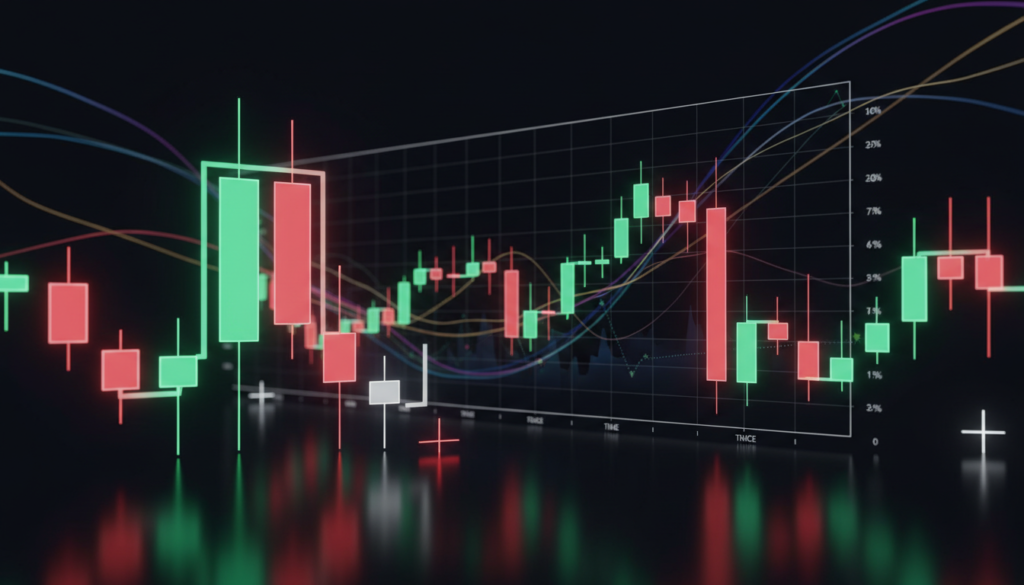
Simple formations often provide the clearest signals for potential price shifts. A Doji, for instance, appears when the open and close are nearly identical, signaling market indecision. Meanwhile, a Hammer pattern suggests that sellers pushed the price down, but buyers regained control by the end of the session.
Traders frequently look for the Engulfing pattern to spot momentum shifts. When a large candle completely covers the previous one, it often indicates a strong change in direction. These candlestick patterns serve as the building blocks for more complex technical analysis.
Advanced Candlestick Patterns
Once the basics are understood, more complex formations offer deeper insights into trend strength. The Three White Soldiers pattern consists of three consecutive long green candles, signaling a powerful bullish reversal. Conversely, the Evening Star acts as a warning sign that an uptrend may be losing its steam.
These advanced candlestick patterns require patience and confirmation from other indicators. Relying on a single formation is rarely enough to guarantee success in volatile crypto markets. Instead, smart traders look for these shapes to align with broader market trends.
Interpreting Market Sentiment
At its core, every chart is a reflection of human emotion. High volatility often manifests as long wicks, representing fear or extreme greed among participants. By analyzing candlestick patterns, you can identify the psychological state of the crowd at any given moment.
Understanding these signals helps traders remain calm when the market becomes irrational. Consistency is the ultimate goal for anyone looking to navigate the digital asset space effectively. By studying these candlestick patterns, you gain the confidence to make informed decisions regardless of market noise.
Support and Resistance Levels Explained
Mastering the art of reading price charts begins with understanding the invisible boundaries known as support and resistance. These zones act as the floor and ceiling for any digital asset’s price movement. By observing historical data, traders can pinpoint where market sentiment shifts, often confirmed by specific candlestick patterns.
Identifying Support Levels
A support level represents a price point where a downtrend tends to pause due to a concentration of demand. When the price drops to this area, buyers often step in, viewing the asset as a bargain. This increased buying pressure prevents the price from falling further, creating a reliable floor.
Recognizing Resistance Levels
Conversely, a resistance level acts as a ceiling where an uptrend struggles to break through. At this stage, selling pressure intensifies as traders look to take profits or exit positions. This psychological barrier often forces the price to retreat, marking a critical turning point in the market.
Significance of Price Ranges
Understanding these zones is vital for setting entry and exit points that align with established market boundaries. When combined with candlestick patterns, these levels provide a clearer picture of potential breakouts or reversals. Traders who respect these ranges avoid the common mistake of chasing prices at unfavorable levels.
Utilizing Trend Lines in Crypto Analysis
Trend lines serve as the backbone of effective crypto chart analysis, guiding traders through volatile markets with clarity and confidence. By connecting key price points, these lines reveal the underlying momentum of an asset. They transform chaotic price action into a clear visual narrative that helps investors make better decisions.
Drawing Trend Lines
To draw a reliable trend line, a trader must connect at least two major points on a price chart. For an uptrend, connect the rising lows, while for a downtrend, connect the falling highs. Precision is vital, as accurate lines provide a stronger foundation for your crypto chart analysis.
Master technical analysis and never trade blindly again.
Always ensure your lines do not cut through the body of the candlesticks. Instead, aim to touch the wicks to capture the true range of market sentiment. This simple practice creates a more authentic representation of price behavior over time.
Types of Trends: Upward, Downward, and Sideways
Markets generally move in three distinct directions, each requiring a unique approach to crypto chart analysis. Recognizing these patterns early allows a trader to align their strategy with the current market flow.
An upward trend shows growing demand, while a downward trend signals selling pressure. When the price moves sideways, it indicates a period of market consolidation. Understanding these phases is essential for maintaining a disciplined trading mindset.
Importance of Trend Reversals
Recognizing a trend reversal is often the difference between a profitable trade and a significant loss. When a price breaks through a well-established trend line, it often signals that the prevailing momentum is shifting. This moment serves as a critical alert for any serious practitioner of crypto chart analysis.
Traders should watch for increased volume during a breakout to confirm the reversal’s strength. By staying vigilant and adaptable, you can protect your capital while positioning yourself for new opportunities. Mastering these shifts empowers you to navigate the digital asset space with unwavering focus.
Key Indicators and Tools for Analysis
Mastering the art of crypto chart analysis requires more than just intuition; it demands the right set of mathematical tools. By utilizing specialized trading indicators, investors can effectively filter out market noise and uncover hidden opportunities. These instruments provide a clearer perspective on price action, allowing traders to move beyond guesswork and rely on data-driven insights.
Beyond the primary tools, many professionals also incorporate the MACD to gauge momentum shifts. This indicator acts as a powerful companion to other metrics, helping to confirm whether a trend has the strength to continue or if a reversal is imminent. Integrating these resources into your strategy is a transformative step toward becoming a more disciplined market participant.
Moving Averages
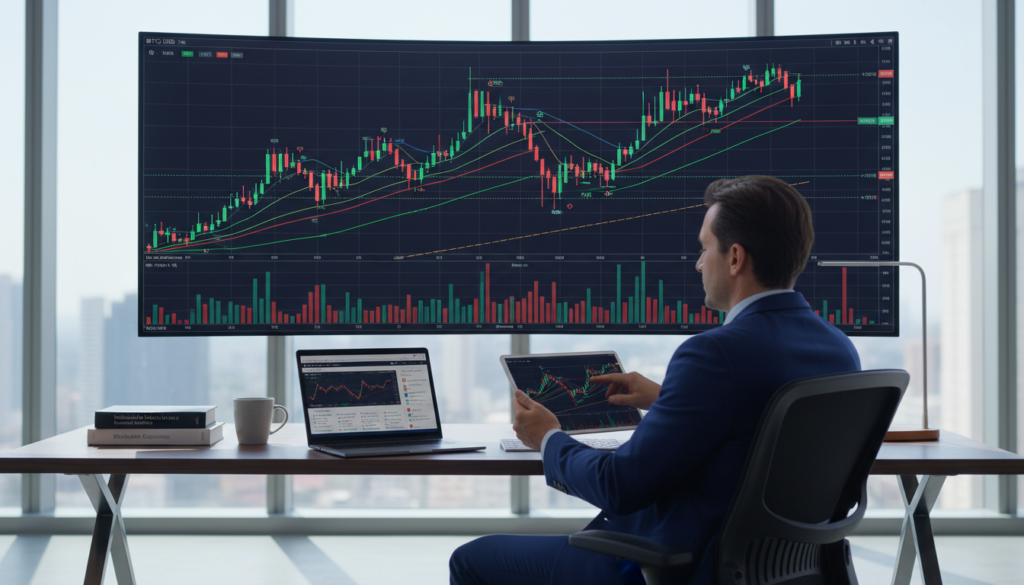
Moving Averages serve as the foundation for trend smoothing in any technical strategy. By calculating the average price over a specific period, these lines help remove the erratic spikes that often distract from the broader market direction. Identifying the trend becomes significantly easier when you can visualize the smoothed path of an asset’s price.
Traders often use a combination of short-term and long-term averages to spot potential entry or exit points. When a shorter-term average crosses above a longer-term one, it is often viewed as a bullish signal. Conversely, a downward cross suggests that the momentum may be shifting in favor of the bears.
Relative Strength Index (RSI)
The RSI is an essential tool for measuring the speed and change of price movements. It oscillates between zero and 100, providing a quick snapshot of whether an asset is currently overbought or oversold. When the index climbs above 70, it often indicates that the asset is overextended and might be due for a correction.
On the other hand, an index reading below 30 suggests that the asset may be undervalued. Savvy traders watch these levels closely to anticipate potential turning points in the market. Using this indicator helps you avoid buying at the top or selling at the bottom of a cycle.
Bollinger Bands
Bollinger Bands offer a unique way to assess market volatility and identify potential breakouts. These bands consist of a middle moving average and two outer lines that expand or contract based on price fluctuations. When the bands tighten, it indicates a period of low volatility, which is often followed by a significant price move.
When the price touches the upper band, it may signal that the asset is reaching a resistance level. If the price hits the lower band, it could indicate that the asset is finding support. Understanding how to read these bands allows you to adapt your strategy to the ever-changing rhythm of the crypto market.
Volume Analysis in Crypto Trading
If price is the direction of the market, volume is the engine that determines how far that price can travel. Many traders focus solely on price action, but volume analysis provides the necessary context to validate market moves. By observing the amount of activity behind a price change, a trader can better assess the sustainability of a trend.
Understanding Trading Volume
Trading volume represents the total number of units of a cryptocurrency that have changed hands during a specific period. It serves as a primary metric for measuring the intensity of market participation. When volume is high, it indicates that a large number of buyers and sellers are actively engaged in the asset.
Conversely, low volume suggests that market participants are hesitant or uninterested. Without significant volume, price movements often lack the momentum required to sustain a long-term trend. Experienced traders use these metrics as essential trading indicators to gauge the health of the market.
Volume Trends and Price Movements
The relationship between volume and price is a cornerstone of technical analysis. When a price breakout occurs on high volume, it signals strong conviction from the market participants. This suggests that the move is likely to continue rather than reverse quickly.
If a price increases while volume remains low, it often indicates a lack of buying pressure. Such scenarios frequently lead to a “fake-out,” where the price eventually retreats to previous levels. Recognizing these patterns helps traders avoid entering positions during weak market movements.
Volume Indicators to Watch
To effectively track these shifts, traders rely on specific trading indicators designed to visualize volume data. These tools help filter out market noise and highlight significant changes in momentum. Integrating these into your strategy can significantly improve your decision-making process.
Start analyzing your next trade with confidence today.
By mastering these trading indicators, you gain a clearer picture of market sentiment. Always remember that volume confirms the price, and price confirms the trend. Using these tools in harmony will help you build a more resilient and profitable trading strategy.
The Role of Time Frames in Analysis
Selecting the right time frame is the secret to unlocking clarity in volatile crypto markets. Every chart tells a story, but the duration of that story changes based on the interval selected. Traders must align their analytical tools with their personal goals to avoid getting lost in the noise of rapid price fluctuations.
By mastering the relationship between time and price, investors can gain a competitive edge. This process allows them to filter out irrelevant data and focus on the trends that truly matter to their specific strategy.
Choosing the Right Time Frame
The choice of a time frame should reflect a trader’s unique personality and risk tolerance. A day trader might thrive on one-minute or five-minute charts, where quick decisions are essential for capturing small price movements. Conversely, a long-term investor often ignores these micro-trends in favor of daily or weekly views.
Consistency is key when selecting your primary window of observation. If a trader constantly switches between intervals without a clear plan, they risk becoming overwhelmed by conflicting signals. It is better to specialize in one or two time frames that align with your lifestyle and capital requirements.
Long-Term vs. Short-Term Analysis
Short-term analysis is often characterized by high volatility and significant market noise. While these charts offer frequent trading opportunities, they also require intense focus and rapid execution. Long-term analysis, by contrast, provides a broader perspective that smooths out temporary price spikes.
The following table highlights the fundamental differences between these two approaches to market observation:
Impact of Time Frames on Decision-Making
Understanding multi-timeframe analysis is a transformative skill for any serious participant in the crypto space. By checking a higher time frame before entering a trade on a lower one, a trader can ensure they are moving with the broader market trend. This top-down approach significantly reduces the likelihood of making impulsive decisions based on isolated, noisy data.
Ultimately, the time frame acts as a filter for your trading logic. When you align your entry points with the dominant trend of a larger time frame, you increase the probability of success. Patience and discipline in selecting your view will always serve you better than reacting to every minor tick on a short-term chart.
Risk Management Strategies
Protecting your portfolio is the single most important habit for long-term success in the volatile digital asset market. While technical analysis helps identify potential opportunities, it cannot predict every market shift. A robust framework ensures that you remain in the game even when trades do not go as planned.
Setting Stop-Loss Orders
A stop-loss order acts as an essential safety net for your capital. By pre-defining the price at which you will exit a losing trade, you remove the emotional burden of decision-making during high-volatility events. This simple tool effectively limits your downside exposure and prevents small losses from turning into catastrophic account drains.
Traders often place these orders just below key support levels identified through their charts. When the price breaks below that threshold, the trade closes automatically. This disciplined approach allows you to preserve your remaining funds for better opportunities in the future.
Determining Position Size
Calculating the correct position size is just as vital as choosing the right entry point. You should never risk a significant percentage of your total account equity on a single trade. A common rule involves risking only 1% to 2% of your total capital on any given position.
By adjusting your position size based on the distance to your stop-loss, you maintain consistent risk across different market conditions. This strategy ensures that a string of losses will not wipe out your trading account. Consistency is the hallmark of a professional trader who values longevity over quick, reckless gains.
Diversifying Your Portfolio
Diversification serves as a powerful shield against the inherent risks of the crypto market. Instead of concentrating all your capital into one asset, spreading your investments across various projects can help balance your overall exposure. This approach reduces the impact of a sudden price crash in any single cryptocurrency.
Consider the following table to understand how different asset categories can balance your risk profile:
By maintaining a well-balanced portfolio, you position yourself to capture growth while minimizing the danger of total loss. Always remember that the goal is to grow your wealth steadily over time. True success comes to those who prioritize capital preservation above all else.
Common Mistakes in Technical Analysis
Achieving consistent results in crypto markets often comes down to what you avoid rather than what you do. Even experienced traders occasionally stumble when they lose sight of core principles. By recognizing these common errors, one can sharpen their decision-making process and protect their capital more effectively.
Overcomplicating Analysis
Many beginners fall into the trap of “analysis paralysis” by cluttering their charts with too many indicators. When a screen is filled with conflicting signals, it becomes nearly impossible to execute a clear trade. Simplicity is often the ultimate sophistication in the fast-paced world of digital assets.
Traders should focus on mastering a few reliable tools rather than trying to use every available feature. Relying on a handful of indicators allows for faster interpretation and more decisive action. Quality of analysis always outweighs quantity when navigating market volatility.
Ignoring Market News
Technical analysis provides a roadmap, but fundamental news often acts as the weather that changes the path. Major announcements, regulatory shifts, or macroeconomic events can override even the strongest technical patterns. Ignoring these external factors is a dangerous oversight that can lead to unexpected losses.
Successful traders maintain a balanced view by keeping an eye on the broader economic landscape. They understand that technical signals are most effective when they align with the current market sentiment. Staying informed ensures that one is never caught off guard by sudden price swings.
Failing to Adapt to Market Conditions
The crypto market is dynamic and constantly evolving. A strategy that worked perfectly during a bull run may fail miserably during a period of consolidation or a bear market. Flexibility is a vital trait for anyone looking to thrive in this space over the long term.
Traders must be willing to adjust their parameters as market volatility shifts. Those who remain rigid often find themselves holding onto losing positions for too long. Embracing change allows one to remain resilient and proactive in the face of uncertainty.
Putting It All Together: Making Informed Decisions
Mastering the digital asset market requires a shift in perspective. Learning how to read crypto charts serves as the foundation for every successful trader. It transforms raw data into a clear map for future moves.
Crypto technical analysis remains a journey of constant growth. Traders should view every trade as a lesson rather than a simple win or loss. Markets change, and the best participants adapt their strategies to fit new conditions.
Building a personal trading style takes time and patience. Engaging with platforms like TradingView or joining active investor communities helps refine these skills. A disciplined mindset keeps emotions in check during periods of high volatility.
Success comes to those who stay curious and consistent. Every chart provides a new story about supply and demand. Keep practicing these methods to gain confidence in every decision made within the crypto ecosystem.