
Is $100 enough to start forex trading? Learn realistic profit expectations, risk management, leverage, and how to trade a $100 forex account safely.
You already know that forex trading can be started with relatively little money, and you’ve probably seen claims that $100 is all you need. What many beginners don’t realize is that starting with $100 comes with important limitations and risks that can determine whether the account survives. In this guide, you’ll learn exactly what a $100 forex account can realistically achieve, how to manage risk properly, and whether it’s the right starting point for you.
Key Takeaways
- A $100 forex account is enough to start learning and gaining real-market experience.
- Risk management is more important than account size when trading a small forex account.
- Leverage increases buying power, but it also magnifies losses.
- Micro lots and cent accounts make forex trading accessible with limited capital.
- A $100 account is generally not enough to generate significant income.
- Capital preservation helps small accounts survive longer and grow steadily.
- Trading discipline determines long-term success more than starting capital.
What Is Forex Trading and How Does It Work?
Forex trading is the process of exchanging one currency for another with the goal of profiting from changes in exchange rates.
First, when you trade forex, you are buying one currency while simultaneously selling another. These currencies are traded in pairs such as EUR/USD, GBP/USD, and USD/JPY.
For example, if you believe the euro will strengthen against the U.S. dollar, you may buy EUR/USD. If the exchange rate rises, you can potentially profit from the price difference.
Moreover, the forex market is the largest financial market in the world. Daily trading volume exceeded $7.5 trillion in 2022 and reached approximately $9.6 trillion by 2025 according to BIS survey data and industry reporting. — Source: BIS Triennial Survey, 2025 (CompareForexBrokers)
Basic Forex Trading Concepts
Currency pairs represent the value of one currency relative to another.
Key concepts include:
- Base currency
- Quote currency
- Pips
- Lots
- Leverage
- Margin
- Stop losses
For example, EUR/USD at 1.1000 means one euro is worth 1.10 U.S. dollars.
Why Forex Appeals to Beginners
Forex trading offers relatively low barriers to entry compared to many other financial markets.
For example, many brokers allow traders to open accounts with deposits as low as $10 to $100. This accessibility explains why many new traders ask whether forex trading with $100 is realistic.
Read Here: “complete forex trading guide for beginners” → Forex beginner guide
Why Does Starting Capital Matter in Forex Trading?
Starting capital matters because it directly affects risk exposure, position sizing, profitability, and account longevity.
First, a larger account can withstand normal market fluctuations more easily than a smaller account. A loss of $10 represents only 1% of a $1,000 account but 10% of a $100 account.
Account Size Influences Risk
Small forex accounts are more vulnerable to percentage-based losses.
For example, losing five consecutive trades while risking 5% per trade would reduce a $100 account to approximately $77. Losing the same percentage on a larger account has a less dramatic psychological impact.
Account Size Influences Profit Potential
Profitability is limited by account size because position sizes must remain proportional to account equity.
For example, earning 5% in a month on a $100 account produces only $5. The same performance on a $10,000 account generates $500.
Account Size Influences Position Sizing
Position sizing determines how much money is at risk on each trade.
For example, risking 1% on a $100 account means risking only $1 per trade.
Read Here: “how forex leverage works” → Forex leverage explained article
Is $100 Enough to Start Forex Trading?
A $100 forex account is sufficient for learning real-market trading, but it is generally not enough to generate significant income.
This is the most important takeaway for beginners.
When $100 Is Enough
A $100 account is enough when the goal is education, practice, and skill development.
For example, you can:
- Learn order execution
- Practice risk management
- Experience trading psychology
- Test a strategy in live conditions
- Build trading discipline
When $100 Is Not Enough
A $100 account is not enough when the goal is replacing income or generating substantial monthly profits.
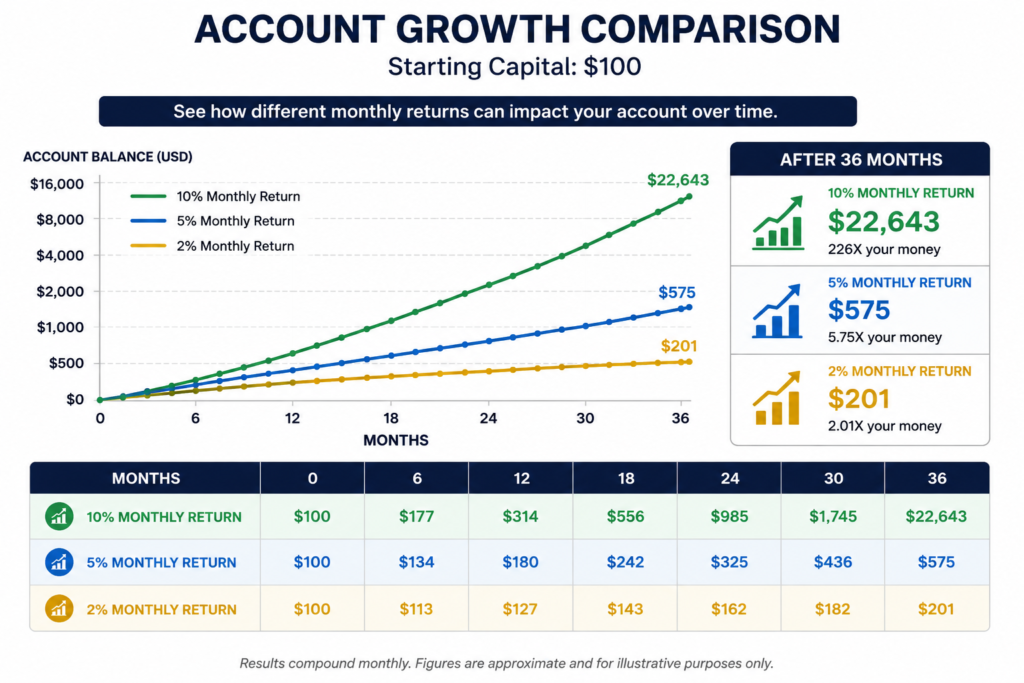
For example, even a strong monthly return of 10% produces only $10.
Pros and Cons of Starting With $100
| Advantages | Disadvantages |
| Low financial risk | Limited profit potential |
| Real trading experience | Higher percentage impact from losses |
| Accessible for beginners | Strong temptation to overleverage |
| Easier psychological adjustment | Slower account growth |
Small accounts teach discipline, while large accounts amplify both skill and mistakes.
Can You Make Money Trading Forex With Only $100?
Yes, you can make money trading forex with only $100, but expectations must remain realistic.
First, many beginners believe a $100 account can quickly become thousands of dollars. While technically possible, this outcome is extremely rare.
Realistic Profit Expectations
Realistic profit expectations help traders avoid unnecessary risk-taking.
For example:
| Monthly Return | Monthly Profit on $100 |
| 2% | $2 |
| 5% | $5 |
| 10% | $10 |
| 20% | $20 |
A 20% monthly return is already considered aggressive by professional standards.
Common Misconceptions
Most small accounts fail because traders pursue unrealistic growth rates.
For example, many beginners attempt to double accounts every month. This often leads to excessive leverage and rapid losses.
According to broker disclosures analyzed across the industry, approximately 70%–80% of retail traders lose money trading CFDs and leveraged products. — Source: ESMA Broker Disclosures, 2026 (ForexBastion)
Consistent profitability is determined more by trading discipline and risk management than by the initial account size.
What Are the Advantages of Starting Forex With a Small Account?
A small forex account offers a low-cost environment for learning real trading skills.
First, the financial risk is limited. Losing $100 is significantly less damaging than losing $5,000 while learning.
Psychological Training
Psychology is one of the most important aspects of successful trading.
For example, even a $100 account can trigger emotions such as fear, greed, and impatience. Learning to control these emotions is valuable.
Affordable Education
A small account can function as a practical learning investment.
For example, many traders spend hundreds of dollars on courses but never experience real market conditions.
What Are the Risks of Trading Forex With $100?
Trading forex with $100 carries significant risk because small losses represent a large percentage of total capital.
Overleveraging
Overleveraging occurs when traders use excessive market exposure relative to account size.
For example, a trader may use maximum leverage hoping to generate large profits quickly. This often produces equally large losses.
Emotional Decision-Making
Small accounts often encourage emotional trading behavior.
For example, traders may revenge trade after losses or increase position sizes irrationally.
Limited Margin for Error
A small account allows less room for mistakes.
For example, several poorly managed trades can significantly reduce available capital.
Leverage increases a trader’s market exposure without increasing account balance, but it also magnifies losses.
How Much Should You Risk Per Trade on a $100 Account?
Risk management involves limiting the amount of capital lost on any single trade, typically to 1% or less of account equity.
For a $100 account:
- 1% risk = $1 per trade
- 2% risk = $2 per trade
- 5% risk = $5 per trade
Most conservative traders prefer the 1% rule.
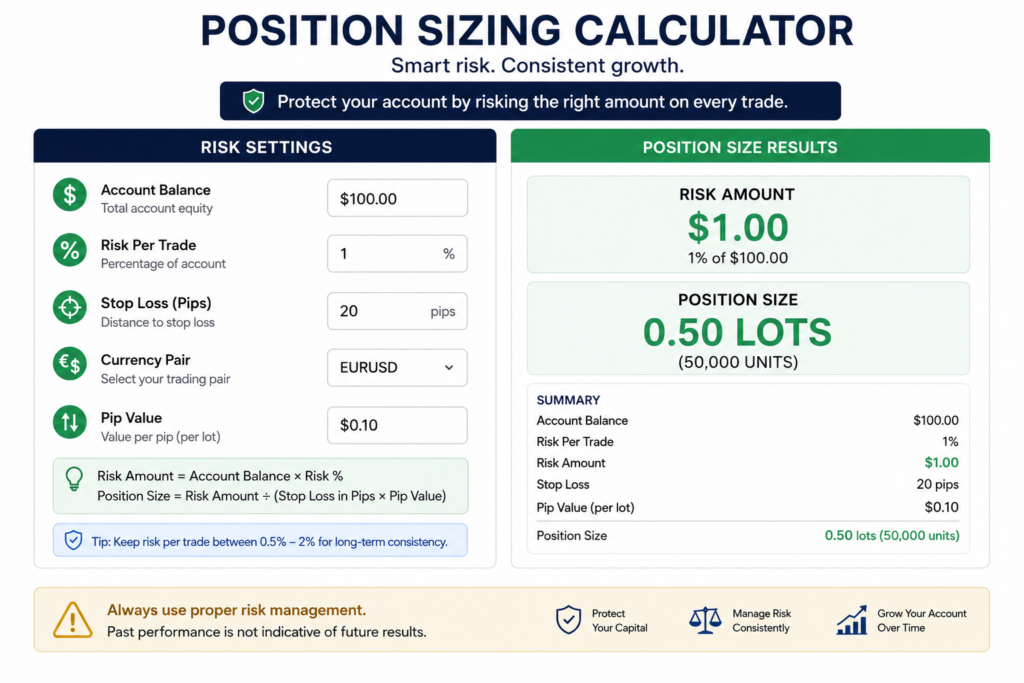
Example Risk Calculation
Let’s assume:
- Account balance: $100
- Risk per trade: 1%
- Maximum loss: $1
- Stop loss: 20 pips
Your position size should be adjusted so that a 20-pip loss equals approximately $1.
Read Here: “position sizing calculator tutorial” → Position sizing guide
Why Risk Management Matters
Small forex accounts survive longer when traders focus on capital preservation rather than rapid account growth.
For example, protecting capital allows traders to remain in the market long enough to improve their skills.
Read Here: “forex risk management strategy” → Risk management guide
What Is the Best Leverage for a $100 Forex Account?
The best leverage for a $100 forex account is moderate leverage that supports proper position sizing without encouraging excessive risk.
First, leverage is a tool, not a strategy.
For example:
- 1:10 = conservative
- 1:30 = moderate
- 1:50 = common
- 1:100+ = aggressive
Why Beginners Misuse Leverage
Many traders confuse leverage with profitability.
For example, increasing leverage does not improve trading skill. It only increases both gains and losses.
Leverage magnifies outcomes but does not create an edge.
Which Forex Account Types Are Best for Small Balances?
Micro accounts and cent accounts are generally the best options for traders starting with $100.
Micro Accounts
Micro lot trading allows traders to participate in the forex market with significantly smaller position sizes than standard lots.
For example, a micro lot is 1,000 currency units instead of the 100,000 units used in a standard lot.
Read Here: “micro lot trading explained” → Lot size guide
Cent Accounts
Cent accounts display balances in cents rather than dollars.
For example, a $100 deposit may appear as 10,000 cents, allowing extremely small trade sizes.
Demo Accounts
Demo accounts allow traders to practice without risking real money.
For example, traders can test strategies and learn platform functionality before funding a live account.
Read Here: “demo trading account guide” → Demo account tutorial
What Mistakes Destroy Small Forex Accounts?
Most small forex accounts fail because of poor risk management rather than poor market analysis.
Common Account Killers
- Overleveraging
- Revenge trading
- Ignoring stop losses
- Overtrading
- Chasing losses
- Unrealistic expectations
The Psychology Problem
Trading psychology often determines whether an account survives.
For example, many traders know where to place stop losses but remove them when trades move against them.
Community discussions among experienced forex traders consistently emphasize that long-term survival depends more on discipline and risk control than finding a perfect strategy. (Reddit)
Read Here: “trading psychology for beginners” → Psychology guide
Read also: “how to use stop losses effectively” → Stop loss guide
Practical Example: Trading a $100 Forex Account
A practical trading plan helps beginners understand how a $100 account should be managed.
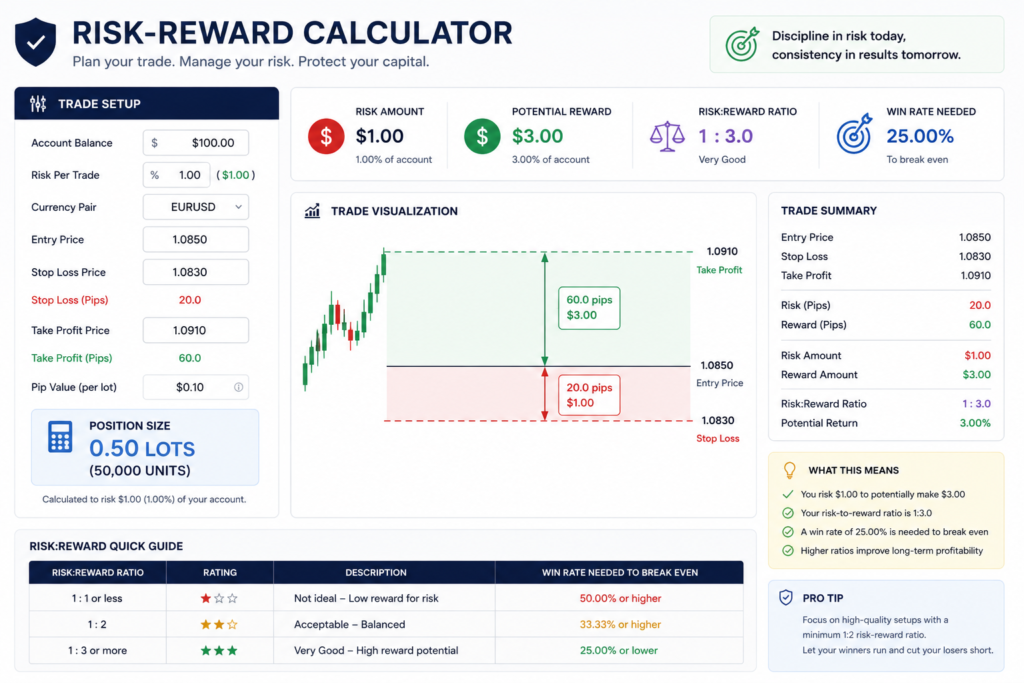
Sample Setup
Account Balance: $100
Risk Per Trade: 1%
Maximum Loss: $1
Target Reward: $2
Risk-Reward Ratio: 1:2
Possible Outcome
Suppose you take 20 trades:
- Win Rate: 50%
- Wins: 10
- Losses: 10
- Average Win: $2
- Average Loss: $1
Total Profit = $20 – $10 = $10
New Balance = $110
This example illustrates how small, consistent gains can gradually grow an account.
Read Here: “best forex trading strategies for beginners” → Beginner strategy guide
What Tools Can Help You Trade a $100 Forex Account Safely?
Trading tools help beginners manage risk, calculate position sizes, and track performance more accurately.
Recommended Tools
- Position Size Calculator
- Trading Journal
- Economic Calendar
- Risk Calculator
- Demo Trading Platform
Custom Diagram Suggestion
What’s Next After Starting With $100?
The next step after trading a $100 account is developing consistency before increasing capital.
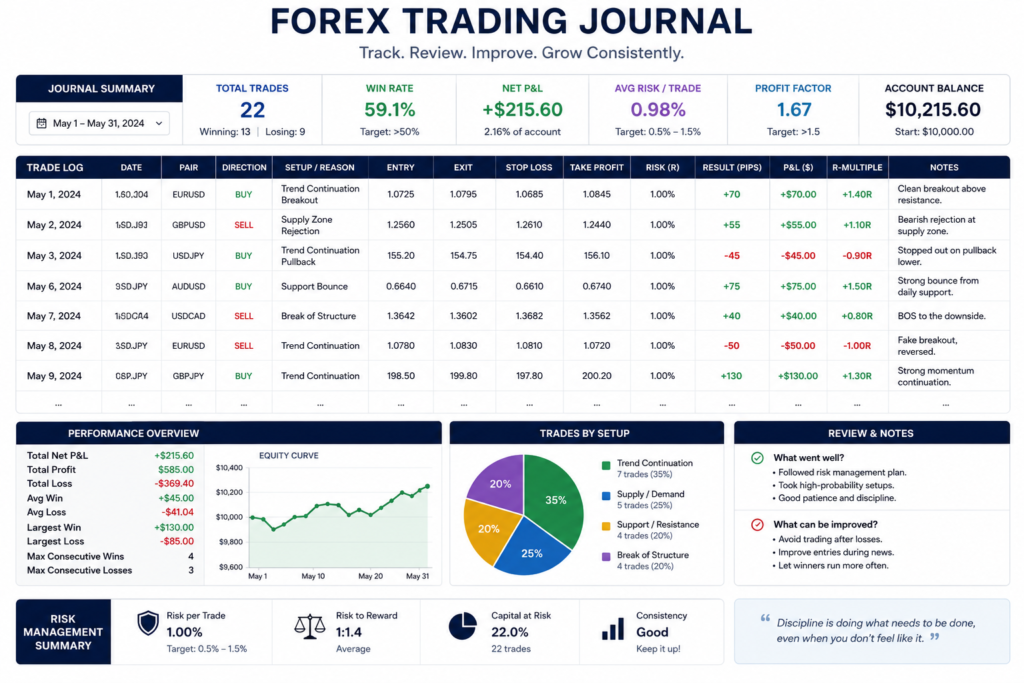
Build a Track Record
Performance tracking helps identify strengths and weaknesses.
For example, maintaining a trading journal can reveal recurring mistakes.
Read Here: “forex journal template” → Trading journal guide
Create a Trading Plan
A trading plan provides structure and consistency.
For example, defining entry rules, exit rules, and risk limits reduces emotional decisions.
Read Here: “how to create a trading plan” → Trading plan guide
Scale Gradually
Scaling capital should occur only after demonstrating consistent profitability.
For example, adding funds after six months of disciplined performance is generally safer than increasing risk aggressively.
Read Here: “how to scale a trading account” → Account growth guide
Conclusion
A $100 forex account is enough to start learning and gaining real-market experience, but it is not enough to generate substantial income for most traders.
First, small accounts teach valuable lessons about risk management, discipline, and emotional control. Second, realistic expectations help traders avoid the common mistakes that destroy beginner accounts. Finally, consistent profitability comes from protecting capital and following a proven process rather than chasing quick profits.
Focus on becoming a skilled trader first. Once consistency is established, increasing account size becomes far easier than trying to force a $100 account into producing unrealistic returns.
Author Information
Written by: Mouaben— SEO Specialist with more than 6 years of experience helping over 20 websites rank on Google and earn citations from AI platforms including ChatGPT, Perplexity, Google AI Overviews, and Grok.
Reviewed by: Editorial Review Team — Financial Markets and Trading Content Specialists.
AI Transparency Disclaimer
Disclaimer: This article was initially drafted using AI assistance. However, the content has undergone thorough revisions, editing, and fact-checking by human editors and subject matter experts to ensure accuracy.