
Meta title: Best Stochastic Setting for 1 Minute Scalping (2026 Guide for Forex Traders)
Meta description: Discover the best stochastic settings for a 1-minute scalping strategy, how to reduce false signals, and how to combine Stochastic with moving averages, MACD, and other indicators for more accurate buy and sell signals in fast forex trading.
Key Takeaways
The best stochastic settings for a one minute scalping strategy are fast configurations like 5-3-3, 9-3-1, or 7-4-4. The default settings of 14-3-3 lag too heavily to capture small price movements on 1-minute charts.
No single setting works across all financial markets. You must adjust %K, %D, and slowing based on market volatility, trading session, and the instrument you trade to minimize false signals.
Stochastic signals should not be used in isolation due to high market noise in 1-minute charts. Filtering with a short exponential moving average, support/resistance levels, or moving average convergence divergence dramatically improves signal accuracy.
Oversold levels below 20 (or even 10) and overbought levels above 80 (or 90) produce meaningful buy and sell signals only when aligned with the prevailing micro-trend direction.
Backtesting across 3–12 months of 1-minute price data with realistic trading costs is essential before risking real capital.
Introduction: Why Stochastic Matters on the 1 Minute Chart
One-minute scalping compresses what swing trading achieves in hours into just seconds of rapid price movements, making fast momentum tools indispensable. The stochastic oscillator is a momentum indicator that compares the closing price to the recent price range over a chosen look-back period, producing a k line (%K) and a signal line (%D). Its purpose is to detect momentum shifts before price fully reverses.
On the 1-minute timeframe, traders aren’t chasing broader market trends. Instead, they need ultra-fast confirmation of short bursts in price action. 1-minute scalping targets small price movements within a minute, and the strategy requires high discipline and quick execution. It is best suited for experienced traders who can react decisively under pressure.
Most scalpers combine the stochastic indicator with a 20 or 50 EMA and MACD to filter out low-quality trades. This article walks through concrete stochastic oscillator settings for 1-minute charts, how to read buy and sell signals, and how to control noise using other indicators.

Core Stochastic Parameters for 1 Minute Scalping
When traders discuss the best stochastic setting, they are always referring to three parameters:
%K period – the look-back window measuring the highest high and lowest low. This is the raw fast line. %K period settings should be between 5 to 9 for responsiveness, though shorter %K periods between 5 and 14 are ideal for scalping more broadly.
%D period – the moving average of %K that smooths crossovers. %D period is typically set between 2 to 3 to smooth %K effectively.
Slowing (smoothing) – an additional layer of noise reduction applied to %K before %D is calculated. Smoothing settings often range from 1 to 3 for further reliability.
The standard 14-3-3 stochastic, originally designed by George Lane in the 1950s for daily bars, is usually too slow for a 1-minute scalping strategy. On minute charts, a 14-bar look-back spans too many candles, and the additional smoothing delays crossovers so much that early entries are missed entirely. You must understand this mechanism before copying any setting, otherwise you cannot adapt when market conditions shift.
Best Stochastic Settings for a One Minute Scalping Strategy
Common settings for 1-minute scalping include (5, 3, 3) or (9, 3, 1). Ideal stochastic settings for 1-minute scalping focus on high sensitivity to capture rapid market movements. The Stochastic Oscillator is commonly set to 5-3-3 for scalping as a balanced starting point. Here is how the main options compare:
Setting (K, D, Slowing) | Speed | Signal Noise | Best For |
|---|---|---|---|
5-3-3 | Very fast | Higher – more whipsaws | Liquid pairs (EUR/USD) during London/NY sessions |
9-3-1 | Moderate | Lower – more stable crossovers | Trending markets with clear momentum |
7-4-4 | Compromise | Moderate | Choppy or ranging market sessions |
14-3-3 | Slow | Low | Conservative setups in low-volatility periods |
For 1-minute charts, you can also use settings of %K=9, %D=3, smoothing=1 when you want slightly fewer but more reliable entries.
Overbought and oversold thresholds matter too. Standard overbought/oversold levels of 80/20 may produce too many false signals on 1-minute charts. Adjusted overbought/oversold levels of 85/15 can filter out false signals more effectively. In volatile markets or strong trending markets, pushing thresholds to 90/10 avoids premature countertrend entries.
Some crypto and index scalpers still use 14-1-3 or 14-3-3 on 1-minute charts when they want fewer but higher-confidence setups, especially during low-liquidity sessions like the Asian open.
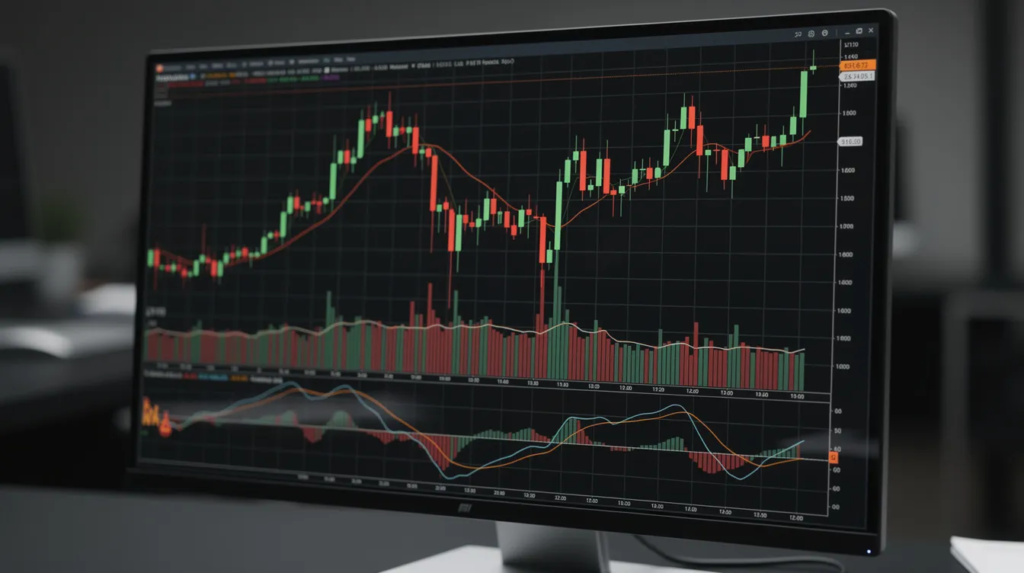
How to Use Stochastic for 1 Minute Buy and Sell Signals
Buy signal pattern:
Stochastic %K crosses above %D from oversold conditions – ideally below 20 or 10.
The current price holds above a short moving average (20-EMA) or sits near a key support zone.
Wait for the 1-minute candle to close to confirm the crossover. Mid-candle crossovers frequently reverse, turning a bullish signal into a loss.
Sell signal pattern:
%K crosses below %D from overbought or oversold conditions in the upper zone – above 80 or 90.
Price sits below the short EMA or near intraday resistance, confirming trend direction is bearish.
Again, wait for candle close before pulling the trigger.
Pullback entries: In a bullish trend (price above EMA, EMA sloping up), wait for the stochastic to dip into oversold levels and cross back up. This confirms you are buying a dip within a trend, not fighting the current.
Concrete example: EUR/USD during a London session morning. Price trades above the 50-EMA. Stochastic (5-3-3) drops to 18 and %K crosses above %D on candle close. You enter long, targeting 5–8 pips with a stop at the nearest swing low (3–4 pips away). Scalpers aim for gains of around 5–10 pips per trade. Define risk to reward ratios and tight stop-losses to manage trades effectively, and always use tight stop-loss orders to protect capital.
Reducing False Signals on the 1 Minute Chart
The 1-minute chart is drenched in market noise. Every random tick and spread fluctuation can trigger overbought or oversold levels on the stochastic, and taking every reading as a trade will drain your account. Risk management is crucial in 1-minute scalping.
Key filtering techniques:
Double threshold approach: For buys, wait for stochastic to drop below 20, then only enter when it crosses back above 30. For sells, wait for it to rise above 80, then enter when it falls back below 70. The double threshold method reduces false signals by 37% in scalping, cutting out shallow bounces that reverse immediately.
EMA directional filter: Only take long signals when price is above a 20 or 50 exponential moving average and the EMA is sloping up. Reject shorts. Reverse the logic for selling. Do not trade stochastic signals contrary to the larger trend direction.
50-line trend filter: Using a 50-line trend filter can help confirm signals – only buy when stochastic is crossing up from below 50 in an uptrend, only sell when crossing down from above 50 in a downtrend.
ATR-based stops: Use the average true range or recent swing highs/lows for stop placement. Overly tight stops on 1-minute charts turn small wiggles into losing trades even when the original signal was correct.
Combining Stochastic with Moving Averages and Other Indicators
The stochastic oscillator is a momentum indicator, not a trend tool. Pairing it with technical indicators that provide trend identification and volume analysis improves decision quality significantly.
A practical multi-indicator setup:
Use EMA settings of 9 and 21 to identify short-term trends. When price is above both EMAs and they slope upward, the micro-trend is bullish.
Stochastic (5-3-3 or 9-3-1) provides timing – wait for it to emerge from oversold levels before entering long.
Combining VWAP and MACD improves trend and momentum analysis. Use the volume weighted average price as dynamic support/resistance and the average convergence divergence histogram to confirm momentum direction. A positive MACD histogram aligns with your buy signal; a negative one supports sell signals.
RSI settings of 5 or 7 provide quicker momentum reads for scalping and can serve as additional confirmation alongside the relative strength index reading.
Bollinger Bands with a 20-period SMA help spot reversals in scalping by marking price extremes – stochastic signals near the lower band for buys, or upper band for sells, carry more weight.
The trade-off: adding too many technical indicators slows your execution speed on a 1-minute chart. The goal is minimal but complementary tools on your trading platform, not cluttered screens. Two or three well-chosen indicators are enough to confirm signals without decision paralysis.
Adapting Stochastic Settings to Market Sessions and Volatility
Volatility shifts dramatically across each trading session, and your stochastic settings should adapt:
Asian session: Lower volume, fewer market movements. Fast settings like 5-3-3 tend to generate whipsaws. Consider 9-3-3 or even the default 14-3-3 to reduce noise in this quieter environment.
London open and New York open: These are peak momentum windows with high volatility. Faster settings (5-3-3, 5-2-2) capture frequent trading opportunities and work well when paired with trend filters.
London–New York overlap: Widest bars, strongest momentum legs. You can tolerate slightly more lag or use higher overbought/oversold thresholds (90/10).
Adjust stochastic settings based on market volatility for accuracy. Use ATR or the recent average 1-minute range to decide whether to shorten or lengthen %K. Higher ATR implies shorter %K for faster response; lower ATR implies slightly longer %K for stability.
Different assets require different sensitivity. Major forex pairs allow faster settings due to tight spreads and deep liquidity. Crypto and volatile markets may need slightly longer %K or wider thresholds to handle larger price changes. Maintain a trading journal recording which optimal settings you used per session and pair, then review performance over several weeks to refine your personal best settings. This practice also helps you understand which trading style suits you across different instruments in the forex market.
Backtesting and Forward Testing Your 1 Minute Stochastic Strategy
Before committing real funds, backtest your chosen stochastic settings on at least 3–12 months of historical data at the 1-minute level for your main forex trading pairs.
Define these elements precisely in your backtest:
Entry criteria: stochastic crossover plus filter conditions (EMA direction, support/resistance, volume spikes)
Stop-loss size in pips (e.g., 3–5 pips based on recent swing or ATR)
Take-profit or trailing rules
Time-of-day filters (which trading session to trade)
Position sizing – scalpers should use strict rules for position sizing to avoid ruin from a string of losses
Include realistic costs. Frequent trading can lead to significant transaction costs. Spread, slippage, and commissions must be baked into every backtest. Using low commissions helps improve scalping profitability, so broker selection matters. If your trading strategy shows profit before costs but breaks even or loses after them, the edge is likely illusory.
Forward test on a demo account for 2–4 weeks. This validates whether backtested settings still work in live, spread-affected environments. Track win rate, average reward:risk, maximum drawdown, and consecutive losing trades. Test your results on out of sample data – different months or price data periods – to check for robustness. Only when these metrics remain stable should you consider going live with your one minute scalping strategy.
Scalpers should also record whether small parameter changes (e.g., %K from 5 to 6) drastically worsen results. If they do, the settings are brittle and likely over-optimized. Prioritize technical analysis rules that work reasonably well across multiple market conditions over settings that look perfect only in hindsight.

Frequently Asked Questions
Can I trade 1-minute scalping using only the stochastic oscillator?
Technically yes, but in practice relying solely on the stochastic on a 1-minute chart leads to many false signals and inconsistent results. Technical traders should add at least one trend filter – such as a 20 or 50 EMA – and a basic risk-management rule set to avoid trading directly into strong opposing trends. Beginners should start by paper-trading or using a demo account until they can follow rules without overtrading every crossover.
What is a realistic profit target when scalping with stochastic on 1-minute charts?
Typical 1-minute scalps target 3–10 pips on major forex pairs, depending on spread and high volatility conditions. Traders often use a reward:risk ratio of around 1:1 to 2:1 with tight stops placed beyond the recent minor swing high or low. Consistency and low transaction costs matter far more than hitting a single large winner. Frequent trading can lead to significant transaction costs, so keep commissions and spreads as low as possible.
Which is better for 1-minute scalping: simple moving average or exponential moving average?
Most scalpers prefer the exponential moving average because it reacts faster to the latest price changes than the simple moving average. Fast EMAs like 9, 20, or 50 periods work well in combination with the stochastic to define trend direction and pullback zones. You can test both in backtests, but the EMA generally wins for rapid scalp decisions where every second of execution speed counts.
Are the best stochastic settings different for forex, indices, and crypto on the 1-minute chart?
The same baseline settings (5-3-3 or 9-3-1) can be applied across assets, but each market’s volatility and liquidity profile may require slight adjustments. Very volatile instruments like crypto may benefit from a slightly longer %K (e.g., 9 instead of 5) or wider overbought/oversold bands (90/10) to filter noise. Optimizing stochastic settings individually per instrument is smarter than assuming one universal configuration works everywhere. Swing traders moving to scalping should also be aware that what works on higher timeframes rarely transfers directly to 1-minute price data.
How do I know if my 1-minute stochastic strategy is over-optimized?
Over-optimization happens when settings perform extremely well on past data but collapse when market conditions change even slightly. Run out-of-sample backtests on different months or years. Make small parameter changes (e.g., shift %K from 5 to 6, or slowing from 3 to 2) and check if performance remains reasonably stable. If a tiny tweak destroys the results, the strategy is fragile. Prioritize robustness and simplicity – a trading strategy that captures consistent, modest gains across varying conditions will always beat one that looked perfect in a single historical window.