
Forex trading involves high financial risk, and most retail traders lose money. Understanding the specific dangers before you start trading is the difference between managed exposure and reckless speculation. This guide breaks down every major risk category, explains how losses accumulate, and gives you practical tools to protect your capital.
Key Takeaways
The main risk factors in forex trading are market volatility, leverage and margin, counterparty and liquidity risk, and psychological or behavioural risk.
Poor forex risk management and trading without a clear forex trading plan greatly increase losses and can wipe out accounts quickly.
Forex is often forex riskier than stocks because of higher available leverage and 24-hour trading conditions in the foreign exchange markets.
Tools like stop losses, disciplined trade sizing, and a defined risk reward ratio help manage risk but never eliminate it entirely. There is no such thing as zero risk.
Only about 27% of retail forex accounts in the US were profitable in recent data, underscoring the importance of a suitable risk management strategy.
What Are the Core Risks of Forex Trading?
Every fx trade carries potential loss. Currency prices move continuously in response to economic data, political events, and shifting market sentiment, and no position is guaranteed to be profitable. The risks of forex trading stem from several interconnected sources that every trader must understand before committing real capital.
The core forex trading risk categories include:
Volatility / market risk – sudden, sharp currency pair movements triggered by news or sentiment shifts.
Leverage and margin risk – controlling large positions with a small initial deposit, which amplifies both gains and losses.
Liquidity risk – difficulty executing trades at expected prices during thin-market periods.
Counterparty / broker risk – the possibility that your broker fails, manipulates execution, or restricts withdrawals.
Psychological risk – emotional decision-making that leads to abandoning your trading plan.
The forex market is over-the-counter (OTC), and forex market liquidity was $7.5 trillion per day as of April 2022. That enormous scale creates opportunity but also substantial systemic risk. New traders often underestimate how quickly leveraged positions can move against them, leading to rapid account drawdowns. Understanding these risks involved is the first step in any serious forex risk management approach.
Volatility and Market Risk in the Forex Market
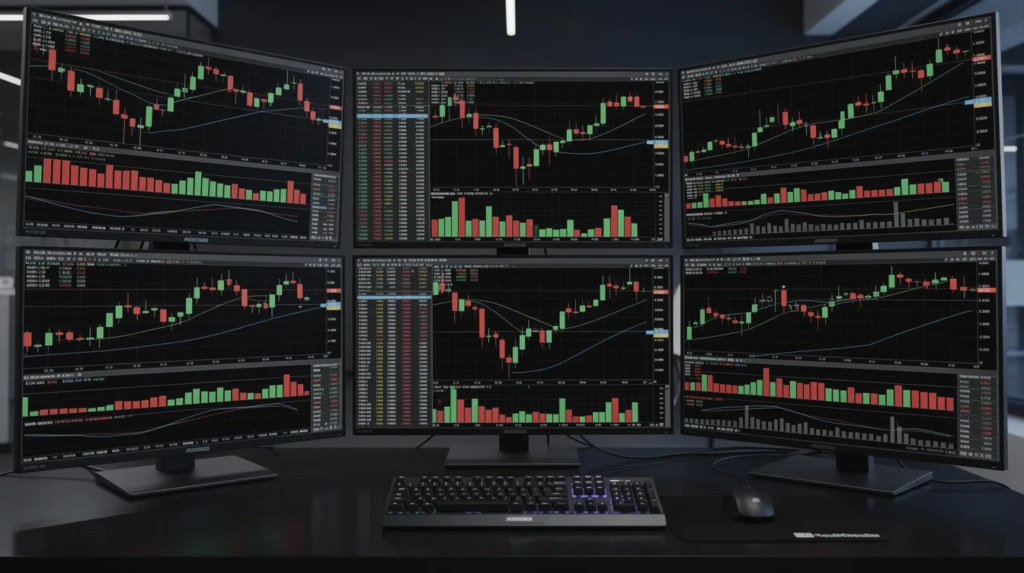
Volatility in the forex market can trigger sudden price fluctuations across even the most liquid pairs like EUR/USD, GBP/USD, or USD/JPY. High volatility can lead to significant price swings that turn a profitable position into a losing one within seconds.
Currency values fluctuate due to geopolitical events and economic data releases. Scheduled announcements such as US Nonfarm Payrolls can produce 50–150 pip moves in affected pairs. FOMC rate decisions, ECB meetings, and inflation reports create similar spikes. Political events – election shocks, referendums like Brexit in 2016, or unexpected sanctions – add headline risk that no technical analysis can fully predict.
Volatile forex markets can amplify both profits and losses. Traders often prize highly volatile markets for potential profit opportunities, but that same volatility increases the risk of trading losses when positions are unmanaged. Highly volatile forex markets punish traders who lack a clear trading plan and reward those who respect the full range of downside risks.
Leverage, Margin, and the Danger of Amplified Losses
Leverage means trading a large position with a small deposit. Forex trading can involve leverage up to 100:1, and a 5% margin allows trading a position worth 20 times the deposit. In practice, using leverage, a $1,000 deposit can control $100,000 in trades.
Leverage can magnify both profits and losses in trading. Here is how the leverage impact works in real numbers:
Account Size | Leverage | Position Controlled | 1% Adverse Move | Loss as % of Account |
|---|---|---|---|---|
€1,000 | 30:1 | €30,000 | €300 | 30% |
$1,000 | 100:1 | $100,000 | $1,000 | 100% |
With 30:1 leverage (common under EU/UK/ASIC regulations), a 1% market reverses direction wipes out 30% of total capital. At 100:1, available in some offshore jurisdictions, the same move eliminates the entire account.
Traders may face margin calls if a trade goes against them. When equity drops below maintenance margin, the broker can force-close positions automatically, often at unfavorable prices during fast market moves. Forex trading can result in losses that exceed the initial deposit unless the broker offers negative-balance protection. Leverage increases the risk of significant losses in trading and is a key reason why forex is often considered forex riskier than unleveraged stock investing.

Other Major Risks of Forex Trading
Beyond volatility and leverage, several less obvious risks can erode your account. The two main risk factors that catch inexperienced traders off guard are liquidity risk and counterparty risk, but operational and psychological dangers also matter.
Liquidity risk – During low liquidity periods, executing or closing trades may be difficult. Spreads widen around rollover times (near 22:00–23:00 UTC), late Friday sessions, and in exotic currency pairs. Slippage can jump from 1–3 pips to 10–50 pips during these windows.
Gap risk – Market gaps occur when prices jump over stop levels after weekend closures or major announcements. About 15–25% of overnight periods can produce gaps exceeding 1% in certain instruments. The market’s opening level can be far from Friday’s closing price.
Counterparty and broker risk – Trading in forex may occur against the dealer who controls the interface. Unregulated brokers can manipulate trade data or disappear with client funds. Platform outages, requotes, and withdrawal delays are red flags. Always verify regulation with authorities like the commodity futures trading commission (CFTC), FCA, or ASIC.
Operational risk – Internet disconnections, trading platform freezes, or execution delays at critical moments can increase realized losses beyond your accepted risk.
Psychological risk – Fear, greed, revenge trading after losing trades, and overconfidence after successful positions cause traders to abandon planned rules. This is covered further below.
Forex Risk Management: How to Manage Risk Effectively
Forex risk management is the structured set of rules and tools designed to limit downside and protect trading capital. It must be planned before entering trades, not improvised after losses occur. Without a risk management strategy, even profitable strategies eventually blow up.
Core principles to manage risk effectively:
Limit risk per trade. A good risk per trade is 2% of total capital. Risking 2% of your account allows 50 losing trades before the account is emptied – meaning even ten losing trades in a row only reduces equity by roughly 20%.
Position sizing is a key risk management strategy for traders. Calculate lot size based on stop distance and account balance so that each trade risks the same percentage, not the same number of pips.
Use stop-loss and take profit orders to automate exits rather than relying on manual reactions. Stop-loss orders limit maximum losses on trades.
Diversify across currency pairs, timeframes, and different strategies to avoid concentrating too much capital in one position.
Review and adapt. Markets change. Adjust your risk management strategy during periods of unusually high volatility or ahead of major scheduled events.
Traders should limit the maximum percentage of capital risked per trade. This single rule does more to preserve capital than any other market technique.
Stop Losses, Take Profits, and Practical Risk Management Tools
Stops and limits are the basic tools for automated risk control in forex trading. They remove guesswork from exits and enforce discipline when emotions run high.
Stop-loss order: closes your trade at a predetermined adverse price. Example: buy EUR/USD at 1.1000, set stop-loss at 1.0980, risking 20 pips.
Take profit order: closes your trade at a favorable price. Example: set profit targets at 1.1040, gaining 40 pips. A risk-reward ratio of 1:2 means targeting twice as much profit as the amount risked – or double the profit on each winner versus each loser.
Types of stops:
Stop Type | How It Works | Best For |
|---|---|---|
Standard stop | Becomes a market order once price is hit | Normal conditions |
Trailing stop | Moves with price to lock in profits close to the market | Trending markets |
Guaranteed stop | Fills at exact price even through market gaps (extra cost) | High-impact news events |
Practical placement tips:
Use recent support or resistance levels, recent swing highs/lows, or ATR-based distances instead of arbitrary pip counts.
Avoid moving stops further away in hope of recovery – this consistently leads to further losses.
Setting stops too tight in volatile conditions leads to being stopped out repeatedly; too wide, and you risk too much capital per trade.
Test stop placement on a demo account before applying to live markets.
Building a Forex Trading Plan for Better Risk Control
A forex trading plan is a written document defining entry rules, exit rules, risk per trade, maximum daily loss, and risk reward ratio targets. Your trading plan should define how much to deposit, how much potential profit to target, and when to walk away. Trading plans help maintain discipline in volatile markets.
Guidelines for forex trading plan planning:
Risk per trade: no more than 1–2% of account equity.
Risk reward ratio: a trading plan should include your risk/reward ratio. Set a risk/reward ratio of 1:2 for trades at minimum, so that how much potential profit on winners outweighs losses.
Example: risking $100 per trade with a planned short trade targeting $200–$300 in potential profit. Even with a 40% win rate, the account grows over time.
Maximum daily loss: stop trading after losing 3–5% in a single day.
Define when not to trade: e.g., avoid opening positions within one hour of high-impact news if inexperienced.
A trading diary helps track entry and exit points, rationale, emotions, and outcomes. Use that data to refine your plan. If you notice consistent failure after losing streaks, adjust your approach. The goal of forex trading plan planning is continuous improvement, not perfection from day one.
Is Forex Riskier Than Stocks and Other Markets?
Is forex riskier than trading stocks or other market instruments? In several measurable ways, yes.
Leverage: forex markets typically offer far higher leverage to retail traders than cash stock investing. Many stock accounts cap at 2:1 or 5:1; forex brokers may offer 30:1 to 500:1 depending on jurisdiction.
Trading hours: foreign exchange markets trade 24 hours a day, five days a week. This exposes traders to overnight moves, exchange rates shifts, and news events while away from screens. Stock exchanges have set hours, reducing but not eliminating overnight risk.
Regulation: stock markets generally have stronger circuit breakers and exchange oversight. The forex market as an OTC financial instrument lacks centralized exchange protections.
However, risk level depends heavily on the trader’s own forex risk management, position sizing, and trading plan. Someone trading stocks aggressively with options and high margin can face greater risk than a conservative forex trader using 5:1 leverage. Choose position sizes and leverage that match your risk tolerance regardless of the asset class.
Psychology, Discipline, and Long-Term Capital Preservation
Psychological discipline is directly tied to effective forex risk management and long-term survival in the forex market. Retail traders often struggle with emotional trading and lack of structured plans, which is a primary reason most lose money.
Common traps:
Revenge trading: chasing trades after a loss to recover all the money quickly.
Overtrading: taking excessive positions after a win due to overconfidence.
FOMO: entering without a setup because the market moves and you fear missing out.
Abandoning the plan: moving stops, increasing size, or ignoring rules under stress.
Emotional decision-making can lead to reckless risk management in trading. Practical safeguards include daily loss limits, a maximum number of trades per day, and mandatory cooling-off periods after significant losses. Many professional traders treat trading as a business, achieving success by focusing on preserving capital and consistent execution rather than chasing quick profits. Review your emotional state in a trading journal and reduce position room when you notice impulsive patterns.
Using Demo Accounts to Learn Forex Risk Management
Demo accounts let you practise forex trading learn risk-free with virtual funds. They are essential before you start trading with real money.
Use a demo account to:
Test a new trading plan and see how it performs across different market conditions.
Experiment with stop-loss and take-profit placements and refine your risk reward ratio without financial pressure.
Practice different strategies across fx markets and timeframes.
While demo trading removes monetary risk, treat it seriously. Follow the same forex risk management rules you plan to use in live markets. Transition gradually: start with small position sizes to adjust to real-money emotions, where the psychological pressure is entirely different. Track performance over several months – ideally 50–100+ trades – before committing larger capital. This is not just that first step; it is the foundation for managing overall risk.
Demo accounts teach mechanics. Live markets teach discipline. You need both.
FAQs: Common Questions About Forex Trading Risks
Can I completely eliminate risk in forex trading?
No. Risk can never be fully eliminated – only reduced and controlled through careful forex risk management and a solid trading plan. Even with stops, slippage and market gaps can occur during fast-moving conditions. This is not investment advice, but the reality: you must accept some level of uncertainty as part of selling currencies and buying them in fx markets. There is no path to zero risk.
How much should I risk per trade in my forex trading plan?
Many experienced traders risk between 0.5% and 2% of their account per trade. Calculate risk based on account size, stop distance in pips, and lot size so that potential loss stays within predefined limits. For example, risking 2% means that even after ten losing trades, roughly 80% of the account remains intact – only a return of about 25% is needed to recover, rather than facing catastrophic drawdown.
What is a good risk reward ratio for forex trades?
The risk reward ratio describes the relationship between potential loss and potential profit on a single trade. Most professionals recommend at least a 1:2 or 1:3 ratio. At 1:2, profits referred to each winning trade equal twice as much profit as each losing trade costs. This means you can be wrong more than half the time and still grow your account, provided you set profit targets consistently.
How does news affect forex trading risk?
High-impact news – interest rate decisions, jobs reports, inflation data – can cause sudden high volatility, slippage, and spread widening in the forex market. During these events, market moves can be extreme and unpredictable. Traders either avoid opening positions around such events or reduce position size and widen stops to give the position room to absorb the spike. Mitigate risk by checking an economic calendar daily.
How do I know if my broker is increasing my forex trading risks?
Check whether the broker is properly regulated by a credible authority (FCA, NFA, ASIC). Verify they clearly disclose margin requirements, provide transparent pricing, and maintain a stable trading platform. Red flags include frequent platform outages, unexplained slippage in normal high liquidity conditions, difficulty withdrawing funds, or an opening price consistently different from the market’s opening level. Unregulated brokers pose the greatest counterparty risk and should be avoided entirely.