
The foreign exchange market is the world’s largest financial arena, and it is open to anyone with an internet connection, a small deposit, and the willingness to learn. If you have been curious about trading currencies but feel overwhelmed by charts, jargon, and conflicting advice, this guide is for you. Below, you will find a practical, step-by-step walkthrough that takes you from zero knowledge to placing your first responsible trade.
Key Takeaways
Forex trading involves speculating on currency price movements to make a profit, buying one currency while simultaneously selling another in pairs like EUR/USD or GBP/JPY.
Beginners should start with a regulated broker, a demo account, and basic forex trading strategies such as trend trading or swing trading before risking real money.
Leverage in the forex market can magnify both profits and losses, so new forex traders should use low leverage (5:1 to 10:1) and strict risk management from day one.
A realistic beginner path is: learn the basics, practice on demo, start small, avoid day trading at first, and gradually build a rules-based clear trading plan.
Past performance does not guarantee future results, and investing involves risk, including the possible loss of your entire investment.
What Is Forex Trading and the Forex Market?
Forex trading, also known as foreign exchange trading, is the act of buying one currency while selling another to profit from changes in the exchange rate between them. It is the foundation of currency trading worldwide, powering everything from international business payments to individual speculation.

Here are the core concepts you need to understand:
The forex market is a global, decentralized marketplace where currencies trade electronically 24 hours a day, five days a week, from Sunday evening through Friday evening (London and New York time). There is no single physical exchange; instead, transactions happen over the counter via banks, brokers, and electronic networks.
Currency pairs are how forex traders buy and sell currencies. In a currency pair, the first currency is the base currency and the second is the quote currency. For example, in EUR/USD, the euro is the base and the us dollar is the quote. Other popular pairs include GBP/USD (the british pound versus the dollar) and USD/JPY (the dollar versus the japanese yen).
Market size: Forex market daily turnover is often over USD 7 trillion. In fact, the Bank for International Settlements reported average daily turnover of USD 9.6 trillion as of April 2025, making it by far the largest of all financial markets. The us dollar appears in roughly 89% of all trades.
Why people trade forex: Speculation on price movements is the most common reason for retail traders. Businesses use foreign exchange to hedge currency risk on international income or expenses. Others convert money for travel or cross-border payments.
Currency fluctuations are influenced by interest rates and inflation, central bank policy, geopolitical events, and economic growth data. Understanding these factors influencing currency prices is the first step toward trading forex responsibly.
How the Forex Market Works in Practice
Fx markets operate over the counter rather than through a centralized exchange. This means trades are executed through a network of banks, brokers, and electronic platforms, with pricing and spreads varying by provider.
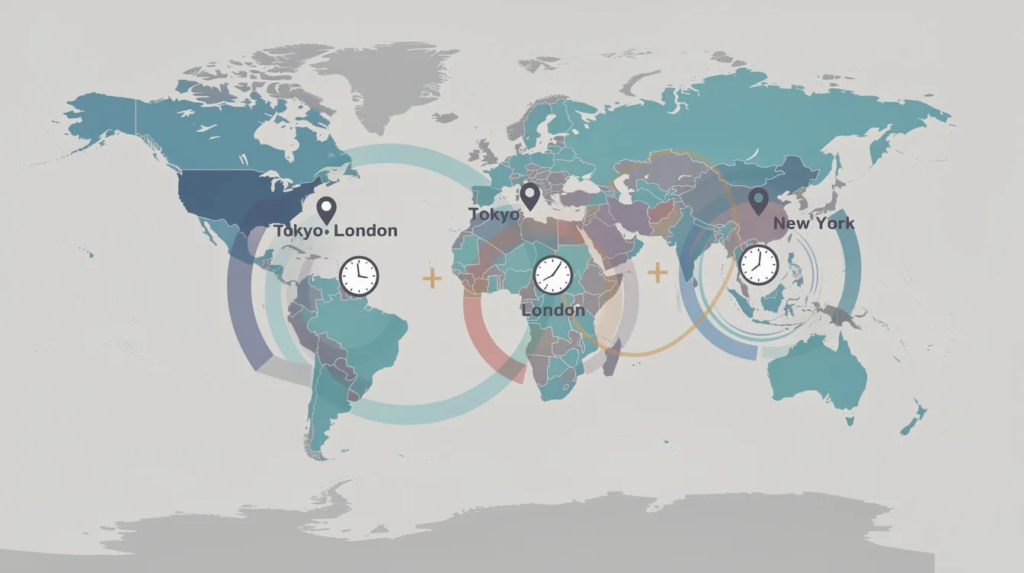
Trading sessions: Three major sessions drive liquidity: Tokyo (Asian session), London (European session), and New York (North American session). The highest liquidity and market volatility typically occur during the overlap of London and New York, roughly 8 AM to noon EST, when market participants from both continents are active simultaneously.
Who participates: The foreign exchange market includes central banks (setting interest rates and monetary policy), commercial banks (providing liquidity), hedge funds and institutional investors (speculating or hedging), multinational corporations (managing currency risk on global operations), and retail traders accessing the market through online platforms.
How quotes work: A quote like EUR/USD = 1.0950 means it costs 1.0950 US dollars to buy one euro. Small price movements are measured in pips. For most pairs, a pip is the fourth decimal place, so a move from 1.0950 to 1.0951 equals 1 pip.
Access for beginners: Most beginner traders access the market through spot forex accounts (often via CFDs) or through the futures market on regulated exchanges. This article focuses primarily on spot trading, which is the most common entry point.
Types of Forex Markets and Instruments
Before you start trading, it helps to understand the different venues and instruments available. Here is a quick comparison:
Instrument | What It Is | Who Uses It | Settlement |
|---|---|---|---|
Spot | Immediate currency exchange | Retail traders, banks | Within two business days |
Forward | Custom OTC contract at a fixed rate on a future date | Businesses hedging | Agreed future date |
Futures | Standardized exchange-traded contract | Speculators, hedgers | Standardized future date |
Options | Right, not the obligation, to trade at a set price | Advanced traders, hedgers | Before or at expiration |
Spot market: The spot market is the largest forex market, accounting for about 31% of daily volume. Spot market trades settle within two business days, and this is where most retail traders operate. When you open a standard forex account and place a trade on EUR/USD, you are typically in the spot market.
Forward market: Forward contracts are customized agreements for future currency trades between two parties. A company expecting payment in euros three months from now might lock in today’s exchange rate using a forward to manage risk.
Futures market: Futures contracts are standardized and traded on exchanges like the CME Group in the United States. They are regulated, transparent, and used by both speculators and hedgers. Products like charles schwab futures access allow US-based traders to participate in currency futures.
Options market: Forex options give the right to buy or sell currencies at a set price before a certain date but not the obligation to do so. Options are typically more advanced instruments, used for hedging portfolio exposure or trading market volatility. The options market has seen rapid growth, with volumes roughly doubling between 2022 and 2025.
Getting Started: Step-by-Step Guide to Your First Forex Trades
This section walks you from zero to placing a small, real-money trade responsibly. Treat it as a numbered journey.
Choose a regulated broker: Choose a reliable forex broker regulated by financial authorities such as the FCA in the UK, the CFTC and NFA in the US, or ASIC in Australia. Compare spreads, commissions, and available major currency pairs. Unregulated brokers may disappear or offer unfair execution, so verification matters.
Open your account: Open a trading account with your chosen forex broker. This typically involves submitting ID documents, proof of address, and completing a suitability questionnaire, all done online. Most brokers offer several forex accounts types, including standard, mini, and micro account options.
Start with a demo account: Many brokers offer practice accounts to test trading strategies without financial risk. Start with a demo account to practice trading without risk for several weeks. Learn order types: market, limit, stop, stop-loss, and take-profit. Practice trading on live prices with virtual money until you feel comfortable with the platform.
Spending 4-8 weeks on demo is not wasted time. It is the cheapest education you will ever get.
Fund a live account: When you are ready, fund a live account with a small initial investment you can afford to lose, such as USD 100-500. Select low leverage, around 5:1 or 10:1, when you begin. Remember that investing involves risk and you should never trade with money needed for rent or bills.
Place your first trade: Start trading with major currency pairs like EUR/USD. Decide whether to buy or sell based on a simple plan, and set both stop-loss and take-profit levels in advance. For example, if you believe the euro will strengthen against the dollar, you buy EUR/USD; if it weakens, you lose.
Monitor wisely: Watch open positions only during your chosen trading hours. Avoid trading around high-impact economic news events such as US Nonfarm Payrolls or Federal Reserve rate decisions until you understand how markets respond, including slippage and spread widening. Economic data can cause rapid currency price changes, and risking real money during these events without experience is dangerous.
Forex Basics Every Beginner Must Understand
Mastering core terminology reduces confusion and helps you avoid costly mistakes. Learn key forex terminology like pips and spreads before placing any real trade.
Pip: The smallest standard price movement. For EUR/USD, moving from 1.0950 to 1.0951 is 1 pip (0.0001). For pairs involving the japanese yen, a pip is the second decimal place (e.g., USD/JPY 150.00 to 150.01).
Lot sizes: A standard lot is 100,000 units of the base currency. A mini lot is 10,000, a micro lot is 1,000, and some brokers offer nano lots. Smaller lots let beginners control risk with limited capital.
Spread: The difference between the bid (sell) and ask (buy) price. Tighter spreads mean lower trading costs. Major pairs like EUR/USD usually have the tightest spreads due to high liquidity.
Leverage and margin: Forex trading allows control of large positions with smaller deposits through margin. For example, leverage of 30:1 allows control of USD 3,000 with just USD 100 in margin. However, leverage can amplify losses, risking entire investments if the market moves against you. In the US, leverage is capped at 50:1 for major pairs and 20:1 for minors under CFTC rules.
Margin calls and stop-outs: When your account equity drops below the broker’s required margin level, you receive a margin call. If equity falls further, your broker may automatically close positions (stop-out) to prevent negative balances.
Overnight swap charges: When positions stay open past the New York market close, you pay or receive swap charges based on the interest rate differential between the two currencies in your pair. This matters for swing trading and longer holds.
Basic Forex Trading Strategies for Beginners
Beginners should use a small set of clear, rules-based trading strategies instead of guessing or chasing price fluctuations. Here are the most accessible approaches:
Trend trading: Trend trading involves following the market’s direction on higher timeframes like the 4-hour or daily chart. In an uptrend, you buy pullbacks; in a downtrend, you sell rallies. This works well when driven by macro forces such as interest rates or economic growth. The main risk is that trends end, and late entries can result in losses.
Range trading: Range trading identifies support and resistance levels for buying and selling. When price oscillates between two clear boundaries, you buy near support and sell near resistance with tight stop-loss orders. The danger is a breakout that invalidates the range.
Breakout trading: Breakout trading enters the market after a currency pair breaks a range or consolidation pattern. You wait for a decisive candle close beyond resistance or support and enter with the momentum. False breakouts are the primary risk, so confirmation is important.
Swing trading: Swing trading holds positions for days to capture medium-term movements. It combinestechnical analysis tools like moving averages and candlestick charts with fundamental analysis, such as tracking upcoming central bank meetings or economic indicators. This style suits part-time traders who cannot watch screens all day.
What to avoid: Scalping aims for small profits from quick trades and requires constant screen time, razor-thin spreads, and fast reflexes. Beginners should explicitly avoid trading this way initially. Similarly, high-frequency day trading demands experience and low transaction costs that most beginner traders do not yet have.
Pick one strategy. Master it on demo. Then take it live with tiny positions.
Reading Forex Charts and Candlesticks
Charts help you visualize price action and make decisions based on what the market is actually doing rather than what you hope it will do. Beginners should focus on a few simple tools instead of loading up dozens of indicators.
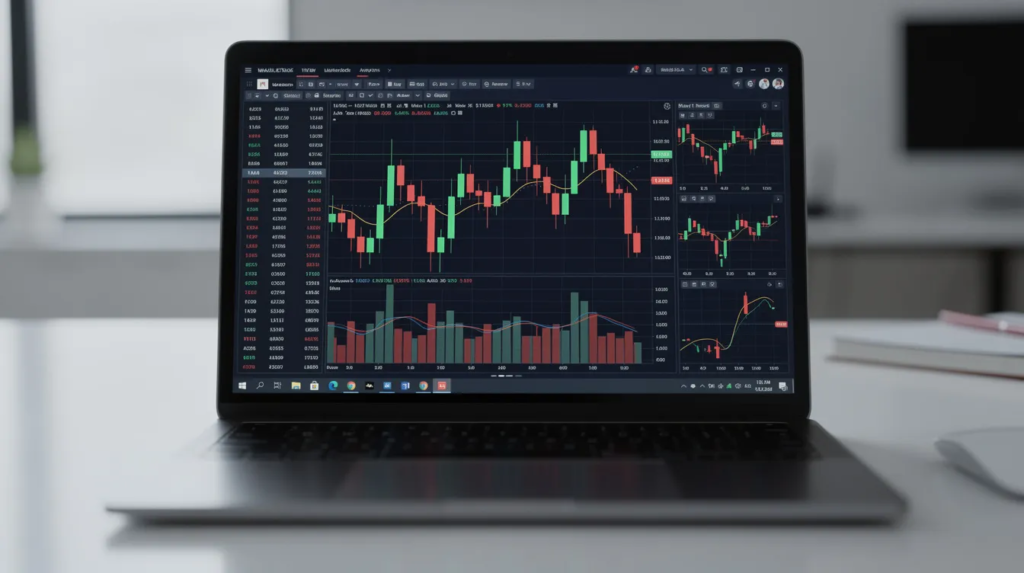
Line charts: The simplest chart type, connecting closing prices over time. Useful for quickly spotting the overall direction and major swings on daily or weekly timeframes.
Bar charts: Show open, high, low, and close for each period. Functional but less visually intuitive than candlesticks.
Candlestick charts: The most popular chart type among experienced traders and beginners alike. Each candle shows the open, high, low, and close. A green or white candle means the close was above the open (bullish); a red or black candle means it closed lower (bearish). For example, a daily EUR/USD candle on 1 March 2026 might open at 1.0900, hit a high of 1.0960, dip to 1.0880, and close at 1.0945.
Basic patterns: A doji candle (open and close nearly equal) signals indecision. A bullish engulfing pattern (a large green candle fully swallowing the previous red candle) can hint at a reversal upward. A pin bar with a long lower wick at support shows rejection of lower prices.
Always combine chart observations with risk management rules rather than treating any single candlestick pattern as a guaranteed signal. Patterns provide clues, not certainties.
Risk Management: Protecting Your Capital in the Forex Market
Risk management is essential in forex trading. Lasting success depends more on controlling losses than on finding perfect entries. Many traders blow their accounts not because their analysis was wrong but because they sized their positions recklessly.

The 1% rule: Never risk more than 1% to 2% of your total account balance on a single trade. With a USD 1,000 account, that means risking no more than USD 10 per trade. This keeps you in the game through inevitable losing streaks.
Stop-loss and take-profit orders: Always set automatic stop-loss orders to limit potential losses before you enter a trade. Similarly, set take-profit levels to lock in gains. These orders execute even when you are away from the screen.
Leverage discipline: Avoid over leveraging. Using 50:1 leverage might sound appealing, but it means a 2% adverse move wipes out your margin. Start at 5:1 or 10:1 and increase only as your skill and account size grow.
Understand the risks involved: Forex market volatility can lead to significant losses, especially during geopolitical shocks. In June 2016, GBP dropped from $1.50 to below $1.30 after Brexit, devastating traders who were long the british pound without stop-losses. Counterparty risk exists if brokers default on obligations, which is why regulation matters. Liquidity risks can cause wider spreads and slippage during off-hours or around market news.
Diversification: Spread exposure across a few uncorrelated pairs. Avoid having multiple trades all tied to one currency, such as going long EUR/USD, GBP/USD, and AUD/USD simultaneously since all are essentially short the dollar.
Trading journal: Keep a written log of every trade: entry, exit, reasoning, and emotional state. Reviewing this weekly helps identify patterns in your mistakes and strengthens discipline over time.
Common Beginner Mistakes and How to Avoid Trading Pitfalls
Most new forex traders lose money for similar, avoidable reasons. Here is what to watch for:
No written plan: Trading without a clear trading plan is the most common mistake. Before going live, define your strategy, timeframes, risk per trade, and maximum daily loss. Develop a trading plan outlining your financial goals and rules before you start forex trading with real capital.
Revenge trading: After a loss, the urge to immediately make it back leads to oversized positions and emotional entries. Psychological risks can lead to impulsive trading decisions. Impose a daily loss limit. If you hit it, walk away.
Over-leveraging: Using maximum leverage on every trade is a fast path to losing your entire investment. Stick to position-sizing rules no matter how confident you feel.
Following blind tips: Copying trades from social media signal groups without understanding the rationale or the risks involved is gambling, not trading. Always do your own technical analysis or fundamental analysis before entering.
Trading during high-impact news: Geopolitical events can lead to unpredictable currency movements, and economic data releases can whipsaw prices in seconds. Until you have experience, avoid trading around US Nonfarm Payrolls, Federal Reserve decisions, or ECB announcements.
Ignoring costs: Spreads, commissions, slippage, and overnight swap fees all erode small accounts. Factor these into every strategy you test.
How Much Money Do You Need to Start Forex Trading?
There is no universal minimum, but realistic expectations depend on your account size, leverage, and risk tolerance per trade.
Many regulated brokers allow opening forex accounts with as little as USD 50-100, often through a micro account. These balances are best treated as tuition rather than a serious income source.
A more practical starting point is USD 500-1,000. This lets you manage risk properly, risking 1% per trade while still having enough margin to absorb a few losses without blowing the account.
Traders focused on mini or standard lots may prefer larger starting capital, such as USD 2,000-5,000, to keep leverage and risk within safe levels.
Remember to factor in spreads, possible commissions, and overnight financing costs when projecting how long your capital might last under different strategies.
Only invest money you can afford to lose without affecting essential living expenses. Treat your initial deposit as education money, not a down payment on a yacht.
Building a Simple Forex Trading Plan
A trading plan is a written document that defines how, when, and why you enter and exit forex trades. Without one, you are reacting to the market instead of acting on a strategy. Here is what to include:
Choose your style: Pick one primary trading style. Swing trading on 4-hour and daily charts is often ideal for beginners who work full-time. Focus on one or two major currency pairs to start.
Define entry rules: Specify exact conditions. For example: enter long only when the 50-period moving average is trending up and price pulls back to it, with a bullish candlestick confirmation.
Define exit rules: Use a fixed risk-to-reward ratio like 1:2. If you risk 30 pips, target 60 pips. Set stop-loss below recent support; set take-profit at the next resistance zone.
Set trading hours: Choose hours that match your time zone and life schedule. If you are in the US, the London-New York overlap (8 AM-12 PM EST) offers the best market conditions for major pairs. Never trade when tired or distracted.
Review and adapt: Review performance weekly or monthly. Adjust the plan only after a statistically meaningful sample of trades, at least 20-30, rather than after every single win or loss. Emotional tweaks after one bad day are not improvements; they are reactions.
Start Small, Start Simple, and Grow Gradually
The forex market will still be here in 5, 10, and 20 years. You do not need to rush.
Start with major currency pairs, basic forex trading strategies, and a single well-understood platform. Resist the urge to try every indicator, every exotic pair, and every new tool simultaneously. Experienced traders built their edge over years, not days.
Encourage yourself to do extensive practice on a demo account, followed by very small real-money positions to bridge the psychological gap between simulated and live trading. The emotional difference between trading virtual money and real money is enormous, and only live trading reveals your true risk tolerance.
Steady learning, disciplined risk management, and realistic expectations matter far more than chasing quick profits. Country’s currency values shift based on complex, interconnected forces. No one masters them overnight. Domestic currency fluctuations, interest rate risk, and financial uncertainty are constants in this market. Your job is not to predict every move but to manage risk when your predictions are wrong.
Start today with a demo account, commit to one strategy, and let your results guide your next steps.
FAQ: Forex Trading for Beginners
Is forex trading a good idea for beginners in 2026?
Forex trading can be suitable for beginners who treat it as a skill to learn rather than a get-rich-quick scheme. The tools, educational resources, and regulated broker options available in 2026 are better than ever. However, you should be willing to practice trading for months on demo before risking significant capital. Past performance does not guarantee future results, and the market does not owe you profits simply because you showed up.
How long does it take to become consistently profitable in forex?
Many traders need 1 to 3 years of regular study, backtesting, and live trading with small sizes before they see consistent results. This timeline varies widely depending on how much time you invest in learning, how disciplined you are with risk management, and whether you keep a trading journal to track mistakes and improvements.
Can I trade forex part-time while working a full-time job?
Yes. Part-time trading forex is entirely possible by focusing on higher timeframes like 4-hour or daily charts, limiting screen time, and choosing trading hours that overlap with active market sessions in your time zone. Swing trading is particularly well suited to part-time traders since it does not require watching charts all day.
What are the safest currency pairs for beginners?
Start with major currency pairs like EUR/USD, GBP/USD, and USD/JPY. These pairs typically offer tight spreads, deep liquidity, and abundant analysis compared with exotic pairs involving less-traded currencies like the swiss franc crosses or emerging market currencies. Price movements on majors tend to be more predictable and less prone to sudden gaps.
How do I know when I should avoid trading?
Avoid trading when feeling emotional, fatigued, or distracted. Also step aside during major unscheduled political shocks and around high-impact economic data releases like central bank rate decisions if you do not yet have a tested news-trading plan. If you have already hit your daily or weekly loss limit, stop. The market will be open tomorrow. Sell currencies or buy currencies only when your plan says to, not when your emotions demand it.